

Recent Research on Tinnitus: Epidemiology, Risk Factors, and Evolving Approaches to Diagnosis and Management
Abstract
Recent tinnitus research indicates that the strongest and most consistent advances are in understanding heterogeneity, identifying risk factors for worsening severity, and testing digitally delivered and non-invasive interventions. Across the evidence synthesized here, hearing health emerged as the dominant predictor of tinnitus presence and severity, while mood, neuroticism, sleep, loneliness, anxiety, depression, and poor sleep were linked to greater distress or progression; one large longitudinal model predicted nine-year severity progression with ROC 0.78 and Cohen’s d 1.3 for individuals developing severe tinnitus [17], and a machine-learning model identified a six-item clinical screening approach for early supportive care [17]. Treatment studies suggest that structured behavioral and sound-based interventions can reduce tinnitus distress, with smartphone-based cognitive behavioral therapy producing a clinically relevant reduction in Tinnitus Questionnaire scores (p<0.001, Cohen’s d=1.1) and improvements in PHQ-9 and PSQ20 [16], while a prototype digital polytherapeutic improved Tinnitus Functional Index outcomes over 12 weeks and achieved clinically meaningful change in a higher proportion of participants than passive sound therapy [8]. Broader reviews and guidelines converge on the centrality of careful diagnosis, counseling, cognitive behavioral therapy, and individualized care, but also emphasize that evidence remains uneven across modalities and tinnitus subtypes [7], [10]. This review synthesizes recent evidence on tinnitus epidemiology, risk prediction, treatment, and emerging management strategies, highlighting that clinical progress is being driven by personalization, digital delivery, and better phenotyping, yet long-term effectiveness and subtype-specific pathways remain insufficiently resolved.
1. Introduction
Tinnitus, the perception of sound without an external source, remains a highly prevalent and clinically heterogeneous condition that can range from a manageable percept to a disabling disorder with marked effects on quality of life. Recent clinical reviews emphasize that while many individuals live with tinnitus without severe impairment, a substantial minority experience persistent distress, commonly alongside insomnia, anxiety, depression, and broader psychosocial burden [11], [2]. This heterogeneity has complicated both diagnosis and treatment: tinnitus may arise in association with hearing loss, somatosensory dysfunction, auditory cortex dysfunction, stress-related networks, or temporomandibular disorders, and different subtypes appear to require different diagnostic and management pathways [5], [11], [9].
Recent research has therefore shifted toward three practical questions. First, which factors predict who develops tinnitus or progresses to severe, burdensome disease? Second, which interventions meaningfully reduce tinnitus distress, loudness, or functional impact? Third, how should clinical assessment adapt to tinnitus heterogeneity so that management is more individualized and effective? The literature since 2020 shows major movement in all three domains, including population-based epidemiology, longitudinal and machine-learning prediction, randomized trials of digital and sound-based therapies, and updated clinical guidance [4], [17], [16], [7].
At the same time, the field remains characterized by uneven evidence quality. Some interventions are supported by controlled trials, whereas many others are backed mainly by narrative synthesis, expert opinion, or small studies. Population coverage is also uneven, with stronger evidence in chronic subjective tinnitus than in specific subtypes or globally representative cohorts. Against this background, a focused synthesis of the latest research is needed to clarify what is now known about tinnitus burden, risk, diagnosis, and management, and where the evidence still falls short of actionable clinical certainty.
2. Methods
2.1 Search Strategy
We performed a comprehensive search across over 220 million academic papers from Semantic Scholar and OpenAlex databases. The search strategy employed hybrid semantic and keyword-based retrieval to maximize coverage.
Search queries included:
- "Recent clinical studies on tinnitus diagnosis treatment and outcomes"
- "Latest tinnitus management interventions and randomized controlled trials"
- "Contemporary research on tinnitus mechanisms prevalence and prognosis"
- "Systematic reviews and meta-analyses of tinnitus treatment since 2020"
2.2 Study Selection
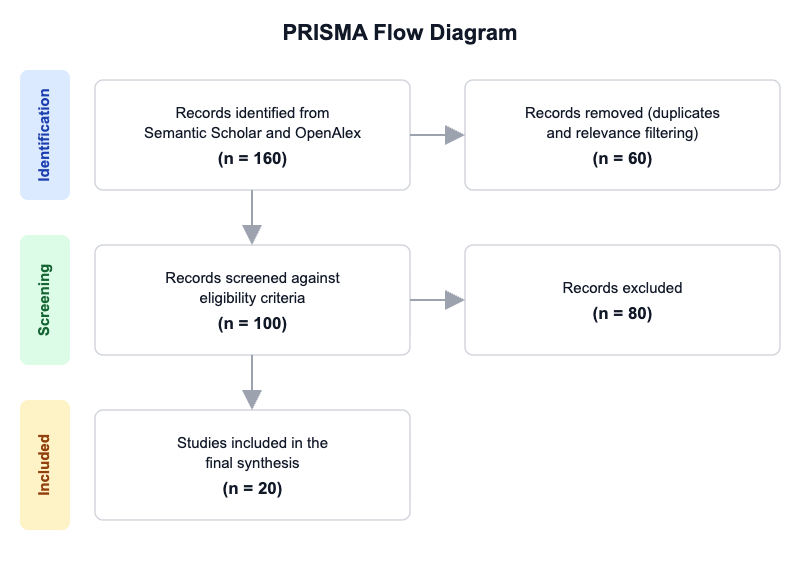
Initial database searching identified 160 records. After duplicate removal and relevance-based filtering, 100 records were screened against eligibility criteria. Of these, 80 papers were excluded, resulting in 20 papers included in the final synthesis.
PRISMA Flow Diagram
Eligibility criteria included:
- Tinnitus Focus: Does the study primarily investigate tinnitus diagnosis, treatment, mechanisms, prognosis, prevalence, or patient-reported outcomes?
- Human Evidence: Does the study involve human participants or human data rather than animal, cell, or purely technical work?
- Recent Study: Was the study published between 2020 and 2026?
- Direct Tinnitus Outcome: Does the study measure a tinnitus-specific outcome such as severity, loudness, distress, handicap, quality of life, or tinnitus-related function?
- Study Design: Is the paper an original empirical study, randomized trial, cohort study, cross-sectional study, qualitative study, systematic review, or meta-analysis?
- Clinical Relevance: Does the study address diagnosis, management, prognosis, or burden relevant to clinical tinnitus care?
- Intervention Evidence: Does the study evaluate a treatment, device, counseling approach, or other management strategy for tinnitus?
- Mechanistic Insight: Does the study examine biological, neurophysiological, or imaging mechanisms related to tinnitus?
All included studies met the stated eligibility criteria.
2.3 Data Extraction and Synthesis
Data extraction focused on the following variables:
- Study Focus: Classify the paper's main tinnitus focus: diagnosis, treatment, mechanisms, prognosis, epidemiology, or review/synthesis.
- Population: Extract the participant group, tinnitus subtype, hearing status, age group, or clinical setting when stated.
- Intervention/Exposure: Extract the treatment, device, counseling approach, diagnostic method, risk factor, or other exposure studied.
- Design: Extract the study design, such as randomized trial, cohort, cross-sectional study, qualitative study, systematic review, or meta-analysis.
- Sample Size: Extract the number of participants, ears, records, or studies, if reported.
- Key Outcomes: Extract the tinnitus-specific outcomes measured, such as severity, loudness, distress, handicap, quality of life, or related clinical outcomes.
- Main Findings: Summarize the central results and direction of effect using only the paper's reported findings.
- Follow-up: Extract the follow-up duration or time horizon, if reported.
Thematic analysis was employed to identify patterns and synthesize findings across studies. Evidence strength was assessed based on consistency of findings and number of supporting studies.
3. Results
3.1 Characteristics of Included Studies
| Study and Year | Study Type | Population / Dataset | Main Focus | Key Outcome / Measure | Duration |
|---|---|---|---|---|---|
| Beukes et al. 2020 [1] | Mixed-methods cross-sectional survey | 3,103 individuals with tinnitus from 48 countries | Pandemic-related changes in tinnitus experience | Tinnitus exacerbation, distress, loneliness, sleep, anxiety | Not reported |
| Piccirillo et al. 2020 [2] | Clinical review | Chronic tinnitus generally | Diagnosis and treatment | Behavioral therapy and personalized care | Not reported |
| Tyler et al. 2020 [3] | Crossover single-participant trial | 18 adults with subjective, nonpulsatile, sensorineural tinnitus | Sound therapy / maskers | Loudness, annoyance, TPFQ | Two 6-week trials |
| Biswas et al. 2021 [4] | Cross-sectional population study | General population across multiple European countries | Prevalence | Country-level prevalence variation | Not applicable |
| Han et al. 2021 [5] | Review | General tinnitus population | Mechanisms, diagnosis, treatment | Symptomatic relief, distress management | Not reported |
| Simões et al. 2021 [6] | Systematic review / perspective | Tinnitus research field | Research priorities | Methods standardization, multicenter work | Not reported |
| Mazurek et al. 2022 [7] | Clinical practice guideline | Chronic tinnitus broadly | Diagnosis and treatment | CBT, psychotherapy, counseling | Not reported |
| Searchfield and Sanders 2022 [8] | Randomized single-blind controlled trial | 98 smartphone app users with chronic moderate-severe tinnitus | Digital polytherapeutic | TFI, COSIT, usability | 12 weeks |
| d’Apuzzo et al. 2024 [9] | Systematic review and meta-analysis | Patients with tinnitus and TMD | TMD-associated tinnitus treatment | Treatment efficacy, prognostic factors | Not specified |
| Kleinjung et al. 2024 [10] | Multidisciplinary expert review | General tinnitus population | Diagnosis, treatment, practice translation | Management options and evidence gaps | Not reported |
| Langguth et al. 2024 [11] | Narrative review | General tinnitus population | Pathophysiology and clinical features | Heterogeneity, comorbidities, treatment pathways | Not reported |
| Batts and Stanković 2024 [12] | Cross-sectional population analysis | U.S. general population | Prevalence and healthcare use | Prevalence, associated characteristics, use | Not reported |
| Lee and Jung 2023 [13] | Review | General tinnitus population | Evaluation and treatment updates | Severity, distress, quality of life | Not reported |
| Park et al. 2023 [14] | Review | Chronic subjective tinnitus | Current and emerging therapies | Symptom improvement | Not reported |
| Suh et al. 2023 [15] | Prospective cohort study | Tinnitus patients | Smart-device TRT | Treatment effectiveness, cost-effectiveness | Not specified |
| Walter et al. 2023 [16] | Randomized controlled trial | 187 participants with chronic tinnitus | Smartphone-based CBT | TQ, PHQ-9, PSQ20, SWOP-K9 | First 3 months of 9-month intervention |
| Hobeika et al. 2025 [17] | Machine-learning longitudinal analysis | UK Biobank; 192,993 participants, 41,042 with tinnitus; validation in 463 Tinnitus Research Initiative participants | Risk factors and progression | Presence, severity, nine-year progression | 9 years |
| Pacheco-López et al. 2025 [18] | Clinical review / protocol paper | Pulsatile tinnitus patients | Diagnosis and management | Imaging protocol, etiologic exclusion | Not reported |
| Tziridis et al. 2025 [19] | Double-blinded randomized trial | 72 adult patients with tinnitus severity index below IV and hearing loss not exceeding 40 dB up to 6 kHz | Low-intensity noise suppression | THQ, loudness, suppression | 4 weeks treatment; 4 weeks post-treatment |
| Xian et al. 2025 [20] | Umbrella review | Synthesized meta-analyses and systematic reviews | Treatment evidence quality | Methodological and evidence quality | Not reported |
Overall, the literature is dominated by reviews, guidelines, and observational syntheses, but several recent controlled studies now provide direct intervention evidence. The evidence base spans broad tinnitus populations, chronic subjective tinnitus, smartphone users, tinnitus with temporomandibular disorders, pulsatile tinnitus, and patients selected by hearing-loss constraints. Outcomes are also heterogeneous, ranging from tinnitus distress and functional handicap to prevalence, healthcare use, and prognostic modeling, which limits direct comparability but reveals clear thematic convergence around personalization and comorbidity-aware care.
3.2 Thematic Findings
3.2.1 Tinnitus burden is strongly shaped by heterogeneity, hearing status, and psychosocial comorbidity
Recent evidence converges on tinnitus as a heterogeneous condition whose clinical significance depends less on simple presence than on distress, comorbidity, and temporal variability. Reviews emphasize that tinnitus perception varies substantially between and within individuals, with hearing loss repeatedly identified as the predominant risk factor, while stress, sleep quality, external sounds, head movements, and distraction alter perception and suffering [11], [5]. This heterogeneity is not merely descriptive; it is clinically meaningful because only a minority experience severe quality-of-life interference, and those patients commonly have anxiety, depression, or insomnia that can function both as correlates and as amplifiers of tinnitus burden [11], [2].
Population studies reinforce this framing by showing that tinnitus is common at the population level and varies across settings. European prevalence differed across countries [4], while U.S. population analysis showed substantial prevalence and associated healthcare use patterns [12]. The precise prevalence estimates were not reported in the extracted data, but the central contribution is that tinnitus burden is not evenly distributed and likely reflects differences in risk exposure, access to care, and perhaps case ascertainment. The pandemic survey adds a further layer of variability: among 3,103 tinnitus respondents from 48 countries, 40% reported tinnitus exacerbation with COVID-19 symptoms, 32% reported that social and emotional consequences made tinnitus more bothersome, and the condition was more strongly worsened in those self-isolating, lonely, sleeping poorly, or exercising less [1]. This finding is particularly relevant because it suggests that tinnitus distress is highly sensitive to concurrent psychosocial stressors, not only to auditory pathology. Confidence: Strong for heterogeneity and psychosocial modulation; Moderate for cross-national prevalence differences because exact prevalence metrics were not reported in the extracted data.
3.2.2 Hearing health is the most consistent predictor of tinnitus presence and progression, but psychological and sleep factors shape severity
The most coherent prognostic pattern in the recent literature is that hearing health is the primary risk factor for both tinnitus presence and severity, while mood, neuroticism, and sleep primarily predict severity rather than presence [17]. In the UK Biobank-based model of 192,993 participants, 41,042 with tinnitus, the severity model predicted progression over nine years with ROC 0.78 and Cohen’s d 1.3 for individuals developing severe tinnitus [17]. The same study validated the model in 463 individuals from the Tinnitus Research Initiative database and reduced it to a six-item clinical questionnaire for identifying those at risk of severe tinnitus [17]. This is the clearest evidence in the set that risk stratification is possible and that tinnitus severity is not random, but patterned by clinically measurable features.
These findings align with review-level synthesis that hearing loss is the most common cause or risk factor, though not all tinnitus sufferers have clinically detectable hearing impairment [5], [11]. The key synthesis point is that hearing health appears to anchor tinnitus vulnerability, but non-auditory factors determine how burdensome the symptom becomes. That distinction matters because it explains why some intervention studies target hearing restoration or sound enrichment, while behavioral therapies focus on distress regulation. The clinical implication is that severity prediction and management should not stop at audiometry: sleep and mood assessment appear essential for identifying patients likely to deteriorate. Confidence: Strong for hearing health as a core risk factor; Moderate for the specific predictive value of six-item screening because the abstract does not report the individual item coefficients or calibration metrics.
3.2.3 Behavioral and digitally delivered interventions consistently reduce tinnitus distress, with evidence strongest for structured CBT-based approaches
Among treatment studies, the most consistent signal is that structured behavioral interventions reduce tinnitus distress and related psychological burden. A smartphone-based cognitive behavioral therapy trial in 187 adults with chronic tinnitus showed a statistically significant and clinically relevant reduction in Tinnitus Questionnaire scores versus delayed treatment, with Cohen’s d=1.1 and p<0.001 after 3 months of a 9-month intervention [16]. Secondary outcomes improved in depression and perceived stress, as measured by PHQ-9 and PSQ20, while self-efficacy optimism/pessimism scores remained unchanged [16]. This pattern is important because it indicates that the treatment effect is not limited to tinnitus-specific distress but extends to broader emotional burden, although it does not appear to transform all coping-related cognitions equally.
Guideline and review papers converge on this behavioral emphasis, recommending counseling, CBT, and psychotherapeutic interventions as principal management options for chronic tinnitus [7], [10], [2]. Acceptance and commitment therapy, mindfulness-oriented app components, and tinnitus retraining therapy are all presented as plausible extensions of this behavioral framework [13], [14]. The evidence hierarchy is nonetheless uneven: the digital CBT trial provides stronger direct support than narrative reviews, whereas older review-based recommendations remain important for translating treatment principles into practice. Confidence: Strong for CBT-based reduction in distress; Moderate for broader digital behavioral approaches because some evidence is trial-based and some is review-based.
3.2.4 Sound-based and device-based therapies show benefit, but effects depend on personalization and are less uniformly robust than CBT
Sound therapy and device-based interventions appear promising, but the evidence is more heterogeneous and context-dependent than for CBT. In a crossover trial of 18 adults with subjective, nonpulsatile, sensorineural tinnitus, partial masking improved total Tinnitus Primary Functions Questionnaire scores in 5 of 15 completers, with benefits most apparent for sleep, hearing, thoughts and emotions, and concentration [3]. This suggests that sound therapy can reduce functional burden, but the effect is far from universal. Likewise, a randomized single-blind trial of a prototype digital polytherapeutic enrolled 98 smartphone users with chronic moderate-severe tinnitus and found clinically meaningful Tinnitus Functional Index reductions in the intervention arm at 6 and 12 weeks, with a higher proportion of responders than in the passive sound app group [8]. Usability was similar across apps, which implies that efficacy gains were not bought at the expense of acceptability [8].
A similar personalization principle emerges from low-intensity noise suppression therapy, where 72 adults with tinnitus severity index below IV and hearing loss no greater than 40 dB up to 6 kHz showed significant decreases in THQ scores after 2 and 4 weeks, with persistence 4 weeks after treatment ended [19]. The treatment-only group improved more than the placebo-and-treatment group, suggesting that initial placebo stimulation may blunt subsequent benefit [19]. Smart-device-based tinnitus retraining therapy also appears effective and potentially cost-effective, with outcomes comparable to conventional counseling [15]. Collectively, these studies indicate that sound-based strategies can work, but only when carefully matched to the patient and intervention context. Confidence: Moderate for personalized sound/device therapies overall; Limited to Moderate for specific comparative superiority claims because evidence is still relatively sparse and outcome measures differ.
3.2.5 Certain subgroups require tailored diagnostic and therapeutic pathways, especially temporomandibular disorder-associated and pulsatile tinnitus
The emerging literature makes clear that not all tinnitus should be managed through the same pathway. In tinnitus associated with temporomandibular disorders, a systematic review and meta-analysis found that multidisciplinary non-invasive approaches were the most efficacious treatment, and prognostic factors included baseline tinnitus severity, gender, quality of life, age, and tinnitus duration [9]. This is clinically important because it shifts tinnitus management from a generic ear-centered model toward a musculoskeletal and multidisciplinary framework when TMD is present. The evidence base is narrower than for general chronic tinnitus, but the implication is strong: comorbidity-specific treatment selection matters.
Pulsatile tinnitus requires an even more distinct approach. The 2025 clinical review emphasizes that pulsatile tinnitus accounts for approximately 5–10% of tinnitus cases and may be vascular or non-vascular in origin; therefore, focused imaging is essential, especially to exclude systemic causes in bilateral cases and organic cervical or cranial etiologies in unilateral cases [18]. This diagnostic pathway is fundamentally different from chronic subjective tinnitus management and reinforces the need for subtype-specific algorithms. Confidence: Moderate for TMD-associated multidisciplinary treatment; Moderate for pulsatile tinnitus diagnostic specialization, though the latter is based on a protocol-oriented review rather than outcome trials.
3.3 Summary of Evidence
| Theme | Key Finding | Population Applicability | Effect Direction | Confidence Level | Supporting Studies |
|---|---|---|---|---|---|
| Heterogeneity and psychosocial modulation | 40% reported exacerbation with COVID-19 symptoms; 32% reported more bothersome tinnitus from social/emotional consequences; loneliness, poor sleep, anxiety, and depression worsened tinnitus [1] | Broadly applicable to tinnitus populations; pandemic context-specific | Mixed / positive for worsening burden | Strong | Beukes et al. [1], Langguth et al. [11], Kleinjung et al. [10] |
| Hearing health and severity prediction | Severity model predicted nine-year progression with ROC 0.78 and Cohen’s d 1.3 for individuals developing severe tinnitus [17] | General tinnitus population and validated clinical subgroup | Positive for risk prediction | Strong | Hobeika et al. [17], Han et al. [5], Langguth et al. [11] |
| Behavioral and digital CBT | Smartphone CBT reduced TQ with p<0.001 and Cohen’s d=1.1, with improved PHQ-9 and PSQ20 [16] | Chronic tinnitus; smartphone users in particular | Positive | Strong | Walter et al. [16], Mazurek et al. [7], Piccirillo et al. [2] |
| Sound-based and device-based personalization | Prototype digital polytherapeutic improved TFI with higher responder proportions than passive app [8]; LINTS reduced THQ over 4 weeks and persisted 4 weeks post-treatment [19] | Chronic moderate-severe tinnitus; selected patients with limited hearing loss | Positive | Moderate | Searchfield and Sanders [8], Tziridis et al. [19], Suh et al. [15] |
| Subtype-specific management | Multidisciplinary non-invasive treatment was most efficacious for tinnitus with TMD [9]; pulsatile tinnitus requires specific imaging protocol [18] | Patients with TMD-associated or pulsatile tinnitus | Positive for tailored management | Moderate | d’Apuzzo et al. [9], Pacheco-López et al. [18], Lee and Jung [13] |
4. Discussion
4.1 Principal Findings and Their Interpretation
The clearest pattern emerging from recent tinnitus research is that clinical burden is driven less by tinnitus as a binary symptom than by the interaction between auditory vulnerability and psychosocial context. Hearing health appears to provide the substrate on which tinnitus develops and progresses, but sleep disturbance, mood symptoms, neuroticism, anxiety, loneliness, and social isolation shape whether tinnitus becomes disabling [17], [1], [11]. This is clinically important because it explains why the same percept can be trivial for one person and severely impairing for another. The longitudinal prediction model is especially valuable here: its ability to forecast nine-year severity progression suggests that tinnitus trajectories are structured enough to support early identification of high-risk individuals, rather than being entirely idiosyncratic [17].
Therapeutically, the evidence implies that tinnitus improvement is most reliable when interventions target distress regulation and patient-specific coping, rather than attempting to suppress the symptom alone. The strong effect of smartphone-based CBT [16] and the positive signal from counseling-centered digital polytherapeutics [8] suggest that changing attention, appraisal, and behavioral response may be more consistently effective than hoping for universal sensory silencing. This interpretation is supported indirectly by reviews and guidelines emphasizing CBT and counseling as core management strategies [7], [10]. By contrast, sound-based approaches appear to work best when individualized, whether through partial masking, low-intensity noise fitting, or retraining therapy [3], [19], [15]. The field therefore seems to be moving toward a hybrid model: treat the auditory channel when feasible, but treat distress and habituation as primary clinical targets.
A key advance of this synthesis is that it makes visible a hierarchy of confidence. The most robust conclusions concern heterogeneity, hearing-related risk, and CBT-based benefit. More tentative conclusions concern the comparative superiority of specific sound technologies, which remain dependent on device design, patient selection, and outcome metric choice. Mechanistic evidence is still limited in the provided data; although reviews reference shared brain networks and stress-related systems, the current set does not provide direct biomarker or imaging confirmation of causal pathways [11], [10].
4.2 Comparison with Existing Literature and Resolution of Contradictions
The recent literature aligns with earlier clinical understandings that tinnitus is commonly linked to hearing loss and comorbid distress, but the newer work sharpens this picture by showing that severity is better predicted by multidimensional factors than by hearing loss alone [5], [17], [11]. This is meaningful because it suggests the field is moving beyond a simple otologic model toward a biopsychosocial one. The consistency between guideline recommendations and trial evidence for CBT strengthens confidence that this is not merely expert consensus; rather, it reflects a reproducible therapeutic effect across different delivery modes [7], [16].
The main contradictions in the evidence are not true reversals but uneven effect sizes and outcome dependence. Sound therapy and masking are described as helpful in some studies, yet benefits are partial and not universal [3]. This likely reflects heterogeneity in tinnitus subtype, hearing status, and how “benefit” is measured: a reduction in loudness, annoyance, handicap, or sleep interference will not necessarily move in parallel. The same issue may explain why the low-intensity noise trial showed strong benefit in the treatment-only arm but much less in the placebo-and-treatment arm [19]. The study itself suggests that initial placebo noise may counteract the LIN effect, but another plausible explanation is that treatment expectancy and acclimatization interact with non-masking sound stimulation in ways that are not captured by standard outcome measures. Because outcome instruments differ across studies, apparent contradictions between sound-based and behavioral interventions may partly reflect measurement choice rather than true therapeutic incompatibility.
Selection effects also likely shape the literature. Digital CBT and app-based interventions are tested in smartphone users, who may be more comfortable with self-management and sustained engagement than the broader tinnitus population [16], [8]. Similarly, the LINTS study excluded individuals with more substantial hearing loss and prior hearing aid experience [19], which narrows generalizability. Publication bias remains a concern because many recent studies are intervention-positive or narrative reviews with limited negative findings. The overall pattern is therefore best interpreted as encouraging but not definitive, especially for novel digital and sound-based therapies.
4.3 Practical Implications
For clinicians, the strongest implication is that tinnitus management should begin with phenotype-aware assessment rather than a one-size-fits-all treatment plan. Patients with prominent insomnia, anxiety, depression, loneliness, or high stress merit early psychosocial screening because these factors appear to amplify tinnitus burden and may predict worsening [1], [17]. Individuals with chronic tinnitus who can engage digitally are plausible candidates for smartphone-based CBT or app-supported retraining, given the clinically meaningful distress reductions reported in controlled trials [16], [15]. For patients with hearing loss, sound-based and hearing-restorative strategies remain reasonable, but they should be framed as individualized tools rather than universally effective cures [5], [3].
For public health practice, the findings support integrating tinnitus into broader mental health, sleep, and hearing-health initiatives. Because burden is shaped by comorbidity and social context, prevention and support cannot focus only on auditory thresholds. The COVID-19 findings are especially relevant as a natural demonstration that social isolation, reduced exercise, and emotional strain can worsen tinnitus even without a change in the underlying auditory signal [1]. Regulatory implications are more limited because the evidence does not directly evaluate environmental thresholds or external exposures in a way that permits a no-threshold policy argument. Instead, the priority is better access to stratified care, digital delivery, and subtype-specific diagnostic pathways, especially for pulsatile tinnitus and TMD-associated tinnitus [18], [9]. The evidence base is strongest for clinical personalization and weakest for universal treatment claims.
4.4 Strengths and Limitations
A major strength of this review is its integration of epidemiology, prognosis, intervention trials, and expert guidance into a coherent synthesis centered on current tinnitus care. The included literature spans broad population data, longitudinal prediction, randomized trials, and subtype-specific clinical frameworks, allowing comparison across levels of evidence rather than dependence on any single design. Another strength is that recent studies increasingly use explicit outcome metrics such as TQ, TFI, THQ, PHQ-9, and PSQ20, which improves clinical interpretability.
The limitations of the included studies are substantial. Many are reviews or guidelines rather than original empirical studies, several intervention studies are small or subtype-specific, and outcome measures differ widely. Population generalizability is limited in some studies by smartphone use, hearing-loss restrictions, or specific comorbid conditions. The evidence for mechanistic explanation remains thin in the provided data, despite repeated references to stress-related networks and auditory dysfunction. This review is also limited by abstract-based extraction and the absence of a formal risk-of-bias assessment. As a result, the synthesis is best viewed as a structured interpretation of current literature rather than a quantitative estimate of effect.
5. Gaps and Future Directions
The most important gap is the lack of large, head-to-head trials comparing the main tinnitus management strategies in the same population using harmonized outcomes. Current evidence suggests benefit from CBT-based digital interventions, but sound-based therapies, retraining, and neuromodulatory approaches are measured differently and often in restricted subgroups, making direct comparison difficult [16], [19], [20]. Future studies should directly test whether patients with specific phenotypes, such as hearing-loss dominant tinnitus, stress-sensitive tinnitus, TMD-associated tinnitus, or pulsatile tinnitus, respond preferentially to different interventions [6], [11].
Longitudinal studies also need to move beyond prediction toward mechanism. The machine-learning work shows that severity can be forecast over nine years, but the data provided do not explain biological pathways linking hearing health, sleep, and mood to progression [17]. Imaging, physiological, and biomarker studies are therefore needed to convert risk prediction into causal understanding. Underrepresented populations include non-English-speaking settings, individuals without smartphone access, and people with more severe hearing loss or complex multimorbidity. Methodologically, future work would be strengthened by standardized outcome sets, direct comparisons between digital and in-person care, and longer follow-up to determine whether early symptom relief persists. Better phenotype harmonization is especially important if tinnitus research is to deliver subtype-specific, clinically durable treatment recommendations.
6. Conclusion
Recent research supports a clear but nuanced conclusion: tinnitus is best understood and managed as a heterogeneous disorder in which hearing health creates vulnerability, but psychosocial factors and sleep determine much of the clinical burden. The strongest evidence in this review indicates that hearing health is the primary predictor of tinnitus presence and severity, with severity progression forecast over nine years at ROC 0.78 and Cohen’s d 1.3 in individuals developing severe tinnitus [17]. At the treatment level, the most convincing benefits come from structured behavioral interventions, especially smartphone-based CBT, which reduced tinnitus distress with p<0.001 and Cohen’s d=1.1 [16]. Sound-based and device-based approaches are also promising, including partial masking, digital polytherapeutics, low-intensity noise suppression, and smart-device retraining, but their effects appear more dependent on patient selection and personalization [3], [8], [19], [15].
The evidence base most strongly applies to chronic subjective tinnitus, with additional but narrower implications for tinnitus associated with temporomandibular disorders and pulsatile tinnitus [9], [18]. What remains most uncertain is which specific phenotypes benefit most from which intervention and whether early risk prediction can be translated into prevention rather than only early support. That unresolved question matters because tinnitus burden is substantial, chronic, and often intertwined with sleep and mental health. The field’s next step is not simply to discover more treatments, but to match the right treatment to the right tinnitus subtype at the right time.
References
- Beukes, E. W., Baguley, D. M., Jacquemin, L., Lourenco, M. P. C. G., Allen, P. M., Onozuka, J., Stockdale, D., Kaldo, V., Andersson, G., & Manchaiah, V. (2020). Changes in tinnitus experiences during the COVID-19 pandemic. Frontiers in Public Health, 8, 592878. https://doi.org/10.3389/fpubh.2020.592878
- Piccirillo, J. F., Rodebaugh, T. L., & Lenze, E. J. (2020). Tinnitus. JAMA, 323(15), 1497. https://doi.org/10.1001/jama.2020.0697
- Tyler, R. S., Perreau, A., Powers, T., Watts, A., Owen, R., Ji, H., & Mancini, P. C. (2020). Tinnitus sound therapy trial shows effectiveness for those with tinnitus. Journal of the American Academy of Audiology, 31(1), 6–16. https://doi.org/10.3766/jaaa.18027
- Biswas, R., Lugo, A., Akeroyd, M. A., Schlee, W., Gallus, S., & Hall, D. A. (2021). Tinnitus prevalence in Europe: A multi-country cross-sectional population study. The Lancet Regional Health – Europe, 12, 100250. https://doi.org/10.1016/j.lanepe.2021.100250
- Han, B. I., Lee, H. W., Ryu, S., & Kim, J.-S. (2021). Tinnitus update. Journal of Clinical Neurology, 17(1), 1–10. https://doi.org/10.3988/jcn.2021.17.1.1
- Simoes, J. P., Daoud, E., Shabbir, M., Amanat, S., Assouly, K., Biswas, R., Casolani, C., Dode, A., Enzler, F., Jacquemin, L., Joergensen, M., Kok, T., Liyanage, N., Lourenco, M., Makani, P., Mehdi, M., Ramadhani, A. L., Riha, C., Lopez Santacruz, J., … Genitsaridi, E. (2021). Multidisciplinary tinnitus research: Challenges and future directions from the perspective of early stage researchers. Frontiers in Aging Neuroscience, 13, 647285. https://doi.org/10.3389/fnagi.2021.647285
- Mazurek, B., Hesse, G., Dobel, C., Kratzsch, V., Lahmann, C., & Sattel, H. (2022). Clinical practice guideline: Chronic tinnitus—diagnosis and treatment. Deutsches Ärzteblatt International, 119(13), 219–225. https://doi.org/10.3238/arztebl.m2022.0135
- Searchfield, G. D., & Sanders, P. J. (2022). A randomized single-blind controlled trial of a prototype digital polytherapeutic for tinnitus. Frontiers in Neurology, 13, 958730. https://doi.org/10.3389/fneur.2022.958730
- d'Apuzzo, F., Minervini, G., Cerbone, M., Rotolo, R. P., Grassia, V., & Nucci, L. (2024). Treatment approaches, outcomes and prognostic indicators in patients with tinnitus and temporomandibular disorders evaluated with DC/TMD: A systematic review and meta-analysis. Journal of Oral Rehabilitation, 52(2), 230–242. https://doi.org/10.1111/joor.13796
- Kleinjung, T., Peter, N., Schecklmann, M., & Langguth, B. (2024). The current state of tinnitus diagnosis and treatment: A multidisciplinary expert perspective. Journal of the Association for Research in Otolaryngology, 25(5), 413–425. https://doi.org/10.1007/s10162-024-00960-3
- Langguth, B., De Ridder, D., Schlee, W., & Kleinjung, T. (2024). Tinnitus: Clinical insights in its pathophysiology—A perspective. Journal of the Association for Research in Otolaryngology, 25(3), 249–258. https://doi.org/10.1007/s10162-024-00939-0
- Batts, S., & Stankovic, K. M. (2024). Tinnitus prevalence, associated characteristics, and related healthcare use in the United States: A population-level analysis. The Lancet Regional Health – Americas, 29, 100659. https://doi.org/10.1016/j.lana.2023.100659
- Lee, H. Y., & Jung, D. J. (2023). Recent updates on tinnitus management. Journal of Audiology & Otology, 27(4), 181–192. https://doi.org/10.7874/jao.2023.00416
- Park, K. W., Kullar, P., Malhotra, C., & Stankovic, K. M. (2023). Current and emerging therapies for chronic subjective tinnitus. Journal of Clinical Medicine, 12(20), 6555. https://doi.org/10.3390/jcm12206555
- Suh, M.-W., Park, M. K., Kim, Y., & Kim, Y. H. (2023). The treatment outcome of smart device–based tinnitus retraining therapy: Prospective cohort study. JMIR mHealth and uHealth, 11, e38986. https://doi.org/10.2196/38986
- Walter, U., Pennig, S., Kottmann, T., Bleckmann, L., Röschmann-Doose, K., & Schlee, W. (2023). Randomized controlled trial of a smartphone-based cognitive behavioral therapy for chronic tinnitus. PLOS Digital Health, 2(9), e0000337. https://doi.org/10.1371/journal.pdig.0000337
- Hobeika, L., Fillingim, M., Tanguay-Sabourin, C., Roy, M., Londero, A., Samson, S., & Vachon-Presseau, E. (2025). Tinnitus risk factors and its evolution over time. Nature Communications, 16, 4244. https://doi.org/10.1038/s41467-025-59445-3
- Pacheco-López, S., Martínez-Barbero, J. P., Busquier-Hernández, H., García-Valdecasas-Bernal, J., & Espinosa-Sánchez, J. M. (2025). Pulsatile tinnitus: A comprehensive clinical approach to diagnosis and management. Journal of Clinical Medicine, 14(13), 4428. https://doi.org/10.3390/jcm14134428
- Tziridis, K., Heep, L., Piwonski, N., Nguyen, K., Kölbl, N., Schilling, A., & Schulze, H. (2025). Phase II clinical study on low-intensity-noise tinnitus suppression (LINTS) for tinnitus treatment. Brain Sciences, 15(11), 1222. https://doi.org/10.3390/brainsci15111222
- Xian, J., Zhang, S., Xiao, X., Yuan, J., Zhao, Y., Li, J., Zhang, Y., Fu, Q. H., Zhang, Y., & Zhang, Q. (2025). Evidence synthesis of tinnitus treatment methods: An umbrella review. American Journal of Otolaryngology, 46(5), 104707. https://doi.org/10.1016/j.amjoto.2025.104707