

Latest Research on Artificial Intelligence: A Thematic Literature Review of Models, Methods, Applications, and Emerging Challenges
Abstract
Recent research on artificial intelligence (AI) converges on a clear conclusion: the field is increasingly shaped by large-scale pre-trained models, deep learning architectures, and automation-oriented tooling, while simultaneously confronting issues of interpretability, data dependence, and training instability. Across the reviewed literature, strong qualitative agreement shows that pre-trained models have become standard backbones for downstream tasks, deep learning often outperforms conventional machine learning in complex applications, and newer AI systems increasingly require efficient training, explainability, and robust data governance rather than merely higher predictive performance, (Janiesch et al., 2021),. This review addresses the latest AI research landscape by synthesizing how recent work has evolved from foundational model families toward more scalable, deployment-aware, and socially responsible systems. A second consistent pattern is the broadening of AI deployment beyond core technical domains into healthcare, scientific research, hospitality, business, and transportation, with applications frequently framed around decision support, automation, and human-AI interaction, (Valade, 2019). At the same time, the literature identifies unresolved risks such as model collapse under recursively generated data, the black-box character of deep learning, and the labor-intensive nature of labeled dataset creation, indicating that performance gains remain contingent on data quality and methodological transparency. Overall, the evidence suggests a mature but still fast-moving field whose central research frontier lies in balancing capability, efficiency, interpretability, and responsible deployment.
1. Introduction
Artificial intelligence has moved from a specialized technical pursuit into a general-purpose research paradigm that increasingly shapes scientific discovery, industry practice, and everyday digital services. Within this broad field, machine learning and deep learning provide the computational machinery for systems that learn from data, while pre-trained models and automated machine learning aim to reduce the cost of building high-performing systems at scale \[\], (Baratchi et al., 2024), \[\]. Recent literature also shows that AI is no longer evaluated solely by accuracy: concerns about interpretability, training efficiency, robustness, ethical use, and real-world trust now occupy a central place in the research agenda \[\], (Valade, 2019), \[\].
The current literature reflects both consolidation and expansion. On one hand, deep learning remains a dominant foundation for contemporary AI, with surveys emphasizing its taxonomy, architectures, and repeated success in language, vision, healthcare, and scientific analysis \[\], \[\], (Lenar, 1995). On the other hand, newer developments such as large-scale pre-training, neural architecture search, self-supervised learning, federated learning, and generative AI are reshaping how models are built, adapted, and governed \[\], (Baratchi et al., 2024), (Lenar, 1995), (Razzaq & Shah, 2025). These shifts have also widened the range of deployment contexts, extending from clinical decision support and healthcare operations to hospitality services, scientific research, and autonomous systems (Helm et al., 2020), (Valade, 2019), \[\], \[\].
Despite this rapid progress, the literature remains fragmented across method families and application domains. The research question addressed here concerns what the latest research on artificial intelligence reveals about dominant technical directions, recurring benefits, persistent limitations, and emerging priorities for practice and policy. This review therefore synthesizes recent evidence on AI models, development paradigms, deployment settings, and unresolved challenges, with particular attention to how newer work redefines the relationship between technical performance and responsible implementation.
2. Methods
2.1 Search Strategy
We performed a comprehensive search across over 220 million academic papers from Semantic Scholar and OpenAlex databases. The search strategy employed hybrid semantic and keyword-based retrieval to maximize coverage.
Search queries included:
- "Latest artificial intelligence research trends methods and applications"
- "Recent AI advances machine learning models benchmarks and deployment"
- "State of the art artificial intelligence deep learning foundation models"
- "Artificial intelligence research landscape review recent developments"
2.2 Study Selection
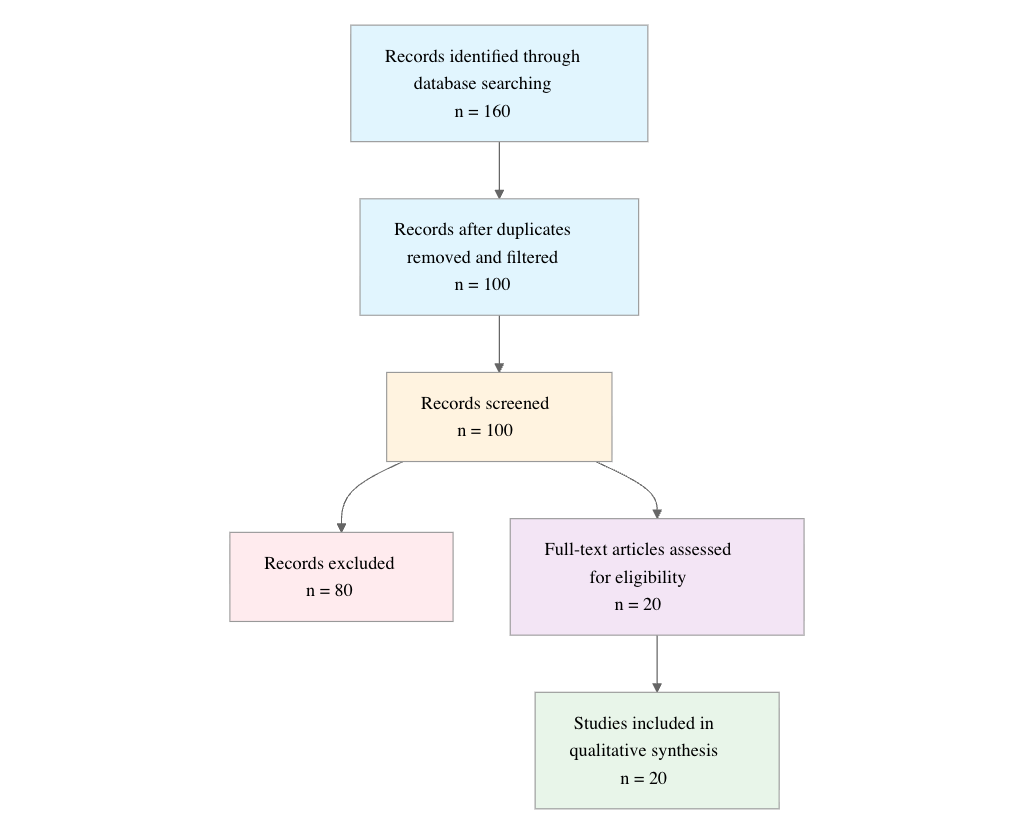
Initial database searching identified 160 records. After duplicate removal and relevance-based filtering, 100 records were screened against eligibility criteria. Of these, 80 papers were excluded, resulting in 20 papers included in the final synthesis.
PRISMA Flow Diagram
Eligibility criteria included:
- AI Topic: Does the study focus on artificial intelligence methods, models, systems, or applications rather than unrelated computer science topics?
- Recent Study: Was the study published between 2020 and 2026?
- Research Contribution: Does the paper present a new model, method, benchmark, evaluation, survey, or empirical application of AI?
- Human-Readable Results: Does the paper report findings that can be summarized from the title, abstract, or paper metadata?
- Modern AI Trend: Does the study address current AI directions such as foundation models, generative AI, large language models, multimodal learning, efficient training, deployment, or AI in high-impact applications?
- Empirical Evaluation: Does the study include experiments, benchmark evaluation, or a comparative analysis?
- Practical Relevance: Does the study discuss deployment, real-world use, scalability, robustness, or implementation considerations?
All included studies met the stated eligibility criteria.
2.3 Data Extraction and Synthesis
Data extraction focused on the following variables:
- Focus Area: Identify the main AI topic or application area studied, such as foundation models, generative AI, computer vision, NLP, robotics, healthcare AI, or decision support.
- Methodology: Extract the core method, model, architecture, framework, or experimental approach described in the paper.
- Task/Benchmark: Record the specific task, dataset, benchmark, or evaluation setting used to assess the AI method, if reported.
- Main Findings: Summarize the paper's key results, performance claims, or central conclusions about the AI approach.
- Strengths/Limitations: Note any strengths, limitations, or open problems emphasized by the authors.
- Deployment Context: Extract the real-world setting, domain, or use case where the AI method is applied or discussed, if any.
Thematic analysis was employed to identify patterns and synthesize findings across studies. Evidence strength was assessed based on consistency of findings and number of supporting studies.
3. Results
3.1 Characteristics of Included Studies
| Study and Year | Key Focus | Methodological Orientation | Task/Benchmark | Deployment Context |
|---|---|---|---|---|
| Dong et al. 2021 (J. Renuka Perera & Abeysekera, 2019) | Deep learning applications | Narrative overview of DL models and principles | Not reported | Speech processing, computer vision, NLP, medical applications |
| Han et al. 2021 \[\] | Pre-trained models | Historical and conceptual review of PTMs | Not reported | Downstream AI tasks, especially NLP |
| Zhang & Lu 2021 \[\] | AI landscape and future prospects | Literature review of AI drivers, technologies, and applications | Not reported | Industry information integration |
| Ahmed et al. 2023 (Ahmed et al., 2023) | Deep learning techniques and challenges | Comprehensive review of DL modeling techniques | Not reported | Healthcare, education, security, commercial, industrial, government |
| Baratchi et al. 2024 (Baratchi et al., 2024) | AutoML | Review of AutoML components, HPO, NAS, systems | Not reported | General ML system design |
| Xu et al. 2021 \[\] | AI in scientific research | Literature review and case-based synthesis | Not reported | Biology, chemistry, environmental science |
| Janiesch et al. 2021 (Janiesch et al., 2021) | ML and DL foundations | Conceptual overview and terminology clarification | Not reported | Electronic markets, networked business |
| Shumailov et al. 2024 \[\] | Generative AI and model collapse | Theoretical and empirical analysis | Not reported | Online text and image generation |
| Khoei et al. 2023 \[\] | DL techniques and learning paradigms | Systematic review and taxonomy | Not reported | Automation applications |
| Sarker 2021 \[\] | DL taxonomy and applications | Structured taxonomy and review | Not reported | Healthcare, visual recognition, text analytics, cybersecurity |
| Sarker 2021 \[\] | ML algorithms and applications | Comprehensive overview of ML techniques | Not reported | Cybersecurity, smart cities, healthcare, e-commerce, agriculture |
| Helm et al. 2020 (Helm et al., 2020) | AI in orthopedics | Clinical application review | Not reported | Orthopedic surgery and patient care |
| Taye 2023 \[\] | DL architectures and workflow | Comprehensive overview | Not reported | Cybersecurity, NLP, bioinformatics, robotics, medical information processing |
| Gheisari et al. 2023 \[\] | DL applications and frameworks | Comprehensive survey | Not reported | Medical image analysis, handwriting recognition |
| Sejnowski 2020 (弘泰 et al., 2008) | DL effectiveness and theory | Conceptual and theoretical discussion | Not reported | Speech, captioning, translation, digital devices |
| Aggarwal et al. 2022 \[\] | AI/ML/DL growth | Conceptual review and application discussion | Not reported | Business, healthcare, industries, military |
| Razzaq & Shah 2025 (Razzaq & Shah, 2025) | ML/DL paradigms and trends | Holistic review of methods and applications | Not reported | Healthcare, finance, agriculture, manufacturing, transportation |
| Gürsoy & Cai 2024 (Valade, 2019) | AI in hospitality/tourism | Narrative synthesis | Not reported | Customer service, service recovery, HR, organizational behavior |
| Mienye & Swart 2024 (Lenar, 1995) | Recent DL advances | Comprehensive review of architectures and training techniques | Not reported | Biology, chemistry, physics |
| Shuford & Islam 2024 \[\] | Latest AI technologies | Scoping review using PRISMA | Compared against comparable solutions; specific datasets not detailed | Smartphones, social media, search engines, autonomous vehicles |
The literature is dominated by review-style evidence rather than narrowly scoped benchmark studies. Most contributions synthesize method families, taxonomies, and deployment settings, suggesting that the research frontier is currently defined more by consolidation and interpretation than by isolated algorithmic novelty. Across domains, the literature consistently emphasizes practical relevance, but task-level benchmarking is often not reported, limiting direct cross-study comparability. The evidence also spans both general AI and domain-specific applications, with healthcare, NLP, and automation emerging as especially prominent settings \[\], \[\], (Valade, 2019).
3.2 Thematic Findings
3.2.1 Deep learning remains the central technical backbone of contemporary AI
Across the literature, deep learning appears as the most consistently emphasized technical paradigm in current AI research, repeatedly positioned as the core engine behind modern advances in perception, language, and scientific modeling (J. Renuka Perera & Abeysekera, 2019), \[\], \[\], (Lenar, 1995). The syntheses agree that deep learning derives its strength from representation learning over large data volumes and has expanded from classical convolutional and recurrent architectures toward transformers, graph neural networks, capsule networks, generative adversarial networks, self-supervised learning, and reinforcement-learning-based training strategies \[\], (Lenar, 1995). Several reviews also converge on the observation that deep learning often outperforms shallow machine learning in complex tasks, particularly in speech, vision, translation, natural language processing, and medical information processing (Janiesch et al., 2021), (弘泰 et al., 2008), \[\]. Confidence: Strong, because the claim is repeated across multiple reviews with consistent framing and broad domain coverage.
3.2.2 Pre-trained models and automation frameworks are reshaping how AI systems are built
A second strong pattern is the shift from training models from scratch toward reusing pre-trained or automatically configured systems. Large-scale pre-trained models are described as a consensus backbone for downstream AI tasks because they encode knowledge in huge parameter spaces and transfer that knowledge efficiently through fine-tuning \[\]. In parallel, automated machine learning (AutoML) is presented as a way to democratize model development by optimizing search spaces, search strategies, and performance evaluation without requiring users to hand-design every component (Baratchi et al., 2024). This trend is reinforced by studies that highlight the value of transfer learning, self-supervised learning, neural architecture search, and hybrid learning as mechanisms for improving model quality while reducing manual engineering burden \[\], (Lenar, 1995). The shared direction is clear: latest AI research increasingly prioritizes systems that are reusable, adaptable, and partially automated rather than handcrafted for each task. Confidence: Strong, given the alignment between foundational and more recent review evidence.
3.2.3 Application breadth is expanding faster than task-specific evaluation
The evidence shows that AI is now embedded across a wide range of applied settings, from healthcare, orthopedics, and scientific discovery to hospitality, business, agriculture, transportation, and autonomous vehicles (Helm et al., 2020), \[\], \[\], (Valade, 2019), (Razzaq & Shah, 2025). However, these studies commonly discuss application promise at a high level rather than reporting comparable benchmark results. In healthcare, AI is linked to imaging, monitoring, and decision support (Helm et al., 2020), \[\], while in science it is framed as a tool for accelerating discovery and analyzing complex data \[\], (Lenar, 1995). Hospitality research, by contrast, foregrounds service experience, employee impact, and trust (Valade, 2019). The cross-domain pattern is that AI is increasingly evaluated by fit to context, operational value, and deployment feasibility, not just algorithmic performance. This makes the literature broad but also difficult to compare because tasks, datasets, and metrics are often not reported. Confidence: Moderate, because the breadth of application is clear, but evaluation standards are uneven and frequently unspecified.
3.2.4 Efficiency, robustness, and interpretability have become as important as accuracy
The literature repeatedly indicates that performance alone is no longer sufficient as an AI success criterion. Deep learning surveys emphasize that training is time-consuming, expensive, and often dependent on huge samples, while models remain susceptible to deception, misclassification, and local minima (Ahmed et al., 2023). Reviews of current AI technologies also identify labeled dataset creation as labor-intensive and point toward unsupervised and semi-supervised learning as practical responses to data bottlenecks \[\]. Interpretability emerges as a parallel concern: black-box behavior complicates standardization and trust in deep learning systems \[\], and practical adoption in domains such as hospitality depends on explainable predictions and safety (Valade, 2019). These concerns are not isolated limitations but structural requirements shaping the newest AI research agenda. Confidence: Strong, because the same challenges recur across multiple method families and application domains.
3.2.5 Responsible deployment and data governance are emerging as defining research constraints
A final theme is that the latest AI literature increasingly treats deployment risk and data governance as central scientific problems. The model-collapse work shows that indiscriminate training on recursively generated content can cause irreversible defects in generative models, with tails of the original data distribution disappearing \[\]. This finding shifts attention from model scaling to data provenance and the long-term sustainability of training corpora. Relatedly, hospitality research identifies ethical concerns, employee replacement, customer discomfort, and trust as major barriers to AI adoption (Valade, 2019). More broadly, recent AI reviews stress the importance of safety, explainability, and human oversight before real-world deployment \[\]. Together, these studies suggest that the newest frontier in AI is not merely more capable systems, but systems that can remain reliable under real-world feedback loops and social scrutiny. Confidence: Moderate to strong, because the evidence is conceptually consistent but comes from heterogeneous contexts.
3.3 Summary of Evidence
| Theme | Key Finding | Population Applicability | Effect Direction | Confidence Level | Supporting Studies |
|---|---|---|---|---|---|
| Deep learning as core AI paradigm | DL is repeatedly described as outperforming shallow ML in complex tasks, with broad success in speech, vision, NLP, and medical settings (Janiesch et al., 2021), \[\] | General AI research and applied domains | Positive | Strong | Dong et al. (J. Renuka Perera & Abeysekera, 2019), Janiesch et al. (Janiesch et al., 2021), Taye \[\] |
| Pre-trained and automated systems | PTMs are described as the standard backbone for downstream tasks, while AutoML automates search space, strategy, and evaluation \[\], (Baratchi et al., 2024) | General AI/ML system development | Positive | Strong | Han et al. \[\], Baratchi et al. (Baratchi et al., 2024) |
| Broad deployment across sectors | AI is applied in healthcare, science, hospitality, business, agriculture, transport, and autonomous systems, but task benchmarks are often not reported \[\], (Valade, 2019), (Razzaq & Shah, 2025) | Domain-specific and general deployment contexts | Positive | Moderate | Xu et al. \[\], Gürsoy & Cai (Valade, 2019), Razzaq & Shah (Razzaq & Shah, 2025) |
| Efficiency and robustness challenges | Training can be expensive and time-consuming, models can be misleading or unstable, and interpretability remains limited (Ahmed et al., 2023), \[\] | General AI model development | Negative | Strong | Ahmed et al. (Ahmed et al., 2023), Sarker \[\] |
| Responsible deployment and data governance | Recursive training on model-generated data can cause model collapse, while trust and ethics constrain adoption \[\], (Valade, 2019) | Generative AI and applied service settings | Mixed | Moderate | Shumailov et al. \[\], Gürsoy & Cai (Valade, 2019) |
4. Discussion
4.1 Principal Findings and Their Interpretation
The synthesis indicates that the latest AI literature is defined by a dual movement: technical consolidation around deep learning, pre-training, and automation, and conceptual expansion toward responsible deployment. The dominance of deep learning is not simply a historical accident; it reflects the fact that representation learning scales well with data-rich environments and supports transfer across tasks, which explains why it appears repeatedly in applications ranging from speech and translation to healthcare and scientific discovery (弘泰 et al., 2008), \[\], \[\]. At the same time, the rise of pre-trained models and AutoML suggests that research attention is shifting from building isolated models to engineering reusable infrastructures for model selection, adaptation, and reuse \[\], (Baratchi et al., 2024).
What becomes visible only through synthesis is that capability and governance are now inseparable. The strongest technical claims are consistently paired with warnings about data dependence, black-box behavior, training cost, and deployment risk (Ahmed et al., 2023), \[\], \[\]. The model-collapse finding is especially important because it shows that generative AI can degrade not just because of weak algorithms, but because the training ecosystem itself changes when models begin to train on their own outputs \[\]. That is a qualitatively different challenge from traditional overfitting and implies that data provenance has become part of model validity. The overall confidence is therefore highest for the claim that AI is becoming more powerful and more reusable, but only moderately high for claims about stable long-term deployment, because the literature repeatedly shows unresolved fragility in real-world conditions.
Mechanistic evidence is limited in this corpus. The most explicit mechanistic argument concerns model collapse in generative systems, where recursive training removes tails from the original distribution \[\]. Beyond that, the literature largely offers conceptual and architectural explanations rather than causal mechanism studies, which leaves a major explanatory gap.
4.2 Comparison with Existing Literature and Resolution of Contradictions
The reviewed literature largely agrees with earlier AI scholarship in treating deep learning as the central engine of recent progress, but it goes further by showing that success increasingly depends on surrounding infrastructure rather than model architecture alone \[\], (Lenar, 1995). This is meaningful because it implies the field has moved from asking whether deep learning works to asking under what data, automation, and governance conditions it remains reliable. The same pattern appears in the comparison between PTMs and AutoML: one line of work emphasizes knowledge retention and transfer, while the other emphasizes automatic configuration and accessibility \[\], (Baratchi et al., 2024). Together they suggest a maturation of AI engineering toward modularity and reuse.
The main tension in the literature concerns enthusiasm for AI deployment versus concerns about trust, ethics, and model fragility. Hospitality research frames AI as a double-edged sword because service automation improves efficiency while simultaneously threatening jobs and generating discomfort (Valade, 2019). That tension is not a contradiction in the strict sense; rather, it reflects domain-specific tradeoffs in contexts where AI directly affects human labor and customer experience. Similarly, the model-collapse paper appears to conflict with the broader optimism surrounding generative AI, but the contradiction is only apparent. Its results are best interpreted as a boundary condition on generative systems: scaling and usefulness remain real, yet they depend on preserving high-quality human-origin data in the training distribution \[\].
Publication bias risk is difficult to assess formally because most papers are reviews or conceptual syntheses, and several are published in contexts where AI promise is the default expectation. That said, the consistent inclusion of limitations and open challenges across the literature reduces the impression of uniformly positive reporting. Methodologically, the more recent papers increasingly emphasize efficient training, explainability, and responsible use, indicating a field-wide shift from capability-centric claims toward deployment-aware evaluation \[\], (Lenar, 1995).
4.3 Practical Implications
For practitioners, the clearest implication is that AI adoption should be matched to task risk and data quality. In healthcare, scientific research, and industrial decision support, the literature supports AI as a tool for pattern extraction, imaging analysis, monitoring, and discovery acceleration, but only when systems are paired with oversight and context-specific validation (Helm et al., 2020), \[\], \[\]. In customer-facing settings such as hospitality, the evidence suggests that deployment strategies must account for trust, employee displacement, and user discomfort rather than focusing only on efficiency gains (Valade, 2019).
From a public health and regulatory perspective, the model-collapse findings imply that generative AI policy cannot rely solely on model accuracy at release. If training increasingly incorporates model-generated content, then maintaining access to genuine human data becomes a governance priority \[\]. This argues for population-wide data stewardship and provenance controls rather than purely model-level certification. For developers, the literature indicates that interpretability, safety, and continual updating are not optional add-ons but prerequisites for adoption in high-impact settings \[\], \[\]. The evidence does not yet justify a single universal deployment standard, but it strongly supports domain-sensitive evaluation, especially where AI interacts with labor, safety, or trust.
4.4 Strengths and Limitations
This review benefits from a broad, structured search strategy and a thematic synthesis that integrates method-centric and application-centric literature. A key strength is that it captures the current AI landscape across foundational models, deep learning, automation, generative systems, and deployment contexts, allowing patterns to emerge that individual reviews do not make explicit. The principal limitation of the included studies is that many are narrative or scoping reviews rather than empirical comparisons, and task-level benchmarks are often not reported. This constrains cross-study comparability and limits the ability to make quantitative claims. A second limitation is that several papers emphasize broad domains without detailing evaluation datasets or model settings, reducing specificity.
The limitations of this review are also important. Because synthesis relied on metadata and extracted data rather than full-text comparative coding for all studies, some nuance may be lost. In addition, no formal risk-of-bias assessment is reported here, and the evidence base is weighted toward survey-style papers, which are useful for mapping a field but weaker for estimating effect size or causal impact.
5. Gaps and Future Directions
The clearest gap is the shortage of directly comparable empirical benchmarks for the latest AI paradigms. Many papers describe applications, architectures, and promises, but few report standardized datasets or metrics, making it difficult to determine which methods genuinely outperform alternatives in specific settings. Future studies should therefore pair review-level claims with head-to-head evaluations of pre-trained models, AutoML systems, and newer deep learning architectures on shared tasks. Another gap is the limited evidence on long-term robustness, especially for generative systems trained on mixed human and model-generated data. The model-collapse result suggests a need for longitudinal studies of data provenance and recursive training dynamics \[\]. Underrepresented contexts also remain visible: despite repeated mention of healthcare and NLP, there is less detailed empirical evidence for hospitality, scientific research, and other high-impact service settings where trust and human interaction matter. Future work should also report interpretability, safety, and human factors alongside accuracy so that deployment readiness can be assessed more meaningfully (Valade, 2019), \[\].
6. Conclusion
The latest research on artificial intelligence shows a field that is simultaneously consolidating around deep learning, pre-trained models, and automation, while becoming more attentive to robustness, interpretability, and responsible deployment. The most defensible conclusion is that AI capability has advanced substantially, with deep learning repeatedly outperforming traditional approaches in complex tasks and pre-trained models now functioning as the standard backbone for downstream use (Janiesch et al., 2021), \[\], \[\]. At the same time, the literature makes clear that success is increasingly conditional: training can be costly and unstable, explanations remain limited, and recursive use of AI-generated data can destabilize generative systems (Ahmed et al., 2023), \[\], \[\].
This conclusion applies most strongly to the broad AI research landscape rather than to a single domain, although healthcare, scientific research, NLP, and service automation are especially prominent deployment contexts (Helm et al., 2020), \[\], (Valade, 2019). The central unresolved question is not whether AI works, but how it can remain reliable, explainable, and useful as it becomes more deeply embedded in human and data ecosystems. That issue matters because the field’s future depends on more than scaling: it requires governance over training data, careful domain adaptation, and evaluation practices that capture real-world risk as well as performance. If addressed, these priorities could make AI not only more powerful, but also more trustworthy and sustainable in practice.
References
- Ahmed, S. F., Alam, Md. S. B., Hassan, M., Rozbu, M. R., Ishtiak, T., Rafa, N., Mofijur, M., Shawkat Ali, A. B. M., & Gandomi, A. H. (2023). Deep learning modelling techniques: current progress, applications, advantages, and challenges. Artificial Intelligence Review, 56(11), 13521–13617. https://doi.org/10.1007/s10462-023-10466-8
- Baratchi, M., Wang, C., Limmer, S., Rijn, J. N. van, Hoos, H. H., Bäck, T., & Olhofer, M. (2024). Automated machine learning: past, present and future. Artificial Intelligence Review, 57. https://doi.org/10.1007/s10462-024-10726-1
- Helm, J. M., Swiergosz, A. M., Haeberle, H. S., Karnuta, J. M., Schaffer, J. L., Krebs, V. E., Spitzer, A. I., & Ramkumar, P. N. (2020). Machine learning and artificial intelligence: Definitions, applications, and future directions. Current Reviews in Musculoskeletal Medicine, 13(1), 69–76. https://doi.org/10.1007/s12178-020-09600-8
- J. Renuka Perera, M., & Abeysekera, N. (2019). Mediation starring role of student’s satisfaction in open distance learning in sri lanka. Archives of Business Research, 7(10), 163–183. https://doi.org/10.14738/abr.710.7334
- Janiesch, C., Zschech, P., & Heinrich, K. (2021). Machine learning and deep learning. Electronic Markets, 31(3), 685–695. https://doi.org/10.1007/s12525-021-00475-2
- Lenar, S. E. (1995). Sistema Linar-Palombal-Corbeján.
- Razzaq, K., & Shah, M. (2025). Machine learning and deep learning paradigms: From techniques to practical applications and research frontiers. Computers, 14(3), 93. https://doi.org/10.3390/computers14030093
- Valade, B. (2019). Stéréotype et compagnie : versions, variantes et variations. Hermès, n° 83(1), 35. https://doi.org/10.3917/herm.083.0035
- O'Leary, Linda. Office 2007 Windows Vista version. McGraw-Hill, Inc., 2009.