

Latest Research on Grid Storage Energy: A Thematic Literature Review of Technologies, Performance, and Deployment
Reviewed by
Abdinasir Hirsi , Research ReviewerPowered by
Paperguide Literature Review Agent
Updated on
16 Aug 2026
Latest Research on Grid Storage Energy: A Thematic Literature Review of Technologies, Performance, and Deployment
Abstract
Recent research on grid storage energy shows a clear convergence around one central finding: storage value is determined less by a single "best" technology than by matching duration, cost, and grid function to the application. For short-duration services, lithium-ion batteries remain dominant for frequency regulation, voltage support, peak shaving, and renewable integration, while long-duration systems require substantially lower energy-capacity costs and higher duration to materially reshape decarbonized power systems; one modeling study found energy-capacity costs must be ≤US$20 kWh⁻¹ to reduce electricity costs by ≥10% and ≤US$1 kWh⁻¹ to fully displace modeled firm low-carbon generation, with storage durations exceeding 100 h (Sepulveda et al., 2021). The literature also indicates that pumped hydro energy storage continues to anchor bulk storage because it is far cheaper for large-scale storage than batteries, whereas compressed air and hydrogen-based options are increasingly positioned for long-duration balancing (Blakers et al., 2021; Bazdar et al., 2022; Hunter et al., 2021). This review synthesizes recent work on grid-scale storage technologies, integration roles, techno-economic thresholds, and deployment barriers to clarify where the field has moved from general promise toward application-specific evidence. Across studies, the strongest consensus concerns the importance of duration, capital cost, and system context; more tentative evidence concerns commercialization pathways for emerging chemistries and hybrid configurations. Safety, recycling, geographic constraints, low roundtrip efficiency, and data transparency remain recurring barriers, while the most important gap is the absence of harmonized, application-specific evidence that directly links technology characteristics to grid needs across regions and operating conditions.
1. Introduction
Grid storage energy has moved from a supporting role in power systems to a central enabling technology for renewable integration, reliability, and decarbonization. As solar and wind penetration rises, electricity systems face sharper mismatches between generation and demand, greater curtailment risk, and increased need for ancillary services such as frequency regulation, voltage support, and capacity firming. In response, the literature now spans electrochemical, mechanical, thermal, and chemical storage technologies, each with distinct operating envelopes and system roles (Olabi et al., 2021; Tan et al., 2021; Elalfy et al., 2024).
A key shift in the recent literature is the move away from treating "energy storage" as a single category. Instead, studies increasingly distinguish short-duration storage, mid-duration storage, and long-duration energy storage (LDES), because the technical and economic requirements differ sharply across these use cases (Jafari et al., 2022; Shan et al., 2022). Batteries are repeatedly emphasized for fast-response grid services and renewable smoothing, whereas pumped hydro, compressed air, hydrogen, and other LDES pathways are evaluated for seasonal shifting and firm-capacity substitution (Blakers et al., 2021; Hunter et al., 2021; Sepulveda et al., 2021). This diversity has also exposed a persistent gap between laboratory progress and grid deployment, especially for emerging technologies whose performance characteristics do not yet align cleanly with real-world planning, safety, or cost constraints (Zhu et al., 2022).
At the same time, recent reviews increasingly stress that technical performance alone is insufficient. Capital cost, storage duration, roundtrip efficiency, land footprint, safety, recyclability, and policy context all shape viability, and the importance of each parameter changes by application (Shan et al., 2022; Huang & Li, 2022; Khalid, 2024). Despite a large and fast-growing literature, the field lacks a unified synthesis that compares technologies by grid function rather than by device class alone. The present review addresses that gap by integrating recent evidence on storage technologies, their grid applications, techno-economic thresholds, and the main barriers to deployment.
2. Methods
2.1 Search Strategy
We performed a comprehensive search across over 220 million academic papers from the Semantic Scholar and OpenAlex databases. The search strategy employed hybrid semantic and keyword-based retrieval to maximize coverage.
Search queries included:
- "Grid-scale energy storage latest research technologies and applications"
- "Recent advances in battery energy storage for power grid integration"
- "Long-duration energy storage for electrical grids modern studies"
- "Grid storage systems renewable integration and flexibility research"
- "Pumped hydro compressed air thermal storage grid applications recent"
2.2 Study Selection
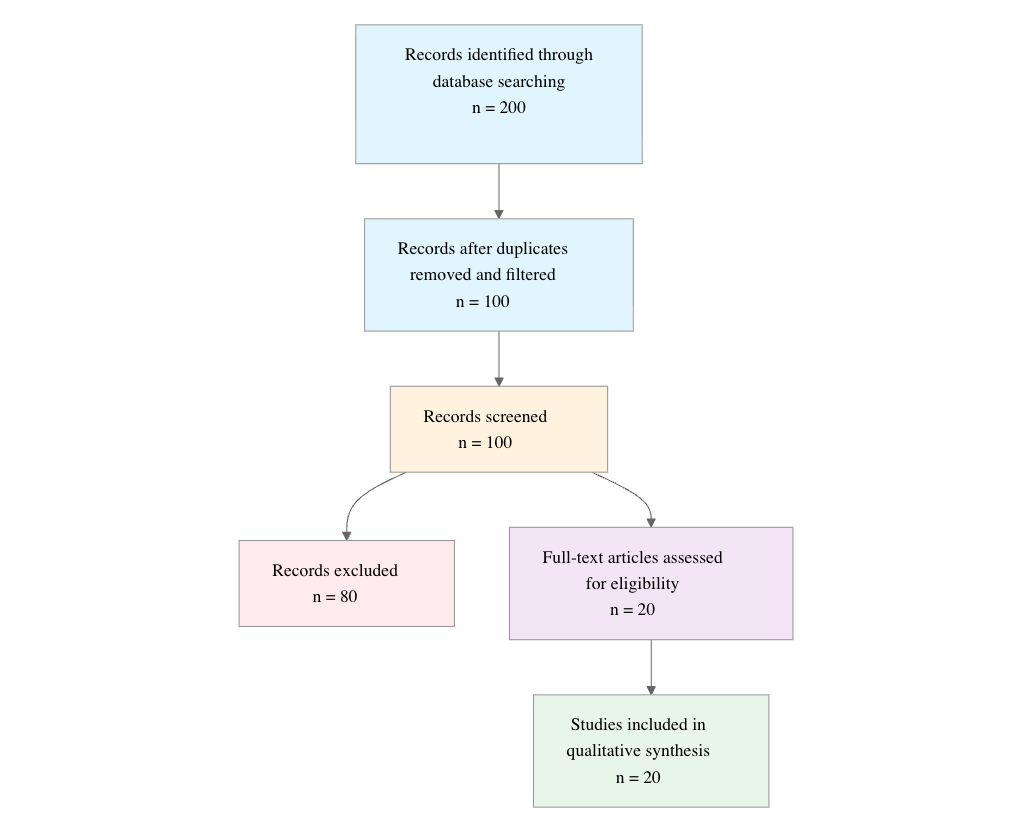
Initial database searching identified 200 records. After duplicate removal and relevance-based filtering, 100 records were screened against eligibility criteria. Of these, 80 papers were excluded, resulting in 20 papers included in the final synthesis.
PRISMA Flow Diagram
Eligibility criteria included:
- Grid Storage: Does the study investigate electrical grid energy storage technologies or systems for power-system use?
- Recent Year: Was the study published in 2020 or later?
- Human / Grid Context: Does the study address utility-scale, grid-connected, or power-system applications rather than only portable or consumer devices?
- Storage Technology: Does the paper evaluate a specific storage technology, hybrid storage system, or grid storage architecture?
- Performance Data: Does the study report technical, operational, or economic performance results relevant to grid storage?
- Renewable Integration: Does the study discuss renewable integration, flexibility, balancing, or ancillary services in the power grid?
- Long Duration: Does the study focus on storage durations of 4 hours or more, or explicitly long-duration energy storage?
- Deployment Relevance: Does the study include pilot, demonstration, commercialization, market, or policy implications for deployment?
All included studies met the stated eligibility criteria.
2.3 Data Extraction and Synthesis
Data extraction focused on the following variables:
- Storage Type
- Grid Use Case
- Key Contribution
- Performance Findings
- Scalability / Deployment
- Cost / Economics
- Constraints / Challenges
- Study Type
Thematic analysis was employed to identify patterns and synthesize findings across studies. Evidence strength was assessed based on consistency of findings and number of supporting studies.
3. Results
3.1 Characteristics of Included Studies
| Study and Year | Study Type | Storage Type | Primary Grid Use Case | Key Focus |
|---|---|---|---|---|
| Zhao et al. (2023) | Review | Lithium-ion BESS | Frequency regulation, voltage support, energy arbitrage | BESS applications, duty profiles, integration |
| Zhu et al. (2022) | Review | Multiple battery chemistries | Grid-scale renewable integration | Technology requirements and academia-to-industry translation |
| Hunter et al. (2021) | Techno-economic analysis | Hydrogen, natural gas with carbon capture, adiabatic compressed air, pumped thermal | Long-duration storage for high-VRE grids | Least-cost pathways under uncertainty |
| Sepulveda et al. (2021) | Techno-economic analysis | Long-duration storage technologies | Decarbonized power systems | Cost and efficiency thresholds for system impact |
| Olabi et al. (2021) | Review | Multiple storage systems | Renewable integration, frequency regulation | Broad comparative assessment |
| Kebede et al. (2022) | Review | Lithium-ion, capacitors, supercapacitors, SMES, thermal storage | Grid support, seasonal and bulk storage | Suitability mapping by application |
| Tan et al. (2021) | Review | Battery, thermal, pumped, compressed air, hydrogen, magnetic | Renewable integration, reliability | Comparative framework for smart-grid use |
| Elalfy et al. (2024) | Review | Electrical, electrochemical, mechanical, thermal, chemical | Renewable integration, system stability | Comparative tables and selection criteria |
| Jafari et al. (2022) | Systems-level review | Short-, mid-, and long-duration storage | Decarbonization pathways | Storage duration roles in system planning |
| Blakers et al. (2021) | Review | Pumped hydro | Large-scale renewable integration | Cost, environmental impacts, future opportunities |
| Khalid (2024) | Review | Not specified | Smart-grid renewable integration | Grid integration challenges and interoperability |
| Farivar et al. (2023) | Review | Mechanical, electrical, electrochemical, chemical, thermal | Frequency regulation, peak shaving, capacity firming | Grid-connected ESS and power electronics |
| Khan et al. (2024) | Review | Mechanical, electrical, chemical, thermal | Ancillary services, reliability | Recent advancements and gaps |
| Worku (2022) | Review | Lithium-ion, flywheel, CAES, pumped hydro, SMES, supercapacitors | Renewable integration, frequency regulation | Grid integration and converter aspects |
| Sayed et al. (2023) | Review | Not detailed | Renewable integration, hybrid energy management | Renewables and storage coordination |
| Huang and Li (2022) | Review | Lithium-ion batteries | Decarbonization with wind/solar | Safety and recycling barriers |
| Deguenon et al. (2023) | Review | Lithium-ion and flow batteries | Variable renewable energy integration | Incentives and weak-grid deployment |
| Bazdar et al. (2022) | Review | Compressed air energy storage | Renewable integration, integrated energy systems | CAES design and integration |
| Shan et al. (2022) | Review | Emerging LDES technologies | Renewable integration, project deployment | Modularity, footprint, cost-duration tradeoffs |
| Zhang et al. (2024) | Review | Advanced compressed air energy storage | Renewable integration, supply-demand balancing | Technical maturity and cost/performance comparison |
Overall, the evidence base is dominated by review articles and a smaller number of techno-economic analyses. The literature is broad in technology coverage but concentrated in application framing around renewable integration, decarbonization, and long-duration balancing. Quantitative reporting is strongest in LDES modeling studies and weakest in general technology reviews, which often summarize comparative attributes without full numerical estimates. Across the corpus, batteries are most closely tied to fast grid services, while pumped hydro, compressed air, hydrogen, and pumped thermal systems are positioned for longer-duration and seasonal roles.
3.2 Thematic Findings
3.2.1 Storage Duration Is the Primary Determinant of Grid Role and System Value
Recent studies converge on the view that storage duration, more than device class alone, determines the grid function a technology can credibly serve. Short-duration storage is repeatedly linked to frequency regulation, peak shaving, and solar balancing, whereas mid-duration systems support wind integration and curtailment reduction, and long-duration systems shift energy across days to seasons (Jafari et al., 2022). A particularly strong system-level result is that LDES technologies only become materially transformative when energy-capacity cost is very low and duration is very long: energy-capacity cost must be ≤US$20 kWh⁻¹ to reduce electricity costs by ≥10%, and ≤US$1 kWh⁻¹ to fully displace modeled firm low-carbon generation, with storage durations exceeding 100 h (Sepulveda et al., 2021). This threshold logic is consistent with broader techno-economic analyses showing that long-duration balancing is the relevant niche for hydrogen, compressed air, and pumped thermal systems (Hunter et al., 2021; Shan et al., 2022). Confidence: Strong, because the pattern is consistent across planning and techno-economic studies and directly links duration to system value.
3.2.2 Lithium-Ion Batteries Dominate Short-Duration Grid Services, but Safety and Recycling Constrain Scaling
The battery literature presents a coherent picture: lithium-ion BESS are the leading technology for short-duration grid services, especially frequency regulation, voltage support, energy arbitrage, and renewable smoothing (Zhao et al., 2023; Farivar et al., 2023; Worku, 2022). In system terms, batteries are positioned as fast, flexible, and commercially mature enough to meet sub-day grid needs, while also supporting renewable integration and partial peaker replacement (Jafari et al., 2022). However, the scaling debate has shifted away from capital cost alone. For hundred-terawatt-hour deployment, fire safety and recycling are identified as the key constraints rather than cycle life, mining, or manufacturing capacity (Huang & Li, 2022). This aligns with broader review evidence that integration barriers and low data transparency limit operational understanding (Zhao et al., 2023) and that battery systems require power electronic interfaces, grid-code compliance, and recycling pathways (Farivar et al., 2023). Confidence: Strong for the role of lithium-ion in short-duration services; Moderate for the specific claim that safety and recycling are the principal scale bottlenecks, because that conclusion is strongly stated in one focused review but less directly quantified elsewhere.
3.2.3 Pumped Hydro Remains the Benchmark for Bulk Storage, While Compressed Air and Hydrogen Fill the Long-Duration Frontier
Mechanical and chemical storage studies consistently portray pumped hydro energy storage as the dominant bulk-storage benchmark. Pumped hydro accounts for about 96% of global storage power capacity and 99% of global storage energy volume, and it remains much cheaper than batteries for large-scale storage over several hours to weeks (Blakers et al., 2021). Comparative reviews similarly identify pumped hydro and compressed air as suitable for enormous-scale power and highly energetic storage applications, especially bulk energy and transmission services (Kebede et al., 2022), while CAES is highlighted for scalability, long discharge time, low self-discharge, and relatively low capital cost per unit of stored energy (Bazdar et al., 2022). Yet CAES also carries recurring drawbacks of low roundtrip efficiency, low depth of discharge, and high response time (Tan et al., 2021), and the newest CAES review extends this by emphasizing technical maturity, operation pressure, efficiency, and investment cost as central comparison axes (Zhang et al., 2024). Hydrogen-based systems emerge mainly in LDES techno-economic studies as least-cost candidates under certain assumptions, including geologic storage (Hunter et al., 2021). Confidence: Strong for pumped hydro's bulk-storage dominance; Moderate for CAES and hydrogen as long-duration solutions, because their attractiveness depends heavily on cost scenario, configuration, and application context.
3.2.4 Hybrid and Multi-Technology Architectures Are Increasingly Framed as the Practical Pathway to Grid Flexibility
A recurring theme across reviews is that no single storage technology satisfies all grid requirements. Hybrid solutions combining multiple storage devices are presented as viable because they can match complementary strengths across power, energy, duration, and response needs (Kebede et al., 2022; Elalfy et al., 2024). This logic appears both in generalized reviews of storage categories and in smart-grid syntheses emphasizing coordination between storage, renewable generation, and control systems (Tan et al., 2021; Sayed et al., 2023). The evidence suggests that hybrids are not merely an engineering convenience but a response to a structural mismatch: high-power devices such as capacitors or supercapacitors are best suited to short bursts, while thermal, pumped hydro, CAES, and hydrogen address bulk and long-duration shifts (Kebede et al., 2022; Olabi et al., 2021). However, the literature provides limited direct deployment data, so the claim remains more conceptual than operational. Confidence: Moderate, because the rationale is highly consistent but empirical deployment evidence is sparse.
3.2.5 Technical Viability Is Increasingly Defined by Deployment Constraints: Geography, Land, Policy, and Grid-Code Compatibility
Across storage families, deployment constraints are becoming as important as intrinsic device performance. Pumped hydro is geographically constrained despite its cost advantage (Kebede et al., 2022), and future closed-loop off-river systems are framed as a way to expand siting options while reducing environmental interference (Blakers et al., 2021). For emerging long-duration technologies, land footprint and equivalent efficiency adjusted for idle losses are used as decision metrics, reinforcing that project feasibility depends on more than roundtrip efficiency alone (Shan et al., 2022). Policy and system context also matter: storage roles are shaped by local decarbonization policy, geography, and end-use electrification patterns, and simplistic planning models can distort the apparent value of technologies (Jafari et al., 2022). Smart-grid reviews further emphasize interoperability, standardization, and contingency protocols as practical barriers to scaling (Khalid, 2024; Khan et al., 2024). Confidence: Strong for the importance of context; Limited for any single deployment pathway, because evidence is mostly qualitative and review-based.
3.3 Summary of Evidence
| Theme | Key Finding | Population Applicability | Effect Direction | Confidence Level | Supporting Studies |
|---|---|---|---|---|---|
| Duration determines value | Energy-capacity cost must be ≤US$20 kWh⁻¹ to reduce electricity costs by ≥10%, and ≤US$1 kWh⁻¹ to fully displace firm low-carbon generation; storage durations >100 h are needed | Decarbonized power-system planning; direct match to grid storage question | Positive for long-duration storage, conditional on cost/duration | Strong | Sepulveda et al. (2021); Hunter et al. (2021) |
| Lithium-ion for short-duration services | Lithium-ion BESS are central for frequency regulation, voltage support, energy arbitrage, and renewable smoothing | Grid-connected utility-scale batteries; direct match | Positive | Strong | Zhao et al. (2023); Farivar et al. (2023); Worku (2022) |
| Safety and recycling limit battery scaling | Fire safety and recycling are identified as the key barriers to hundred-terawatt-hour lithium-ion deployment | Grid-scale lithium-ion deployment; direct match | Negative for unconstrained scaling | Moderate | Huang & Li (2022); Farivar et al. (2023) |
| Pumped hydro anchors bulk storage | Pumped hydro accounts for about 96% of global storage power capacity and 99% of global storage energy volume; it remains much cheaper than batteries for large-scale storage | Large-scale grid storage; direct match | Positive for bulk storage | Strong | Blakers et al. (2021); Elalfy et al. (2024) |
| CAES and hydrogen serve long-duration needs | CAES offers scalability and low self-discharge but suffers from low roundtrip efficiency and high response time | Long-duration grid storage; direct match | Mixed | Moderate | Bazdar et al. (2022); Zhang et al. (2024); Hunter et al. (2021) |
| Hybrid storage is a practical system strategy | Hybrid solutions are repeatedly described as viable for matching complementary storage roles | Grid-system planning and integration; direct match | Positive | Moderate | Kebede et al. (2022); Elalfy et al. (2024); Tan et al. (2021) |
| Deployment depends on context | Geography, land footprint, policy, and grid-code interoperability shape feasibility | Grid deployment contexts; direct match | Mixed | Strong | Jafari et al. (2022); Shan et al. (2022); Khalid (2024) |
4. Discussion
4.1 Principal Findings and Their Interpretation
The strongest pattern across the recent literature is that grid storage cannot be evaluated as a generic technology class; it must be matched to duration, service type, and system context. This explains why lithium-ion batteries remain the default option for fast ancillary services, while pumped hydro, CAES, hydrogen, and pumped thermal systems are repeatedly framed as long-duration or bulk-storage solutions (Zhao et al., 2023; Blakers et al., 2021; Hunter et al., 2021). The practical logic is straightforward: grid services that depend on rapid response and high cycling frequency favor electrochemical systems, whereas multi-day balancing requires energy-capacity costs and siting characteristics that favor mechanical or chemical pathways. The evidence is especially persuasive because it converges from both broad reviews and techno-economic studies rather than from one methodological tradition alone.
The LDES studies sharpen this conclusion by showing that system-level value depends on stringent thresholds. The requirement for ≤US$20 kWh⁻¹ to reduce electricity costs by at least 10% and ≤US$1 kWh⁻¹ to fully displace firm low-carbon generation suggests that many emerging technologies remain promising in principle but not yet transformative in practice (Sepulveda et al., 2021). That finding matters because it redefines innovation priorities: the field is not only seeking higher efficiency, but also radically lower storage energy cost and feasible durations above 100 h. In parallel, pumped hydro's extraordinary share of global storage capacity indicates that scale remains inseparable from geological and environmental fit (Blakers et al., 2021). The evidence base therefore supports high confidence in the short-duration battery paradigm and in the bulk-storage dominance of pumped hydro, while confidence is lower for CAES and hydrogen because their competitiveness is more sensitive to assumptions about system configuration, location, and cost trajectories.
4.2 Comparison with Existing Literature and Resolution of Contradictions
The reviewed studies generally agree that storage value is context dependent, but they differ in how strongly they emphasize cost, efficiency, or deployment constraints. This is not a true contradiction so much as a difference in analytical level. Broad reviews tend to classify technologies by application and qualitative suitability, whereas techno-economic analyses expose hard thresholds that determine whether a technology is actually system-changing (Sepulveda et al., 2021; Hunter et al., 2021). That methodological progression strengthens confidence in the recent literature because it moves the field from descriptive taxonomy toward operational decision criteria.
Where tensions do appear, they are mainly between optimism about emerging LDES technologies and the harder evidence on their limitations. CAES, for example, is attractive because of scalability, long discharge time, and low self-discharge, yet it is simultaneously constrained by low roundtrip efficiency and response time (Bazdar et al., 2022). Rather than treating this as inconsistency, the literature suggests a technology-space tradeoff: CAES may be advantageous where duration and land feasibility matter more than rapid response, but less suitable where cycle efficiency is paramount. A similar pattern appears for lithium-ion batteries, where some reviews frame them as the preferred grid option while others caution that fire safety and recycling may become decisive at very large scale (Huang & Li, 2022). This is likely because near-term operational success and long-term sector-wide deployment are different questions. The former highlights current performance, while the latter exposes lifecycle risk and material governance.
Publication bias is plausible in this literature because many studies evaluate technologies under intended-use scenarios, which can overweight favorable configurations. However, the inclusion of system-level planning studies, negative constraints, and deployment barriers reduces the likelihood that the overall synthesis is artificially positive. Recent work also improves reliability by incorporating land footprint, idle losses, and grid-code issues rather than relying on roundtrip efficiency alone (Shan et al., 2022; Farivar et al., 2023). That methodological evolution is important because it shows the field is increasingly aware that simplistic performance metrics can overstate deployability.
4.3 Practical Implications
For grid planners, the immediate implication is that storage procurement should be service-led rather than technology-led. Lithium-ion batteries are the most defensible option where the goal is frequency regulation, voltage support, peak shaving, or sub-day renewable smoothing (Zhao et al., 2023; Farivar et al., 2023). Pumped hydro remains the most credible option for bulk and long-horizon storage when siting is feasible, while CAES and hydrogen-based systems are better viewed as conditional solutions for long-duration balancing rather than universal replacements (Blakers et al., 2021; Bazdar et al., 2022; Hunter et al., 2021).
For policymakers, the evidence argues against one-size-fits-all storage mandates. The most important constraint is not merely installed capacity but matching technology to duration, geography, and system need. Closed-loop pumped hydro and improved siting frameworks may expand bulk-storage deployment, whereas safety regulation and recycling infrastructure are critical for lithium-ion scaling (Blakers et al., 2021; Huang & Li, 2022). Because the literature suggests that long-duration storage only materially reduces system costs under very low energy-capacity costs, policy support for early-stage LDES should focus on demonstration, market design, and risk reduction rather than assuming near-term parity with batteries (Sepulveda et al., 2021).
For system operators, the practical lesson is that hybrid architectures and improved planning models are likely to outperform simplistic single-technology assumptions (Kebede et al., 2022; Jafari et al., 2022). This is particularly important in weakly interconnected or highly renewable grids, where flexible combinations of storage, generation, and control are more realistic than relying on one storage class alone (Deguenon et al., 2023; Sayed et al., 2023). The evidence does not justify universal prescriptions, but it does support system-wide planning that reduces exposure to renewable variability through diversified storage portfolios.
4.4 Strengths and Limitations
A major strength of this review is the breadth of technology coverage across batteries, pumped hydro, compressed air, hydrogen, thermal storage, and hybrid configurations, allowing the synthesis to compare grid functions rather than isolated devices. Another strength is the inclusion of both qualitative reviews and techno-economic analyses, which makes it possible to distinguish established roles from threshold-based system value. The literature itself also provides useful comparative dimensions, including duration, cost, footprint, efficiency, and integration constraints.
The main limitation of the included studies is that most are reviews, not primary deployment evaluations. As a result, many claims remain conceptual or model-based, and direct evidence on real-world performance, commercialization, and operational degradation is limited. Reporting is also uneven: some studies provide exact cost or duration thresholds, whereas others offer only qualitative assessments. For this review, the main limitation is that synthesis relies on extracted abstract-level and table-level data rather than full-text extraction, and no formal risk-of-bias assessment was conducted. That means confidence is strongest for broad directional conclusions and weaker for claims that depend on detailed operational nuance.
5. Gaps and Future Directions
The most important gap is the lack of harmonized, application-specific evidence linking storage technology characteristics to concrete grid services under comparable assumptions. The literature repeatedly distinguishes short-, mid-, and long-duration storage, but few studies directly compare technologies using the same load profiles, policy settings, or reliability criteria (Jafari et al., 2022; Shan et al., 2022). Future work should therefore evaluate technologies in matched scenarios rather than in isolated benchmarks. There is also a shortage of deployment evidence for emerging LDES options such as advanced CAES, pumped thermal, and hydrogen systems; many studies remain at the review or modeling stage, with limited pilot-scale validation (Bazdar et al., 2022; Zhang et al., 2024; Hunter et al., 2021).
Methodologically, future studies should incorporate land footprint, idle losses, recycling burden, safety risk, and grid-code compliance alongside LCOS and roundtrip efficiency, because recent reviews show these factors materially influence feasibility (Shan et al., 2022; Huang & Li, 2022; Farivar et al., 2023). Underrepresented contexts include weakly interconnected grids, northern-latitude decarbonization systems, and regions where geography constrains pumped hydro siting (Deguenon et al., 2023; Jafari et al., 2022; Blakers et al., 2021). Direct comparative studies in these settings would substantially improve the relevance of the evidence base for real-world grid planning.
6. Conclusion
The recent literature indicates that grid storage energy is moving toward a clear functional stratification: lithium-ion batteries are best supported for short-duration services, pumped hydro remains the dominant bulk-storage technology, and compressed air, hydrogen, and other long-duration systems are promising but remain constrained by cost thresholds, efficiency tradeoffs, and deployment conditions (Zhao et al., 2023; Blakers et al., 2021; Bazdar et al., 2022; Hunter et al., 2021). The most defensible conclusion is therefore not that one storage technology will "win," but that the best technology depends on the grid service required and the system context in which it is deployed.
The quantitative evidence is clearest for long-duration storage: energy-capacity costs must fall to ≤US$20 kWh⁻¹ to reduce electricity costs by ≥10%, and to ≤US$1 kWh⁻¹ to fully displace modeled firm low-carbon generation, with storage durations exceeding 100 h (Sepulveda et al., 2021). At the same time, pumped hydro's scale dominance and lower cost relative to batteries for multi-hour to multi-week storage underscore why it remains the benchmark for bulk storage (Blakers et al., 2021). For batteries, the central insight is that scaling challenges are shifting from performance alone toward fire safety and recycling (Huang & Li, 2022).
What remains most uncertain is which emerging long-duration technologies can meet these cost, durability, and deployment requirements in real grid environments rather than in modeling exercises. Resolving that question is essential because storage is now a core infrastructure issue for renewable-heavy power systems, not a peripheral technology choice.
References
- Bazdar, E., Sameti, M., Nasiri, F., & Haghighat, F. (2022). Compressed air energy storage in integrated energy systems: A review. Renewable and Sustainable Energy Reviews, 167, 112701. https://doi.org/10.1016/j.rser.2022.112701
- Blakers, A., Stocks, M., Lu, B., & Cheng, C. (2021). A review of pumped hydro energy storage. Progress in Energy, 3(2), 022003. https://doi.org/10.1088/2516-1083/abeb5b
- Deguenon, L., Yamegueu, D., Moussa Kadri, S., & Gomna, A. (2023). Overcoming the challenges of integrating variable renewable energy to the grid: A comprehensive review of electrochemical battery storage systems. Journal of Power Sources, 580, 233343. https://doi.org/10.1016/j.jpowsour.2023.233343
- Elalfy, D. A., Gouda, E., Kotb, M. F., Bureš, V., & Sedhom, B. E. (2024). Comprehensive review of energy storage systems technologies, objectives, challenges, and future trends. Energy Strategy Reviews, 54, 101482. https://doi.org/10.1016/j.esr.2024.101482
- Farivar, G. G., Manalastas, W., Tafti, H. D., Ceballos, S., Sanchez-Ruiz, A., Lovell, E. C., Konstantinou, G., Townsend, C. D., Srinivasan, M., & Pou, J. (2023). Grid-connected energy storage systems: State-of-the-art and emerging technologies. Proceedings of the IEEE, 111(4), 397–420. https://doi.org/10.1109/JPROC.2022.3183289
- Huang, Y., & Li, J. (2022). Key challenges for grid-scale lithium-ion battery energy storage. Advanced Energy Materials, 12(48), 2202197. https://doi.org/10.1002/aenm.202202197
- Hunter, C. A., Penev, M. M., Reznicek, E. P., Eichman, J., Rustagi, N., & Baldwin, S. F. (2021). Techno-economic analysis of long-duration energy storage and flexible power generation technologies to support high-variable renewable energy grids. Joule, 5(8), 2077–2101. https://doi.org/10.1016/j.joule.2021.06.018
- Jafari, M., Botterud, A., & Sakti, A. (2022). Decarbonizing power systems: A critical review of the role of energy storage. Renewable and Sustainable Energy Reviews, 158, 112077. https://doi.org/10.1016/j.rser.2022.112077
- Kebede, A. A., Kalogiannis, T., Van Mierlo, J., & Berecibar, M. (2022). A comprehensive review of stationary energy storage devices for large scale renewable energy sources grid integration. Renewable and Sustainable Energy Reviews, 159, 112213. https://doi.org/10.1016/j.rser.2022.112213
- Khalid, M. (2024). Smart grids and renewable energy systems: Perspectives and grid integration challenges. Energy Strategy Reviews, 51, 101299. https://doi.org/10.1016/j.esr.2024.101299
- Khan, M. K., Raza, M., Shahbaz, M., Farooq, U., & Akram, M. U. (2024). Recent advancement in energy storage technologies and their applications. Journal of Energy Storage, 92, 112112. https://doi.org/10.1016/j.est.2024.112112
- Olabi, A. G., Onumaegbu, C., Wilberforce, T., Ramadan, M., Abdelkareem, M. A., & Al-Alami, A. H. (2021). Critical review of energy storage systems. Energy, 214, 118987. https://doi.org/10.1016/j.energy.2020.118987
- Sayed, E. T., Olabi, A. G., Alami, A. H., Radwan, A., Mdallal, A., Rezk, A., & Abdelkareem, M. A. (2023). Renewable energy and energy storage systems. Energies, 16(3), 1415. https://doi.org/10.3390/en16031415
- Sepulveda, N. A., Jenkins, J. D., Edington, A., Mallapragada, D. S., & Lester, R. K. (2021). The design space for long-duration energy storage in decarbonized power systems. Nature Energy, 6(5), 506–516. https://doi.org/10.1038/s41560-021-00796-8
- Shan, R., Reagan, J., Castellanos, S., Kurtz, S., & Kittner, N. (2022). Evaluating emerging long-duration energy storage technologies. Renewable and Sustainable Energy Reviews, 159, 112240. https://doi.org/10.1016/j.rser.2022.112240
- Tan, K. M., Babu, T. S., Ramachandaramurthy, V. K., Kasinathan, P., Solanki, S. G., & Raveendran, S. K. (2021). Empowering smart grid: A comprehensive review of energy storage technology and application with renewable energy integration. Journal of Energy Storage, 39, 102591. https://doi.org/10.1016/j.est.2021.102591
- Worku, M. Y. (2022). Recent advances in energy storage systems for renewable source grid integration: A comprehensive review. Sustainability, 14(10), 5985. https://doi.org/10.3390/su14105985
- Zhang, X., Gao, Z., Zhou, B., Guo, H., Xu, Y., Ding, Y., & Chen, H. (2024). Advanced compressed air energy storage systems: Fundamentals and applications. Engineering, 34, 246–269. https://doi.org/10.1016/j.eng.2023.12.008
- Zhao, C., Andersen, P. B., Træholt, C., & Hashemi, S. (2023). Grid-connected battery energy storage system: A review on application and integration. Renewable and Sustainable Energy Reviews, 182, 113400. https://doi.org/10.1016/j.rser.2023.113400
- Zhu, Z., Jiang, T., Ali, M., Meng, Y., Jin, Y., Cui, Y., & Chen, W. (2022). Rechargeable batteries for grid scale energy storage. Chemical Reviews, 122(22), 16610–16751. https://doi.org/10.1021/acs.chemrev.2c00289