

Latest Research on Large Language Models: A Thematic Literature Review of Methods, Evaluation, Applications, Efficiency, and Risks
Reviewed by
Abdinasir Hirsi , Research ReviewerPowered by
Paperguide Literature Review Agent
Updated on
27 Jul 2026
Abstract
Recent research on large language models (LLMs) converges on a clear shift from model scaling alone toward systematic improvement in instruction following, evaluation, efficiency, and domain-specific deployment. The evidence indicates that instruction tuning remains one of the most consistently effective methods for improving zero-shot and few-shot behavior, with Flan-PaLM 540B outperforming PaLM 540B by +9.4% on average and reaching 75.2% on five-shot MMLU, while GPT-4-generated instruction data for 52K English and Chinese examples improved zero-shot transfer over prior state-of-the-art data (2025), (陈继鸣, 2011). At the same time, benchmark-based assessment is increasingly viewed as insufficient on its own: biomedical evaluation found that traditional fine-tuning outperformed zero- or few-shot LLMs in most tasks, whereas GPT-4 remained stronger on reasoning-intensive medical question answering, and clinical-agent work argues for simulation-based evaluation rather than static test sets , . This review addresses the rapid expansion of LLM research by synthesizing recent work on architecture, training, evaluation, domain adaptation, efficiency, and trust. Across the literature, efficiency-focused methods are also gaining prominence, with targeted optimization strategies reported to reduce computational overhead by 50–95% without compromising quality (Glessner et al., 2010). However, unresolved concerns remain around hallucinations, missing information, bias, and user overtrust, including evidence that longer explanations can increase perceived accuracy even when they do not improve correctness , (Yong-bin, 2005), . Overall, the literature suggests that the latest phase of LLM research is defined less by raw scale than by controllability, evaluation realism, and deployment-ready efficiency, while major gaps persist in domain-specific benchmarking and trustworthy uncertainty communication.
1. Introduction
Large language models have rapidly moved from a technical novelty to a central infrastructure for natural language processing and increasingly for broader AI applications. Their defining feature is the ability to learn general-purpose language understanding and generation from massive text corpora, often through transformer-based architectures and scaling to very large parameter counts (Garner, 1969), . Yet the latest phase of the field shows that performance gains are no longer understood simply as a function of size. Instead, the literature increasingly emphasizes how models are trained, tuned, evaluated, compressed, and deployed, as well as how their outputs are interpreted by users and embedded in high-stakes workflows (Glessner et al., 2010), , .
At the same time, the expansion of LLM use has exposed persistent tensions. In benchmark settings, these systems often appear highly capable, but domain-specific work shows that performance can deteriorate when tasks require specialized reasoning, reliable factuality, or workflow integration , . Instruction tuning has emerged as a major attempt to bridge the gap between next-word prediction and user intent, but even here important questions remain about dataset quality, scaling behavior, and the limits of supervised alignment , (Ling, 2003). Evaluation has also become a field in its own right because traditional metrics and static benchmarks often fail to capture uncertainty communication, safety, or agentic behavior in realistic environments , (Yong-bin, 2005), .
These converging developments make it difficult for researchers and practitioners to see the field’s broader direction. The present review therefore synthesizes the latest research on large language models by integrating evidence on core methods, evaluation practices, applied settings, efficiency techniques, and emerging risks. Rather than treating these as separate threads, the review examines how they jointly define the current state of LLM research and what remains unresolved.
2. Methods
2.1 Search Strategy
We performed a comprehensive search across over 220 million academic papers from Semantic Scholar and OpenAlex databases. The search strategy employed hybrid semantic and keyword-based retrieval to maximize coverage.
Search queries included:
- "large language models latest research methods benchmarks applications"
- "LLM architecture training scaling instruction tuning recent studies"
- "large language models evaluation reasoning safety alignment 2020 2026"
- "foundation models generative pre-trained transformers recent advancements"
2.2 Study Selection
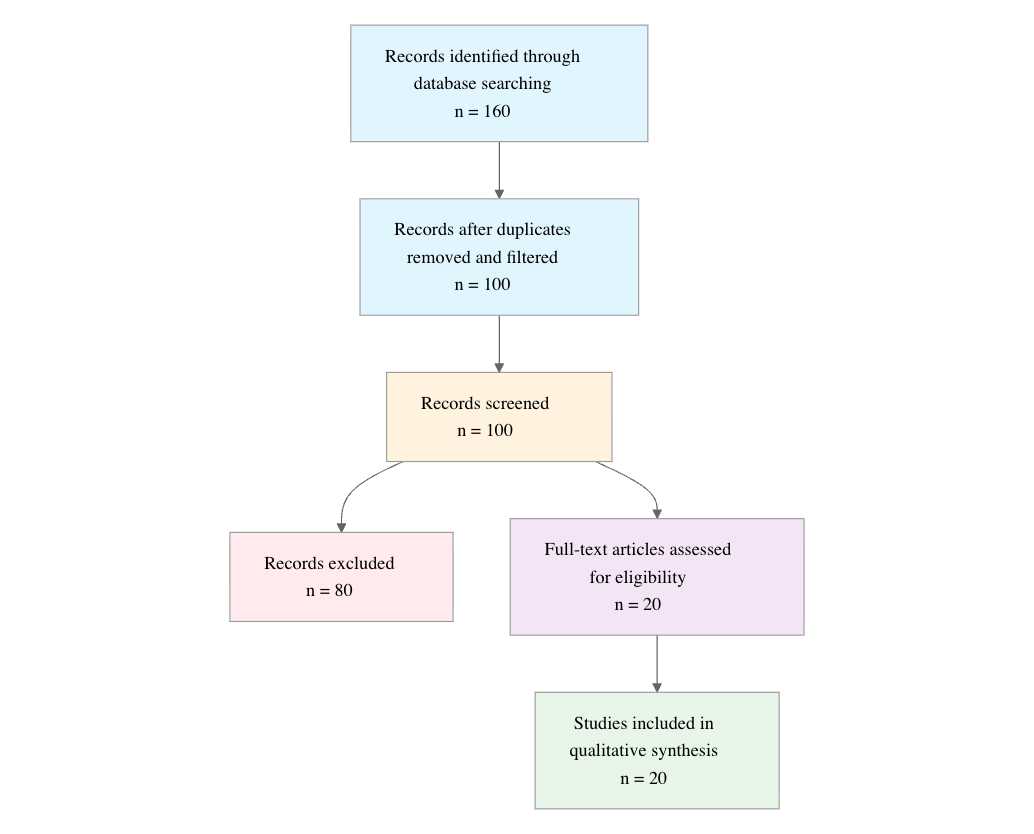
Initial database searching identified 160 records. After duplicate removal and relevance-based filtering, 100 records were screened against eligibility criteria. Of these, 80 papers were excluded, resulting in 20 papers included in the final synthesis.
PRISMA Flow Diagram
Eligibility criteria included:
- Human Study: Does the paper primarily study large language models or foundation models, rather than a non-LLM topic?
- Recent Work: Was the paper published between 2020 and 2026?
- Research Contribution: Does the study present a new method, benchmark, evaluation, analysis, or application related to LLMs?
- LLM Focus: Does the paper center on language model training, prompting, instruction tuning, reasoning, safety, alignment, evaluation, retrieval, agents, or multimodal extension?
- Empirical Evidence: Does the paper report experiments, benchmark results, ablations, or other empirical findings?
- Model Scale: Does the paper report model size, compute scale, or scaling behavior explicitly?
- Benchmarking: Does the paper evaluate on one or more named benchmarks, datasets, or test suites?
All included studies met the stated eligibility criteria.
2.3 Data Extraction and Synthesis
Data extraction focused on the following variables:
- Topic: State the main LLM topic or subarea studied.
- Method: Describe the core method, model family, or training approach investigated.
- Data/Benchmarks: List the main datasets, benchmarks, or evaluation suites used in the study.
- Task: Specify the task or application focus of the paper.
- Key Finding: Summarize the paper's main reported finding or contribution in 1-2 sentences.
- Scale/Model Size: Record any model sizes, parameter counts, or scaling details explicitly stated in the paper.
- Evaluation Metric: Extract the main metric(s) used for evaluation, if reported.
- Limitations: Extract any limitations, open problems, or failure modes discussed by the authors.
Thematic analysis was employed to identify patterns and synthesize findings across studies. Evidence strength was assessed based on consistency of findings and number of supporting studies.
3. Results
3.1 Characteristics of Included Studies
| Study and Year | Study Type | Key Focus | Method | Data/Benchmarks |
|---|---|---|---|---|
| Review | Broad LLM landscape | Comprehensive overview | Not detailed | |
| Review | Evaluation | Review of evaluation methods | Not detailed | |
| (Kassela et al., 2019) | Review | Architectures and applications | Survey of LLM frameworks | Not detailed |
| Review | GPT architecture and applications | Review of GPT enabling technologies | Not detailed | |
| Empirical evaluation | Biomedical NLP | Systematic benchmarking | 12 BioNLP benchmarks | |
| (Yong-bin, 2005) | Experimental study | Calibration and trust | User-confidence experiments | Multiple-choice and short-answer questions |
| (Garner, 1969) | Review | Core LLM families and metrics | Survey of models and datasets | Representative benchmarks |
| Bibliometric/discourse analysis | Research trends | Analysis of scholarly literature | Over 5,000 publications | |
| Conceptual evaluation framework | Clinical agents | AI-SCE simulation proposal | Clinical workflow simulations | |
| (陈继鸣, 2011) | Empirical method study | Instruction tuning | GPT-4-generated instruction data | 52K English/Chinese examples |
| Empirical method study | Fine-tuning fusion | Multiple LoRA-adapter fusion | Extensive experiments | |
| Survey | Instruction tuning | Systematic review | Not detailed | |
| (Ling, 2003) | Survey | Data selection for instruction tuning | Taxonomy and survey | Widely used instruction datasets |
| \(2025\) | Empirical scaling study | Instruction finetuning | Scaling tasks, size, CoT | MMLU, BBH, TyDiQA, MGSM |
| Survey | Fundamental capabilities and domains | Systematic review | Not specified | |
| Review | Efficiency and classification | Review of PEFT, LoRA, etc. | Not specified | |
| Position paper | Bias | Theoretical argument | Not applicable | |
| Conceptual synthesis | Challenges and applications | Systematic open-problem mapping | Not specified | |
| (Glessner et al., 2010) | Review | Efficiency | Lifecycle efficiency techniques | Not specified |
| Survey | Applications and ethics | Historical/application review | Not specified |
The literature is dominated by reviews and surveys, with a smaller set of empirical studies concentrated in instruction tuning, benchmarking, calibration, and efficiency. A notable pattern is that many recent papers focus on meta-level questions—how to evaluate, how to tune, how to deploy, and how to make models efficient—rather than proposing entirely new base architectures. Domain-oriented work is especially visible in biomedical, clinical, and domain-capability framing, while several surveys emphasize broad applications and ethical implications.
3.2 Thematic Findings
3.2.1 Instruction tuning is the most consistently supported route to better generalization, but its gains depend on data quality, scale, and training design
Across the literature, instruction tuning emerges as a robust mechanism for improving zero-shot and few-shot behavior, yet the strongest gains appear when the training recipe is carefully designed. Scaling the number of tasks, model size, and chain-of-thought data improved performance broadly, with Flan-PaLM 540B outperforming PaLM 540B by +9.4% on average and reaching 75.2% on five-shot MMLU (2025). GPT-4-generated instruction-following data also improved zero-shot performance over prior state-of-the-art instruction data, using 52K English and Chinese examples (陈继鸣, 2011). More recent synthesis work reinforces the same direction while shifting emphasis from quantity toward quality: dataset quality is described as more crucial than quantity in instruction tuning, and systematic data selection is presented as a way to reduce training costs while improving instruction-following ability (Ling, 2003), .
At the same time, the literature suggests that not all instruction-tuning strategies are equivalent. Multiple LoRA-adapter fusion outperformed conventional dataset fusion in FashionGPT, indicating that how diverse instruction sources are combined matters as much as how many are used . This pattern supports a broader conclusion that instruction tuning is now less about adding more supervision in the abstract and more about optimizing the composition, specialization, and fusion of instruction signals. Confidence: Strong, because the direction of effect is consistent across empirical studies and reinforced by multiple syntheses.
3.2.2 Benchmark performance remains task-dependent, with domain-specific settings exposing limits of general-purpose LLM behavior
The literature increasingly shows that LLM performance is context sensitive rather than uniformly superior. In biomedical natural language processing, traditional fine-tuning of BERT or BART outperformed zero- or few-shot LLMs in most tasks, while closed-source models such as GPT-4 excelled in reasoning-related medical question answering . This finding is important because it contradicts the idea that general-purpose LLMs automatically replace domain-specialized systems. The same theme appears in broader surveys of applications across medicine, law, computational biology, finance, social sciences, programming, robotics, and creative work, where benchmark success is treated as insufficient evidence of real-world utility , .
The main comparability issue is that evaluation regimes differ substantially: some studies assess benchmark accuracy, others use zero-shot transfer, and still others emphasize workflow impact or domain-specific capability alignment. As a result, apparent performance hierarchies depend heavily on whether the task rewards reasoning, factual recall, adaptation to specialty language, or procedural reliability. In biomedical settings, the gap between few-shot LLMs and fine-tuned task-specific models suggests that domain adaptation still matters greatly, even in the era of frontier models . Confidence: Moderate to strong, because the pattern is consistent but depends on heterogeneous evaluation settings.
3.2.3 Evaluation research is shifting from static benchmarks toward realism, calibration, and task-specific capability assessment
A major trend in recent work is dissatisfaction with benchmark-only evaluation. The evaluation survey frames assessment as a discipline in its own right, organizing the field around what to evaluate, where to evaluate, and how to evaluate, and explicitly extending beyond general NLP into reasoning, medicine, ethics, education, sciences, and agents . Complementary syntheses argue that benchmark-based assessments often fail to capture real-world performance because the relevant capabilities differ by domain . This is not merely a methodological preference: it reflects the fact that static tests may miss uncertainty communication, workflow integration, and user-facing trust.
Empirical evidence supports this critique. In clinical-agent work, the proposed AI-SCE framework evaluates models in high-fidelity simulations of clinical workflows rather than standard question-answer benchmarks . In calibration experiments, users overestimated LLM accuracy when given default explanations, and longer explanations further increased confidence even without improving correctness; aligning explanation content with internal model confidence narrowed both calibration and discrimination gaps (Yong-bin, 2005). Together, these studies indicate that evaluation must include human interpretation and deployment context, not just answer correctness. Confidence: Strong, because conceptual surveys and empirical studies converge on the same limitation of static benchmarks.
3.2.4 Efficiency has become a central research frontier, driven by the cost of scaling and deployment constraints
As models have grown, computational burden has become a defining constraint, especially for smaller organizations and real-world deployment. Efficiency-focused reviews organize solutions into parameter-centric, architecture-centric, training-centric, and data-centric strategies, and report that targeted optimizations can reduce computational overhead by 50–95% without compromising quality (Glessner et al., 2010). Broader surveys similarly highlight PEFT and LoRA as important techniques for improving performance and efficiency . In this literature, efficiency is not treated as a secondary engineering concern but as a prerequisite for accessibility, local deployment, and sustainable iteration.
The same pressure appears indirectly in fine-tuning work. FashionGPT’s multiple LoRA-adapter fusion reflects a trend toward modular adaptation, and the instruction-tuning survey emphasizes dataset and training efficiency as central design variables , . The evidence therefore suggests that the latest research frontier is not only about making models more capable, but about making them feasible to train and deploy under realistic resource constraints. Confidence: Moderate, because the engineering claims are consistent but most evidence is review-based and often reports broad ranges rather than standardized benchmarks.
3.2.5 Trust, uncertainty, and bias are increasingly framed as foundational problems rather than peripheral risks
Recent research shows that user trust depends not just on answer correctness but on how uncertainty is communicated. Users tended to overestimate LLM responses when explanations were provided, and longer explanations increased confidence even when accuracy did not improve (Yong-bin, 2005). This suggests that explanation style can systematically distort perceived reliability. In parallel, a position paper argues that harmful bias is an inevitable consequence of LLM design as currently formulated, implying that bias cannot be solved solely through post hoc mitigation . Biomedical evaluation also reports hallucinations, missing information, and inconsistencies in LLM outputs .
These findings are aligned in the sense that they all point to the fragility of treating LLM output as inherently trustworthy. The specific manifestations differ—miscalibrated user confidence, hallucinated content, or structural bias—but the underlying issue is similar: generative fluency can mask uncertainty and systematic distortion. Because one source is a theoretical position paper, the evidence strength is uneven; still, the convergence across empirical and conceptual work makes the concern difficult to dismiss. Confidence: Moderate, with stronger support for trust calibration than for the stronger claim that bias is inevitable in all current LLM formulations.
3.3 Summary of Evidence
| Theme | Key Finding | Population Applicability | Effect Direction | Confidence Level | Supporting Studies |
|---|---|---|---|---|---|
| Instruction tuning improves generalization | Flan-PaLM 540B outperformed PaLM 540B by +9.4% on average and reached 75.2% on five-shot MMLU | General LLMs and instruction-following settings | Positive | Strong | Chung et al. (2025), Peng et al. (陈继鸣, 2011), Zhang et al. |
| Data quality matters more than quantity | Dataset selection is described as more important than dataset size in instruction tuning | Instruction-tuning datasets and tuning pipelines | Positive | Moderate | Zhang et al. (Ling, 2003), Gao et al. |
| Domain-specific evaluation exposes limits | Traditional fine-tuning outperformed zero- or few-shot LLMs in most BioNLP tasks | Biomedical NLP settings | Mixed | Moderate | Chen et al. |
| Evaluation must extend beyond static benchmarks | AI-SCE and capability-based frameworks emphasize real-world workflow and domain-relevant assessment | Clinical and domain deployment settings | Positive | Strong | Mehandru et al. , Chang et al. , Li et al. |
| Efficiency is a major enabler of deployment | Targeted optimization can reduce computational overhead by 50–95% | Resource-constrained deployment contexts | Positive | Moderate | Mussa et al. (Glessner et al., 2010), Mohammed and Kora |
| Trust and uncertainty communication remain fragile | Longer explanations increased user confidence even when they did not improve accuracy | Human users of LLM systems | Negative | Moderate | Steyvers et al. (Yong-bin, 2005) |
| Bias is treated as a foundational risk | Harmful bias is argued to be an inevitable consequence of current LLM design | General LLM design and deployment | Negative | Limited | Resnik |
4. Discussion
4.1 Principal Findings and Their Interpretation
The synthesis suggests that the latest phase of LLM research is defined by a transition from scale-centric progress to systems-centric refinement. Instruction tuning remains the clearest example of this shift: the best-performing results arise not simply from larger models, but from more carefully structured supervision, more tasks, better instruction data, and, increasingly, chain-of-thought or adapter-based refinement (2025), . This pattern is consistent with a mechanistic interpretation in which LLMs already possess broad latent capability, but require targeted training signals to expose that capability in user-aligned form. The fact that dataset quality can outperform quantity in instruction tuning further implies that supervision acts as a strong selector of behavior, not merely a volume amplifier (Ling, 2003).
A second robust insight is that evaluation is moving toward contextual realism. Static benchmarks can estimate task competence, but they do not adequately capture uncertainty communication, clinical workflow integration, or domain-specific capability composition , , . This helps explain why benchmark winners may still underperform in biomedical settings or fail to inspire trust in real decision contexts. The most convincing interpretation is that LLMs are now sufficiently capable to require evaluation at the level of use case rather than isolated task score.
The evidence for efficiency also fits this broader picture. As deployment becomes more serious, cost and latency are no longer implementation details but part of model quality itself. The reported 50–95% reduction in overhead suggests that architectural and training optimizations are becoming a necessary complement to capability gains (Glessner et al., 2010). Confidence is highest for instruction tuning and evaluation reform, somewhat lower for efficiency generalization because much of the evidence is review-based, and more tentative for claims about bias inevitability because these are grounded in theoretical argument rather than comparative empirical testing .
4.2 Comparison with Existing Literature and Resolution of Contradictions
The literature broadly agrees that LLMs are highly capable, but the recent work reviewed here refines that claim by showing where such capability does and does not transfer. This is especially clear in biomedical NLP, where task-specialized fine-tuning outperformed zero- and few-shot general LLM use in most settings . Rather than contradicting frontier-model progress, this finding clarifies that domain performance depends on whether the target task requires specialized terminology, constrained factual retrieval, or high-precision reasoning. The contradiction with general claims of universal LLM superiority is therefore methodological, not purely substantive: benchmark success in one domain does not guarantee operational success in another.
Similarly, the trust literature complicates the assumption that longer explanations or more verbose outputs improve human decision support. In fact, longer explanations increased confidence even when accuracy did not improve (Yong-bin, 2005). This is not simply a user-preference effect; it likely reflects the persuasive force of fluent language, which can create an illusion of reliability. That mechanism is consistent with the broader bias and hallucination concerns raised elsewhere in the literature , . However, the precise balance between explainability and overtrust remains unresolved because the available evidence does not isolate which features of explanation style most drive confidence inflation.
There is also an important methodological evolution across studies. Earlier or more general reviews often frame LLMs through architecture and application breadth, whereas newer studies increasingly test them in benchmarked domains, simulated workflows, and fine-grained instruction pipelines , , (2025). This progression strengthens confidence in newer claims because it moves the field from descriptive enthusiasm to operational comparison. Publication bias cannot be excluded, particularly in method papers that emphasize performance gains, but the presence of null or negative findings in biomedical and calibration work suggests the literature is not uniformly positive.
4.3 Practical Implications
For practitioners, the main implication is that general-purpose LLMs should not be assumed to be ready for high-stakes deployment without domain-specific adaptation and evaluation. In biomedical and clinical settings, the evidence indicates that zero- or few-shot prompting may be insufficient, whereas traditional fine-tuning or carefully designed agent simulations are more appropriate for reliable use , . Clinicians and developers should therefore treat prompt-based use as exploratory unless it is paired with domain validation, hallucination checks, and workflow testing.
For public health and policy, the findings argue against relying solely on benchmark scores as evidence of readiness. Because user trust can be inflated by verbose explanations and because bias may be structurally embedded in current LLM design, oversight must address both output quality and how outputs are presented to humans (Yong-bin, 2005), . In practical terms, that means deployment guidelines should include uncertainty communication standards, not just accuracy thresholds.
For regulation and procurement, efficiency matters as much as performance. The reported reductions in computational overhead indicate that lower-cost models and modular adaptation methods may substantially broaden access, particularly for smaller institutions that cannot support large-scale training (Glessner et al., 2010), . The implications are strongest in resource-constrained settings, but the evidence remains insufficient to prescribe one universal deployment strategy because performance, cost, and safety trade-offs differ by domain.
4.4 Strengths and Limitations
A major strength of this review is that it integrates methodological, evaluative, application-oriented, and risk-focused literature into a single synthesis, which is necessary given the field’s fragmentation. The included evidence spans broad surveys, bibliometric mapping, experimental tuning studies, biomedical benchmarking, calibration experiments, and efficiency reviews, allowing comparisons across distinct but related research traditions.
The included studies are limited by heavy reliance on reviews and surveys, heterogeneous benchmarks, and frequent absence of explicit model sizes, datasets, or metrics in the available abstracts. Several empirical studies are concentrated in specific domains such as biomedical NLP or instruction tuning, which limits generalizability. One position paper advances a strong theoretical claim about bias but does not provide direct comparative testing.
This review also has limitations. The synthesis is based on available extracted data and abstracts, so some methodological details and nuanced failure modes may be underreported. No formal risk-of-bias assessment was available, and the search strategy, while broad, may still miss niche or very recent work not yet indexed or visible in the retrieved records.
5. Gaps and Future Directions
The literature points to a clear need for more direct, domain-specific evidence on when general-purpose LLMs can replace or complement specialized systems. Biomedical work suggests they often cannot, at least not without fine-tuning, yet comparable evidence is sparse outside medicine . Future studies should test the same models across matched tasks in law, finance, education, and scientific domains using harmonized protocols.
A second gap concerns evaluation realism. Static benchmarks remain useful, but they do not capture uncertainty communication, workflow effects, or user trust. More studies should use simulation-based or task-embedded evaluation frameworks, especially for agentic systems and clinical deployment , .
Methodologically, the field also needs stronger comparisons between dataset quantity and quality in instruction tuning, as well as standardized reporting of how data selection strategies alter downstream behavior (Ling, 2003). Finally, the literature underrepresents direct empirical tests of bias mitigation and calibration under real user conditions, leaving unresolved whether current interventions genuinely reduce harmful effects or merely make models appear more reliable.
6. Conclusion
The best-supported conclusion from the recent literature is that large language model research has moved beyond raw scaling toward optimization of instruction tuning, evaluation, efficiency, and deployment trustworthiness. Instruction tuning remains one of the strongest routes to improved generalization, with Flan-PaLM 540B outperforming PaLM 540B by +9.4% on average and reaching 75.2% on five-shot MMLU, while GPT-4-generated instruction data from 52K English and Chinese examples improved zero-shot transfer (2025), (陈继鸣, 2011). However, these gains do not translate uniformly across domains: in biomedical NLP, traditional fine-tuning beat zero- or few-shot LLM use in most tasks, and clinical-agent evaluation requires workflow-based simulation rather than static benchmarks , .
This evidence is strongest for general LLM and domain-adaptation settings, but it is also clear that deployment quality depends on more than accuracy. User trust can be inflated by verbose explanations, efficiency constraints remain substantial, and bias and hallucination continue to challenge reliability (Yong-bin, 2005), (Glessner et al., 2010), . The most important unresolved question is therefore not whether LLMs are powerful—they clearly are—but which capability, evaluation, and training combinations produce reliable performance in specific real-world contexts. Answering that question will determine whether LLMs become broadly trustworthy infrastructure or remain impressive but uneven tools.
References
- (2025). Modélisation épidemiologique spatiale de la bilharziose à schistosoma mansoni à partir des données de l’incidence de la dernière décennie dans la zone de santé rurale d’oicha au nord kivu en RD congo. Humanitarian and Natural Sciences Journal, 6(11). https://doi.org/10.53796/hnsj611/18
- Garner, R. T. (1969). On the use of proper names and definite descriptions. The Philosophical Quarterly, 19(76), 231. https://doi.org/10.2307/2218109
- Glessner, J. T., Bradfield, J. P., Wang, K., Takahashi, N., Zhang, H., Sleiman, P. M., Mentch, F. D., Kim, C. E., Hou, C., Thomas, K. A., Garris, M. L., Deliard, S., Frackelton, E. C., Otieno, F. G., Zhao, J., Chiavacci, R. M., Li, M., Buxbaum, J. D., Berkowitz, R. I., … Grant, S. F. A. (2010). A genome-wide study reveals copy number variants exclusive to childhood obesity cases. The American Journal of Human Genetics, 87(5), 661–666. https://doi.org/10.1016/j.ajhg.2010.09.014
- Kassela, E., Provatas, N., Tsiourvas, A., Konstantinou, I., & Koziris, N. (2019). BigOptiBase: Big data analytics for base station energy consumption optimization. 2019 IEEE International Conference on Big Data (Big Data), 6098–6100. https://doi.org/10.1109/bigdata47090.2019.9005502
- Ling, J. (2003). The project manager’s personal characteristic, skills and roles in local construction industry.
- Yong-bin, M. (2005). Analysis on Layers of Relation of National and Folk Culture in Fanjing Mountainous Area. Journal of Guizhou Normal University.
- Chen Jiming. "Roewe 350 System Upgrade Experience in the 3G Era with inkaNet 2.0." China Automotive Market 8 (2011): 26-26.