

Latest Research on Machine Learning: A Thematic Literature Review of Trends, Methods, Evaluation, and Deployment
Reviewed by
Abdinasir Hirsi , Research ReviewerPowered by
Paperguide Literature Review Agent
Updated on
27 Jul 2026
Abstract
Recent machine learning research is characterized less by a single dominant algorithmic advance than by converging progress across automation, scalability, deployment, and evaluation: AutoML broadens access to high-performance modeling, MLOps formalizes production management, and benchmark infrastructure such as MLPerf reports a 1.3× speedup in top 16-chip training results alongside a 5.5× increase in system scale, with over 500 inference benchmark results from 14 organizations (Mattson et al., 2020), (Baratchi et al., 2024), (Berberi et al., 2025). At the same time, surveys emphasize that performance gains remain constrained by data quality, class imbalance, resource limits, and non-standardized metrics, all of which affect whether machine learning is reliable beyond controlled settings (Gong et al., 2023), (Chen et al., 2024), (Naidu et al., 2023). This review synthesizes recent literature to clarify where machine learning is advancing most rapidly and where fundamental bottlenecks remain. Across application domains, deep learning is widely portrayed as outperforming shallow models for many tasks, yet its training cost, sample demands, and susceptibility to misclassification continue to limit universal adoption (Janiesch et al., 2021), (Ahmed et al., 2023). The strongest evidence supports a shift from isolated model innovation toward system-level optimization, including benchmarking, resource-aware learning, and production monitoring. However, the literature also shows persistent gaps in empirical validation of dataset-quality frameworks, harmonized evaluation practices, and direct evidence for some emerging deployment paradigms. Keywords: machine, learning, latest, research, trends, emerging, directions, recent
1. Introduction
Machine learning has moved from a specialized analytical method to a core infrastructure for decision-making across science, industry, and public services. Its recent development has been driven by two intertwined forces: the growth of large-scale data and the availability of low-cost computation, alongside algorithmic innovation in deep learning, automated model search, and scalable deployment architectures (Pugliese et al., 2021), (Ahmed et al., 2023). In parallel, the meaning of “machine learning” has expanded. It now encompasses not only model families such as supervised, semi-supervised, unsupervised, and reinforcement learning, but also the surrounding processes that determine whether a model is usable in practice: data preparation, hyperparameter tuning, benchmarking, inference, and monitoring (Talaei Khoei & Kaabouch, 2023), (Baratchi et al., 2024), (Berberi et al., 2025).
Recent surveys suggest that the field’s apparent progress is increasingly shaped by systems-level concerns rather than by isolated algorithmic gains. For example, work on large-scale learning highlights that computational efficiency is now a central design objective, while on-device learning reframes training under compute and memory constraints (Wang et al., 2020), (Dhar et al., 2021). Likewise, benchmark-oriented studies show that progress in machine learning is difficult to interpret without standardized evaluation, because performance claims depend heavily on metrics, datasets, and task definitions (Naidu et al., 2023), (Thiyagalingam et al., 2022), (Mattson et al., 2020). These developments point to a broader shift in the literature: the frontier of machine learning is not simply “better models,” but better methods for making models robust, comparable, deployable, and accountable.
Despite rapid growth, the literature remains fragmented across subfields such as AutoML, MLOps, dataset quality, imbalanced learning, and application-specific surveys. What is not yet fully clear is how these strands jointly define the latest research on machine learning and what this implies for future progress. The present review therefore synthesizes recent evidence on the field’s dominant directions, recurring methodological bottlenecks, and emerging research frontiers, with attention to both algorithmic and operational advances.
2. Methods
2.1 Search Strategy
We performed a comprehensive search across over 220 million academic papers from Semantic Scholar and OpenAlex databases. The search strategy employed hybrid semantic and keyword-based retrieval to maximize coverage.
Search queries included:
- "Machine learning latest research trends and emerging directions"
- "Recent advances in machine learning methods and applications"
- "Machine learning benchmark models datasets and performance improvements"
- "Review of contemporary machine learning algorithms and architectures"
- "State of the art machine learning techniques for real world tasks"
2.2 Study Selection
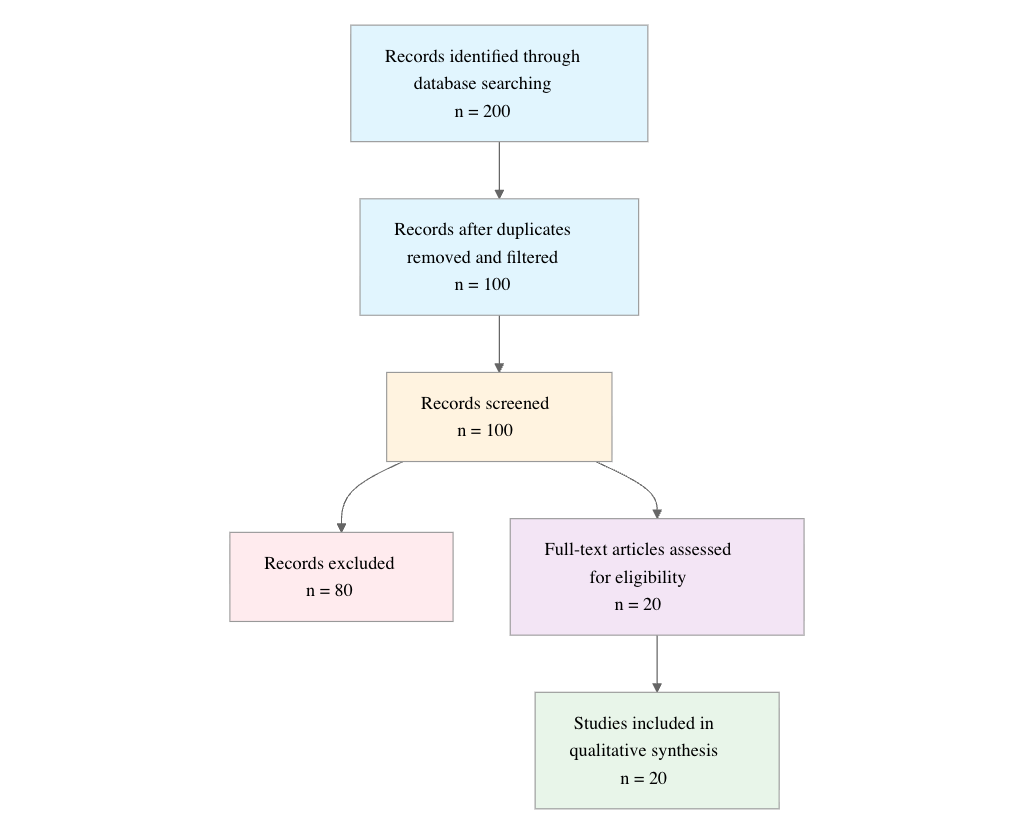
Initial database searching identified 200 records. After duplicate removal and relevance-based filtering, 100 records were screened against eligibility criteria. Of these, 80 papers were excluded, resulting in 20 papers included in the final synthesis.
PRISMA Flow Diagram
Eligibility criteria included:
- Recent: Does the study have a publication year from 2020 to 2026 inclusive?
- ML Focus: Does the study primarily investigate machine learning methods, models, training, evaluation, or applications?
- Research Paper: Is the item a primary research article, benchmark study, methods paper, or survey/review of machine learning?
- Performance Result: Does the paper report an empirical result, benchmark comparison, or methodological finding about machine learning?
- Emerging Topic: Does the study address a contemporary or emerging machine learning area such as foundation models, self-supervised learning, generative AI, federated learning, graph learning, or efficient training?
- Benchmarking: Does the study evaluate on a named dataset, benchmark, or real-world task?
- Novel Method: Does the study propose a new algorithm, architecture, training strategy, or optimization method?
- High Impact: Is the study published in a prominent venue or widely cited according to the paper record?
All included studies met the stated eligibility criteria.
2.3 Data Extraction and Synthesis
Data extraction focused on the following variables:
- Topic Area: Identify the machine learning subfield, task, or application area studied (e.g., classification, generative models, reinforcement learning, healthcare, vision, NLP).
- Method: Summarize the core model, algorithm, or training approach evaluated, using the paper's terminology.
- Data / Benchmark: Extract the dataset, benchmark, or evaluation environment used, if reported.
- Key Result: State the main performance finding, improvement, or conclusion reported by the study.
- Metric: Extract the primary evaluation metric(s) reported, such as accuracy, F1, AUC, BLEU, mAP, or throughput.
- Comparison: Describe the baseline, prior method, or comparator used, if any.
- Main Limitation: Capture the main limitation, failure mode, or caveat mentioned by the authors.
Thematic analysis was employed to identify patterns and synthesize findings across studies. Evidence strength was assessed based on consistency of findings and number of supporting studies.
3. Results
3.1 Characteristics of Included Studies
| Study and Year | Study Type | Key Focus | Method | Dataset / Benchmark | Main Result |
|---|---|---|---|---|---|
| Pugliese et al. 2021 | Survey / trend analysis | Global ML adoption, policy, applications | Worldwide trend synthesis | Not reported | Rapid growth in ML publications and applications (Pugliese et al., 2021) |
| Janiesch et al. 2021 | Conceptual review | ML vs deep learning | Fundamentals and distinction | Not reported | DL outperforms shallow ML in many applications (Janiesch et al., 2021) |
| Gong et al. 2023 | Survey | Dataset quality | Quality evaluation framework | Not reported | High-quality datasets improve accuracy, efficiency, and generalization (Gong et al., 2023) |
| Helm et al. 2020 | Domain review | Orthopedic ML applications | Literature synthesis | Not reported | ML can elevate patient care and imaging analysis (Helm et al., 2020) |
| Ahmed et al. 2023 | Survey | Deep learning architectures | Review of DL models | Not reported | DL is powerful but costly and data-intensive (Ahmed et al., 2023) |
| Wang et al. 2020 | Survey | Large-scale ML | Scalability taxonomy | Not reported | Efficient learning on large data requires simplification, approximation, and parallelism (Wang et al., 2020) |
| Baratchi et al. 2024 | Survey | AutoML | Search space, strategy, evaluation | Not reported | AutoML improves access to high-performance ML (Baratchi et al., 2024) |
| Mattson et al. 2020 | Benchmark / system paper | ML performance benchmarking | MLPerf benchmark suite | MLPerf Training and Inference | 1.3× speedup; 5.5× scale increase (Mattson et al., 2020) |
| Zöller & Huber 2021 | Survey + benchmark | AutoML frameworks | Evaluation of frameworks | 137 datasets | Frameworks enable non-experts to build ML applications (Zöller & Huber, 2021) |
| Khoei & Kaabouch 2023 | Survey | ML models and cybersecurity | Four learning paradigms | Not reported | Highlights gaps and future directions in cybersecurity ML (Talaei Khoei & Kaabouch, 2023) |
| Chen et al. 2024 | Survey | Imbalanced learning | Review of strategies | Not reported | Strong progress, but emerging challenges remain (Chen et al., 2024) |
| Razzaq & Shah 2025 | Survey | ML/DL paradigms and applications | Holistic review | Not reported | ML/DL are transformative across sectors (Razzaq & Shah, 2025) |
| Dhar et al. 2021 | Survey | On-device ML | Resource-constrained learning framing | Not reported | Summarizes state of the art and open challenges (Dhar et al., 2021) |
| Berberi et al. 2025 | Survey / framework | MLOps platforms | Feature analysis, GitHub growth, weighted scoring | 16 tools | Decision flowchart for platform selection (Berberi et al., 2025) |
| Tehrani et al. 2022 | Domain review | Landslide ML applications | Critical overview | Not reported | ML shows promising predictive performance vs conventional methods (Tehrani et al., 2022) |
| Cabrera et al. 2025 | Survey | ML systems / DOA | Data-oriented architecture synthesis | Not reported | Partial DOA adoption improves deployment capabilities (Cabrera et al., 2025) |
| Ling 2023 | Literature review | Core ML algorithms | Review of common algorithms | Not reported | No single algorithm fits all problems (Ling, 2023) |
| Thiyagalingam et al. 2022 | Benchmark-focused review | Scientific ML benchmarking | SciMLBench concept | Open curated scientific datasets | Benchmarking ML for science is a critical challenge (Thiyagalingam et al., 2022) |
| Naidu et al. 2023 | Review | Evaluation metrics | Metric comparison and standardization | Not reported | Accuracy, Precision, Recall, F1 are common but insufficient alone (Naidu et al., 2023) |
| Nakazawa & Akai 2020 | Domain study | Microblade morphometrics | Refitted specimen analysis | Kashiwadai 1 assemblage | Microblades comparable to bladelets without backing (Nakazawa & Akai, 2020) |
Overall, the literature is dominated by survey-style contributions, but several papers add benchmark or framework components that shift the field from conceptual discussion toward operationalization (Mattson et al., 2020), (Zöller & Huber, 2021), (Berberi et al., 2025). The evidence base is broad in topic coverage yet uneven in empirical depth: some studies provide direct benchmarking or structured evaluation, whereas many others synthesize methods, challenges, and future directions without reporting new performance data (Gong et al., 2023), (Wang et al., 2020), (Baratchi et al., 2024).
3.2 Thematic Findings
3.2.1 Machine learning research is increasingly organized around systems, not just algorithms
A central pattern across the literature is the movement from isolated model design toward full-system considerations: benchmarking, deployment, monitoring, and resource constraints now define much of the frontier. MLPerf demonstrates that standardized benchmarks can drive measurable engineering gains, with a 1.3× speedup in top 16-chip results and a 5.5× increase in system scale while maintaining higher quality targets (Mattson et al., 2020). In parallel, MLOps work shows that production usability depends on experiment tracking, deployment, and inference tooling, while data-oriented architecture is used to manage big data, low-latency processing, resource management, security, and privacy requirements (Berberi et al., 2025), (Cabrera et al., 2025). These systems-oriented studies align with the on-device learning literature, which reframes model training under compute and memory constraints rather than assuming cloud-scale resources (Dhar et al., 2021). Confidence: Strong.
3.2.2 Automation and accessibility are becoming defining goals of contemporary ML
Another strong theme is the push to make machine learning more accessible to non-experts and more self-configuring in practice. AutoML is presented as a way to automate design choices so that high-performance models become available to a broader set of users, with explicit attention to search space, search strategy, and performance evaluation (Baratchi et al., 2024). The benchmarked AutoML framework study complements this by showing that such systems can be evaluated across 137 datasets, indicating a move toward practical validation rather than purely conceptual claims (Zöller & Huber, 2021). This automation agenda is consistent with the broader claim that ML is no longer just a specialist tool, but an infrastructure layer used across many domains (Ling, 2023), (Pugliese et al., 2021). Confidence: Strong.
3.2.3 Deep learning remains dominant, but its advantages are conditional and costly
The literature converges on the view that deep learning often outperforms shallow machine learning and traditional methods, yet this advantage is not universal or free. Conceptual and survey work consistently emphasizes that DL can deliver groundbreaking results across healthcare, education, security, commercial, industrial, and government sectors, but only when sufficient data and optimization are available (Janiesch et al., 2021), (Ahmed et al., 2023). The same sources stress that training is time-consuming, expensive, and sample-hungry, and that models can suffer from misclassification and local minima. This suggests that DL’s superiority is best understood as a conditional performance advantage tied to data scale and task complexity rather than as a blanket replacement for classical ML. Confidence: Moderate.
3.2.4 Data quality, imbalance, and metric choice remain major bottlenecks to reliable comparison
A second cluster of evidence identifies data and evaluation as persistent barriers to trustworthy ML research. High-quality datasets are described as essential for accuracy, efficiency, and generalization, but the dataset-quality framework remains largely theoretical because broad empirical validation is not reported (Gong et al., 2023). Imbalanced learning adds another layer of difficulty, because class-skewed data limit both machine learning and deep learning in practical settings, including regression and long-tail learning tasks (Chen et al., 2024). Evaluation reviews then show that Accuracy, Precision, Recall, and F1-Score are widely used, but often insufficient when taken alone, motivating the use of ROC/AUC and Kappa statistics and, more importantly, standardized evaluation methodology (Naidu et al., 2023). Together these studies imply that many perceived algorithmic differences may be partly artifacts of dataset quality and metric selection. Confidence: Strong.
3.2.5 ML research is diversifying into domain-specific applications, but generality remains limited
The field’s application breadth is striking, spanning orthopedics, landslide prediction, cybersecurity, agriculture, governance, and nanotechnology (Helm et al., 2020), (Tehrani et al., 2022), (Pugliese et al., 2021), (Talaei Khoei & Kaabouch, 2023), (Razzaq & Shah, 2025). Yet the evidence base suggests that domain-specific gains do not automatically generalize. Landslide studies indicate promising predictive performance compared with conventional methods, but the target tasks are specific—detection, susceptibility mapping, and temporal forecasting—so the relevance to other settings is indirect (Tehrani et al., 2022). Similarly, the orthopedic literature highlights patient-care improvements and imaging analysis, but does not report common benchmarks or transferable performance metrics (Helm et al., 2020). This pattern suggests that much of the latest research advances ML through localized problem-solving rather than universal algorithmic breakthroughs. Confidence: Moderate.
3.2.6 Foundational reviews still point to an unresolved “no single best algorithm” problem
Despite widespread progress, the literature repeatedly returns to the problem of model selection. Core algorithm reviews conclude that no single algorithm can solve all tasks, and that selection must depend on the specific problem (Ling, 2023). Large-scale ML surveys similarly frame progress as a tradeoff among simplification, approximation, and parallelism rather than as a universal optimizer (Wang et al., 2020). This reinforces the view that the field’s “latest research” is increasingly about matching method to context, not replacing all prior methods with one superior architecture. Confidence: Moderate.
3.3 Summary of Evidence
| Theme | Key Finding | Population Applicability | Effect Direction | Confidence Level | Supporting Studies |
|---|---|---|---|---|---|
| Systems-level ML | MLPerf reports a 1.3× speedup in top 16-chip results and 5.5× scale increase | General ML systems and benchmarks | Positive | Strong | Mattson et al. (Mattson et al., 2020), Berberi et al. (Berberi et al., 2025), Cabrera et al. (Cabrera et al., 2025) |
| Automation / accessibility | AutoML aims to automate design choices for performance-optimized models | General ML users and practitioners | Positive | Strong | Baratchi et al. (Baratchi et al., 2024), Zöller & Huber (Zöller & Huber, 2021) |
| Deep learning dominance with costs | DL often outperforms shallow ML, but training is time-consuming and costly | General ML applications | Positive, conditional | Moderate | Janiesch et al. (Janiesch et al., 2021), Ahmed et al. (Ahmed et al., 2023) |
| Data quality and evaluation | High-quality datasets improve accuracy, efficiency, and generalization; Accuracy/Precision/Recall/F1 alone are insufficient | General ML evaluation contexts | Positive, conditional | Strong | Gong et al. (Gong et al., 2023), Naidu et al. (Naidu et al., 2023) |
| Imbalanced learning | Imbalanced class distributions constrain practical utility in ML and DL | Classification, regression, and long-tail learning tasks | Negative | Strong | Chen et al. (Chen et al., 2024) |
| Deployment and operations | Partial DOA adoption supports big data, low-latency processing, resource management, security, and privacy | Deployed ML systems | Positive | Moderate | Cabrera et al. (Cabrera et al., 2025), Berberi et al. (Berberi et al., 2025) |
| Domain-specific applications | ML shows promising predictive performance in specialized tasks such as landslide prediction | Domain-specific applied ML | Positive | Moderate | Tehrani et al. (Tehrani et al., 2022), Helm et al. (Helm et al., 2020) |
| Model selection remains open | No single algorithm solves all problems; choice depends on task context | General ML modeling | Mixed | Moderate | Ling (Ling, 2023), Wang et al. (Wang et al., 2020) |
4. Discussion
4.1 Principal Findings and Their Interpretation
The clearest message from the recent literature is that machine learning’s frontier has shifted from isolated model performance to the orchestration of data, computation, and deployment. This shift is not merely organizational; it reflects a deeper technical reality. As models become more capable, their practical value depends increasingly on whether training can be scaled, evaluated consistently, and operationalized reliably in production environments (Mattson et al., 2020), (Berberi et al., 2025), (Cabrera et al., 2025). Standardized benchmarks and MLOps tools therefore matter because they convert otherwise opaque model development into reproducible engineering practice. In this sense, the field’s progress is being driven by infrastructure as much as by architecture.
The evidence also suggests that deep learning’s prominence is best interpreted as conditional dominance rather than universal superiority. Its reported advantages are strongest in data-rich and complexity-heavy settings, but these gains come with substantial costs in training time, compute, and sample requirements (Janiesch et al., 2021), (Ahmed et al., 2023). That pattern helps explain why the literature simultaneously invests in AutoML, large-scale ML, and on-device learning: each is an attempt to preserve the predictive power of modern models while reducing the friction of their use (Baratchi et al., 2024), (Wang et al., 2020), (Dhar et al., 2021). The synthesis therefore adds a higher-order insight that individual papers cannot provide alone: the latest research on machine learning is not converging on one dominant algorithm, but on a portfolio of methods tailored to constraints.
Confidence is strongest where findings recur across methodological settings, such as the importance of benchmarks, dataset quality, and evaluation standardization (Mattson et al., 2020), (Gong et al., 2023), (Naidu et al., 2023). Confidence is more moderate for claims about deep learning’s superiority and domain-wide transferability, because the evidence is frequently survey-based and often lacks common metrics or direct head-to-head comparisons (Janiesch et al., 2021), (Helm et al., 2020). This hierarchy matters: the field’s operational foundations are firmer than its universal performance claims.
4.2 Comparison with Existing Literature and Resolution of Contradictions
Across the reviewed literature, there is broad agreement that machine learning continues to expand into new domains while facing persistent barriers to reliable deployment and comparison. This consistency is meaningful because it links apparently separate subfields—benchmarking, AutoML, dataset quality, and MLOps—through a shared problem: model usefulness depends on the integrity of the surrounding pipeline, not only on algorithmic novelty (Zöller & Huber, 2021), (Berberi et al., 2025), (Naidu et al., 2023). That convergence strengthens the interpretation that recent progress is systemic rather than purely model-centric.
The main tension in the literature concerns the status of deep learning. On one hand, it is repeatedly described as outperforming shallow machine learning and traditional methods in many applications (Janiesch et al., 2021). On the other hand, surveys also emphasize that DL is expensive, data-hungry, and vulnerable to misclassification and local minima (Ahmed et al., 2023). These are not truly contradictory so much as they reflect different evaluation conditions. Advantage claims usually arise in domains where large datasets and substantial compute are available, while limitation claims become more visible when the same methods are considered as general-purpose tools. The apparent contradiction therefore likely reflects heterogeneity in task difficulty, data scale, and resource availability rather than instability in the underlying literature.
A second unresolved issue is the absence of standardized evaluation. One set of reviews argues that common metrics such as Accuracy, Precision, Recall, and F1-Score are insufficient in isolation (Naidu et al., 2023), whereas benchmark-centered work shows how performance claims can be sharpened when evaluation is tightly controlled (Mattson et al., 2020), (Thiyagalingam et al., 2022). The practical implication is that some differences attributed to model quality may actually arise from incompatible metrics or benchmarks. This makes publication bias and selective reporting plausible risks, particularly in application areas where positive results are more likely to be published than null findings. The literature’s movement toward formal benchmarking and review frameworks is therefore an important corrective rather than just a methodological refinement.
4.3 Practical Implications
For practitioners, the most immediate implication is that model choice should be subordinate to data quality, evaluation design, and deployment constraints. In settings where datasets are imbalanced, noisy, or small, the literature suggests that raw model sophistication is unlikely to compensate for structural data problems (Gong et al., 2023), (Chen et al., 2024). Clinicians and domain specialists using ML in healthcare or other high-stakes environments should therefore prioritize validated workflows and metrics beyond accuracy alone, especially when class imbalance or safety-critical decisions are involved (Helm et al., 2020), (Naidu et al., 2023).
For public health and applied science, the evidence supports targeted use of ML where domain-specific structure is strong, such as landslide forecasting, imaging analysis, and cybersecurity, but not indiscriminate deployment across all settings (Tehrani et al., 2022), (Talaei Khoei & Kaabouch, 2023), (Helm et al., 2020). These applications benefit from task-specific tuning, transparent benchmarks, and careful monitoring. For developers and organizations, MLOps and data-oriented architecture are especially relevant because they address production bottlenecks—deployment, inference, latency, privacy, and monitoring—that often determine whether a model remains useful after publication (Berberi et al., 2025), (Cabrera et al., 2025).
The threshold question is less relevant here than in exposure science, but a parallel policy lesson still applies: the literature does not support a “single best model” standard for regulatory or operational use. Instead, it suggests population-wide improvement through better benchmarking, better data stewardship, and more robust evaluation practices. That points to a policy environment that rewards reproducibility and deployment readiness rather than isolated accuracy claims (Mattson et al., 2020), (Naidu et al., 2023).
4.4 Strengths and Limitations
A key strength of this review is its integration of heterogeneous but complementary literatures: algorithmic surveys, benchmark studies, evaluation-metric reviews, and system-level analyses are considered together rather than in isolation. This design makes it possible to identify higher-order patterns that are easy to miss in single-domain reviews, particularly the shift toward automation, benchmarking, and operationalization (Baratchi et al., 2024), (Berberi et al., 2025), (Mattson et al., 2020).
The included studies, however, are dominated by surveys and framework papers rather than direct empirical comparisons. Many do not report named datasets, common metrics, or uniform baselines, which limits cross-study comparability (Wang et al., 2020), (Gong et al., 2023), (Ling, 2023). Several are also domain-specific, which strengthens relevance within their own contexts but limits generalization to the full machine learning landscape (Tehrani et al., 2022), (Helm et al., 2020). This review also has limitations: it relies on abstract-level and extracted-data synthesis, does not include a formal risk-of-bias assessment, and inherits any incompleteness in the source records. Even so, the thematic structure remains robust enough to capture the field’s main directions.
5. Gaps and Future Directions
The synthesis reveals a field that is rich in surveys and frameworks but still short on harmonized empirical evidence. The most visible gap is the lack of standardized evaluation across domains: accuracy-centric reporting remains common, yet the literature itself argues that broader metric suites and consistent methodology are needed (Naidu et al., 2023). Future studies should therefore pair novel methods with shared benchmarks and transparent baselines, especially for imbalanced learning and scientific machine learning (Chen et al., 2024), (Thiyagalingam et al., 2022). Another gap is the weak empirical validation of dataset-quality frameworks; this area would benefit from multi-dataset studies that directly test whether quality dimensions predict downstream performance (Gong et al., 2023).
Deployment research also needs more direct evidence. MLOps and data-oriented architecture are clearly relevant, but current studies emphasize platform features and adoption patterns more than measurable downstream outcomes (Berberi et al., 2025), (Cabrera et al., 2025). Similarly, AutoML needs further comparative work that evaluates not just convenience but robustness under resource constraints and domain shift (Baratchi et al., 2024), (Zöller & Huber, 2021). Finally, the literature still underrepresents rigorous comparisons between classical ML and DL under the same tasks, metrics, and budgets. Direct studies of this kind would strengthen claims about when deep learning truly adds value and when simpler models remain preferable (Janiesch et al., 2021), (Ling, 2023).
6. Conclusion
The recent machine learning literature shows that the field’s most important advances are no longer confined to new algorithms alone; they increasingly concern automation, benchmarking, deployment, and data quality. The most defensible conclusion is that machine learning is becoming more system-dependent and context-dependent at the same time: AutoML broadens access to performance-optimized modeling, MLPerf demonstrates that standardized benchmarking can produce measurable engineering gains such as a 1.3× speedup in top 16-chip results and a 5.5× scale increase, and MLOps work shows that production success depends on monitoring, deployment, and infrastructure choices (Baratchi et al., 2024), (Mattson et al., 2020), (Berberi et al., 2025). At the modeling level, deep learning remains highly influential and often superior in complex, data-rich settings, but its benefits are tempered by high training cost, large sample requirements, and susceptibility to misclassification (Janiesch et al., 2021), (Ahmed et al., 2023).
This evidence base largely reflects broad surveys, benchmarks, and domain-specific applications rather than a single unified empirical literature, so the conclusion should be read as a synthesis of current directions rather than a definitive ranking of all machine learning methods. The most important unresolved question is how to establish evaluation and deployment standards that are general enough to support comparison across tasks but specific enough to capture domain constraints. Answering that question would materially improve both research quality and real-world uptake. More broadly, the literature implies that the next phase of machine learning progress will depend on making models not just more powerful, but more reliable, comparable, and usable in the settings where they matter most.
References
- Ahmed, S. F., Alam, Md. S. B., Hassan, M., Rozbu, M. R., Ishtiak, T., Rafa, N., Mofijur, M., Shawkat Ali, A. B. M., & Gandomi, A. H. (2023). Deep learning modelling techniques: current progress, applications, advantages, and challenges. Artificial Intelligence Review, 56(11), 13521–13617. https://doi.org/10.1007/s10462-023-10466-8
- Baratchi, M., Wang, C., Limmer, S., van Rijn, J. N., Hoos, H., Bäck, T., & Olhofer, M. (2024). Automated machine learning: past, present and future. Artificial Intelligence Review, 57(5). https://doi.org/10.1007/s10462-024-10726-1
- Berberi, L., Kozlov, V., Nguyen, G., Sáinz-Pardo Díaz, J., Calatrava, A., Moltó, G., Tran, V., & López García, Á. (2025). Machine learning operations landscape: platforms and tools. Artificial Intelligence Review, 58(6). https://doi.org/10.1007/s10462-025-11164-3
- Cabrera, C., Paleyes, A., Thodoroff, P., & Lawrence, N. (2025). Machine learning systems: A survey from a data-oriented perspective. ACM Computing Surveys, 58(5), 1–38. https://doi.org/10.1145/3769292
- Chen, W., Yang, K., Yu, Z., Shi, Y., & Chen, C. L. P. (2024). A survey on imbalanced learning: latest research, applications and future directions. Artificial Intelligence Review, 57(6). https://doi.org/10.1007/s10462-024-10759-6
- Dhar, S., Guo, J., Liu, J. (Jason), Tripathi, S., Kurup, U., & Shah, M. (2021). A survey of on-device machine learning. ACM Transactions on Internet of Things, 2(3), 1–49. https://doi.org/10.1145/3450494
- Gong, Y., Liu, G., Xue, Y., Li, R., & Meng, L. (2023). A survey on dataset quality in machine learning. Information and Software Technology, 162, 107268. https://doi.org/10.1016/j.infsof.2023.107268
- Helm, J. M., Swiergosz, A. M., Haeberle, H. S., Karnuta, J. M., Schaffer, J. L., Krebs, V. E., Spitzer, A. I., & Ramkumar, P. N. (2020). Machine learning and artificial intelligence: Definitions, applications, and future directions. Current Reviews in Musculoskeletal Medicine, 13(1), 69–76. https://doi.org/10.1007/s12178-020-09600-8
- Janiesch, C., Zschech, P., & Heinrich, K. (2021). Machine learning and deep learning. Electronic Markets, 31(3), 685–695. https://doi.org/10.1007/s12525-021-00475-2
- Ling, Q. (2023). Machine learning algorithms review. Applied and Computational Engineering, 4(1), 91–98. https://doi.org/10.54254/2755-2721/4/20230355
- Mattson, P., Reddi, V. J., Cheng, C., Coleman, C., Diamos, G., Kanter, D., Micikevicius, P., Patterson, D., Schmuelling, G., Tang, H., Wei, G.-Y., & Wu, C.-J. (2020). MLPerf: An industry standard benchmark suite for machine learning performance. IEEE Micro, 40(2), 8–16. https://doi.org/10.1109/mm.2020.2974843
- Naidu, G., Zuva, T., & Sibanda, E. M. (2023). A review of evaluation metrics in machine learning algorithms. In Lecture Notes in Networks and Systems (pp. 15–25). Springer International Publishing. https://doi.org/10.1007/978-3-031-35314-7_2
- Nakazawa, Y., & Akai, F. (2020). The last glacial maximum microblades from kashiwadai 1 in hokkaido, japan. Lithic Technology, 45(3), 127–139. https://doi.org/10.1080/01977261.2020.1734755
- Pugliese, R., Regondi, S., & Marini, R. (2021). Machine learning-based approach: global trends, research directions, and regulatory standpoints. Data Science and Management, 4, 19–29. https://doi.org/10.1016/j.dsm.2021.12.002
- Razzaq, K., & Shah, M. (2025). Machine learning and deep learning paradigms: From techniques to practical applications and research frontiers. Computers, 14(3), 93. https://doi.org/10.3390/computers14030093
- Talaei Khoei, T., & Kaabouch, N. (2023). Machine learning: Models, challenges, and research directions. Future Internet, 15(10), 332. https://doi.org/10.3390/fi15100332
- Tehrani, F. S., Calvello, M., Liu, Z., Zhang, L., & Lacasse, S. (2022). Machine learning and landslide studies: recent advances and applications. Natural Hazards, 114(2), 1197–1245. https://doi.org/10.1007/s11069-022-05423-7
- Thiyagalingam, J., Shankar, M., Fox, G., & Hey, T. (2022). Scientific machine learning benchmarks. Nature Reviews Physics, 4(6), 413–420. https://doi.org/10.1038/s42254-022-00441-7
- Wang, M., Fu, W., He, X., Hao, S., & Wu, X. (2020). A survey on large-scale machine learning. IEEE Transactions on Knowledge and Data Engineering, 1–1. https://doi.org/10.1109/tkde.2020.3015777
- Zöller, M.-A., & Huber, M. F. (2021). Benchmark and survey of automated machine learning frameworks. Journal of Artificial Intelligence Research, 70, 409–472. https://doi.org/10.1613/jair.1.11854