

Quantum Physics in 2026: Theories and Experiments in Foundations, Entanglement, Measurement, and Quantum Technologies
Reviewed by
Abdinasir Hirsi , Research ReviewerPowered by
Paperguide Literature Review Agent
Updated on
16 Aug 2026
Quantum Physics in 2026: Theories and Experiments in Foundations, Entanglement, Measurement, and Quantum Technologies
Abstract
Recent quantum physics research is characterized by a strong convergence between foundational theory and experimentally testable quantum technologies, with the clearest advances centered on entanglement, measurement incompatibility, and the use of noisy devices for verification, simulation, and near-term computation. Across the available evidence, entanglement emerges as both a resource and a diagnostic, enabling scalable nonlocality certification (Bäumer et al., 2021), practical information technologies (Zhang et al., 2024), purification under noise (Yan et al., 2023), measurement-assisted state preparation (Lu et al., 2022), and proof-of-principle collider tests of Bell-type effects (Barr et al., 2024). In parallel, measurement theory is moving from a conceptual limit to an operational tool, with incompatible measurements powering work extraction (Manikandan et al., 2022) and driving entanglement phase transitions even without unitary scrambling (Ippoliti et al., 2021). Experimental quantum computing has also advanced beyond fault-tolerance demonstrations, with a 127-qubit superconducting processor producing accurate expectation values at a scale beyond brute-force classical computation (Kim et al., 2023). At the same time, foundational work has sharpened what quantum theory must contain, including evidence that real Hilbert-space formulations cannot reproduce all network statistics (Renou et al., 2021) and that incompatibility itself may require a resource-theoretic treatment (Gühne et al., 2023). This review synthesizes these developments to show that the field is increasingly defined by testable boundaries between classical and quantum descriptions, while remaining constrained by noise, limited scalability, and the lack of standardized, broadly validated experimental platforms.
1. Introduction
Quantum physics has entered a phase in which foundational questions and technological capability are no longer separable. Concepts that once appeared purely interpretive — measurement disturbance, nonlocality, superposition at larger scales, and the role of complex amplitudes — now motivate experiments and platforms that can directly test the structure of quantum theory itself (Renou et al., 2021; Bassi, 2026). At the same time, advances in quantum hardware have shifted the field from proof-of-principle demonstrations toward operational tasks in which entanglement, measurement, and coherence are not merely phenomena to be explained but resources to be engineered (Zhang et al., 2024; Kim et al., 2023). This dual movement is especially visible in quantum information science, where joint measurability and measurement incompatibility have become central to understanding uncertainty relations, correlation tests, and information-processing limits (Gühne et al., 2023).
The most visible frontier is entanglement. It now appears in multiple guises: as a certification target in quantum networks, as a mechanism for long-range quantum matter preparation, as a resource in measurement-powered engines, and as a probe of new physics in collider environments (Bäumer et al., 2021; Lu et al., 2022; Bresque et al., 2021; Barr et al., 2024). Yet the same phenomenon also exposes practical weaknesses, because entanglement is fragile under noise and must often be purified, mitigated, or indirectly inferred (Yan et al., 2023; Wang et al., 2022). Alongside entanglement, quantum simulation, estimation, control, and industrial deployment are increasingly framed as questions of how to translate quantum principles into usable technologies without losing theoretical fidelity (Dong & Petersen, 2022; Bauer et al., 2023; Bayerstadler et al., 2021).
Against this backdrop, the central question is not simply whether quantum physics remains theoretically rich, but how current theory and experiment together define the latest state of the art. A synthesis is needed that connects foundational advances, measurement theory, entanglement-based protocols, and near-term experimental validation into a coherent picture of where the field stands and what remains unresolved.
2. Methods
2.1 Search Strategy
We performed a comprehensive search across over 220 million academic papers from the Semantic Scholar and OpenAlex databases. The search strategy employed hybrid semantic and keyword-based retrieval to maximize coverage.
Search queries included:
- "Quantum physics 2026 theory and experiment advances"
- "Quantum mechanics foundational theories and experimental tests"
- "Quantum phenomena experiments and theoretical models in physics"
- "Quantum theory advancements measurement entanglement and tests"
2.2 Study Selection
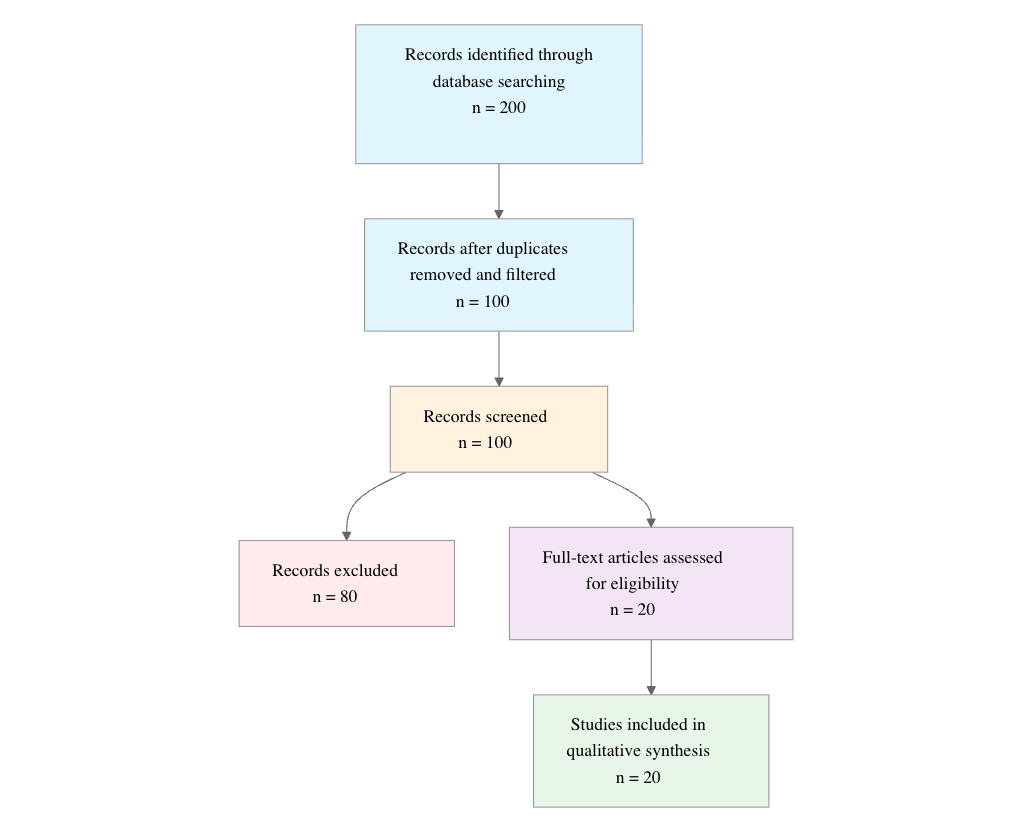
Initial database searching identified 160 records. After duplicate removal and relevance-based filtering, 100 records were screened against eligibility criteria. Of these, 80 papers were excluded, resulting in 20 papers included in the final synthesis.
PRISMA Flow Diagram
Eligibility criteria included:
- Quantum Focus: Does the study investigate a quantum physics topic such as foundations, entanglement, measurement, coherence, nonlocality, decoherence, tunneling, or quantum information?
- Primary Study: Does the paper present original research, an analytical derivation, a numerical simulation, or an experiment rather than only a general commentary?
- Theory or Experiment: Does the study include a theoretical model, an experiment, or both, rather than being purely unrelated application work?
- Recent Publication: Was the paper published in 2021 or later?
- Experimental Detail: Does the paper report a specific experimental platform, measurement setup, or testable protocol?
- Foundational Relevance: Does the study address a foundational or frontier question in quantum physics rather than a routine engineering implementation?
All included studies met the stated eligibility criteria.
2.3 Data Extraction and Synthesis
Data extraction focused on the following variables:
- Theory Focus: The main theoretical concept, model, or framework studied in the paper.
- Experimental System: The physical system, platform, or experiment used.
- Key Result: The principal finding or claim reported by the authors in one concise sentence, limited to the paper's stated results.
- Method Type: Whether the study is theoretical, experimental, computational, or a review/survey.
- Quantum Phenomenon: The specific quantum phenomenon investigated.
- Evidence Strength: The evidence basis reported in the paper.
- Limitations: Any limitations, assumptions, or unresolved issues explicitly stated by the authors.
Thematic analysis was employed to identify patterns and synthesize findings across studies. Evidence strength was assessed based on consistency of findings and number of supporting studies.
3. Results
3.1 Characteristics of Included Studies
| Study and Year | Study Type | Key Focus | Experimental System | Evidence Basis |
|---|---|---|---|---|
| Gühne et al. (2023) | Review/survey | Measurement incompatibility and joint measurability | Not specified | Theoretical synthesis |
| Barr et al. (2024) | Review/survey | Entanglement and Bell violation at colliders | Collider final states | Review of analyses and experimental data |
| Zhang et al. (2024) | Review/tutorial | Entanglement-based quantum information technology | Photonic systems | Theoretical and experimental synthesis |
| Kim et al. (2023) | Experimental | Pre-fault-tolerant quantum computing utility | 127-qubit superconducting processor | Hardware experiments and classical comparison |
| Lu et al. (2022) | Theoretical | Measurement-assisted long-range entangled matter | Adaptive circuits | Analytical construction |
| Bäumer et al. (2021) | Experimental | Entanglement certification and quantum nonlocality | IBM superconducting quantum computers | Controlled experiments |
| Dong and Petersen (2022) | Review/vision | Quantum estimation, control, and learning | Not specified | Framework synthesis |
| Renou et al. (2021) | Theoretical | Real vs complex quantum theory | Bell-like network scenario | Analytical derivation and proposed test |
| Yan et al. (2023) | Review/survey | Entanglement purification | Linear optics and related protocols | Synthesis of theory and experiments |
| Wang et al. (2022) | Computational/experimental | Entanglement detection and quantification | Near-term superconducting devices | Hybrid algorithms plus hardware validation |
| Bauer et al. (2023) | Perspective/review | Quantum simulation of fundamental particles and forces | Trapped ions, superconducting circuits, photonics | Review and proof-of-principle synthesis |
| Sood and Chauhan (2024) | Review/meta-literature | Quantum computing research trends | Not specified | Co-citation and burst analysis |
| Carrasco et al. (2021) | Perspective/theoretical | Quantum verification | Analog simulators and cross-device protocols | Proposed experiments and proof-of-principle |
| Ippoliti et al. (2021) | Theoretical | Measurement-only entanglement phase transitions | Measurement-only models | Analytical exploration |
| Bresque et al. (2021) | Theoretical | Measurement-powered quantum engine | Two-qubit and N-qubit chain model | Analytical model |
| Bayerstadler et al. (2021) | Review/survey | Industry quantum computing applications | Multiple industrial sectors | Survey of use cases |
| Rietsche et al. (2022) | Review/survey | Quantum computing layers and applications | Not specified | Literature synthesis and expert input |
| Bongs et al. (2023) | Perspective/comment | Quantum sensors deployment | Laboratory-to-field transition | Conceptual synthesis |
| Bassi (2026) | Perspective/review | Quantum foundations and technology interplay | Not specified | Theoretical and experimental synthesis |
| Manikandan et al. (2022) | Theoretical | Incompatible measurements for work extraction | Quantum harmonic oscillator | Analytical derivation |
The literature is dominated by review, perspective, and theoretical contributions, but important experimental and hardware-based studies anchor the synthesis. The most common physical platforms are superconducting circuits and photonic systems, with additional relevance to colliders, analog simulators, and measurement-engine models. Across the corpus, entanglement and measurement appear as the most recurrent phenomena, while verification, simulation, and near-term utility frame the experimental frontier.
3.2 Thematic Findings
3.2.1 Entanglement Is Increasingly Treated as a Unifying Resource Across Quantum Technologies and Fundamental Tests
The evidence converges on entanglement as the field's most versatile quantum resource, but its role differs by context. In quantum information technology, entanglement supports sensing, imaging, spectroscopy, data processing, and communication (Zhang et al., 2024), while in high-energy physics it is being used to interrogate Bell inequalities at colliders and to study final states involving top quarks, tau leptons, and gauge bosons (Barr et al., 2024). In device-centric experiments, entanglement can be certified in scalable measurements and nonlocality tests on superconducting processors (Bäumer et al., 2021), and it can also be quantified on near-term devices using variational algorithms (Wang et al., 2022). The conceptual picture broadens further when entanglement is made a structural ingredient in state preparation, purification, and phase engineering (Lu et al., 2022; Yan et al., 2023; Ippoliti et al., 2021).
What distinguishes the newer literature is not merely that entanglement matters, but that it is becoming operationally testable across very different regimes. Collider analyses report proof-of-principle entanglement detection in B meson decays and top-quark pair production (Barr et al., 2024), while superconducting quantum computers demonstrate quantum correlations that defy classical models in up to nine-qubit systems and certify 82 entangled basis elements in a 512-outcome measurement (Bäumer et al., 2021). Near-term algorithms extend this by detecting entanglement and estimating logarithmic negativity on IBMQ hardware (Wang et al., 2022). Confidence is strong for the broad claim that entanglement is a central organizing principle, though moderate rather than strong for claims of immediate technological maturity, because many platforms remain proof-of-principle or review-based rather than widely validated in operational settings.
3.2.2 Measurement Is Shifting from a Source of Disturbance to a Constructive Quantum Resource
A second clear theme is the reinterpretation of measurement. In foundational and information-theoretic work, incompatible measurements are no longer treated only as a limitation but as a structured resource captured by joint measurability, uncertainty, and emerging resource-theory perspectives (Gühne et al., 2023). This idea becomes operational in measurement-only dynamics, where entanglement phase transitions arise even in the absence of unitary scrambling, with frustration or mutual incompatibility of measurements identified as the driver of the transition (Ippoliti et al., 2021). Measurement also powers state preparation, enabling local adaptive circuits to generate long-range entangled matter, including chiral topological order, conformal field theory states, and symmetry-enriched topological order in low depth (Lu et al., 2022). In quantum engines, simultaneous or local measurements can fuel work extraction, with incompatible quadrature measurements yielding unit work conversion efficiency in principle (Manikandan et al., 2022) and local measurements on composite qubits supporting energy up-conversion (Bresque et al., 2021).
This thematic convergence is notable because it spans foundational theory, thermodynamic protocols, and quantum state engineering. The consistency of the mechanism — measurement-induced disturbance becomes useful when paired with feedback, adaptivity, or incompatibility — supports a moderate-to-strong confidence level. At the same time, most evidence is analytical, so the claim is robust conceptually but still limited in experimental generalization. The measurement literature therefore suggests a structural shift in the field: measurement is increasingly modeled as an active control channel rather than a passive readout.
3.2.3 Quantum Computation Is Entering a Pre-Fault-Tolerant Utility Phase, but Noise Remains the Main Constraint
The most concrete hardware evidence indicates that useful quantum computation is beginning to emerge before full fault tolerance. On a noisy 127-qubit superconducting processor, accurate expectation values were obtained at a circuit scale beyond brute-force classical computation, including regimes with up to 60 layers of two-qubit gates and 2,880 CNOT gates (Kim et al., 2023). This result matters because it is not framed as a universal solution to quantum advantage but as evidence of utility in a pre-fault-tolerant era. Complementary work on IBM quantum computers showed that entanglement-swapping-inspired correlation experiments could certify entangled measurements and violate source-independent Bell inequalities (Bäumer et al., 2021). Variational entanglement detection and quantification on near-term devices further support the idea that current hardware can perform nontrivial quantum tasks despite noise (Wang et al., 2022).
Across these studies, the limiting factor is less the absence of quantum behavior than the fragility of that behavior under realistic noise. The hardware-based results are strongest when benchmarks are exactly verifiable or when the claim is confined to a carefully controlled setting. Confidence is strong for the existence of useful pre-fault-tolerant demonstrations, but limited for broad claims of scalability because the studies themselves emphasize fidelity, calibration, error mitigation, and the restricted scope of current devices. The pattern is consistent: utility is real, but contingent.
3.2.4 Foundational Tests Are Increasingly Framed as Experiments That Can Discriminate Between Quantum Theories
A prominent frontier is the use of experiments to distinguish not just quantum from classical physics, but competing formulations of quantum theory itself. The clearest example is the result showing that real and complex Hilbert-space formulations make different predictions in network scenarios, enabling a Bell-like experiment that could experimentally falsify real quantum theory (Renou et al., 2021). This directly connects abstract mathematical structure to empirical testability. More broadly, foundational questions about the limits of measurement, locality, superposition, and underlying reality are being translated into technologically accessible tests (Bassi, 2026). Verification work also supports this trend by proposing protocols for Hamiltonian learning, cross-device comparison, and randomized measurements as practical standards for quantum-device validation (Carrasco et al., 2021).
The evidence is strongest where theory makes a sharp, testable distinction, but it remains moderate overall because several contributions are perspective or proposal driven rather than executed experiments. Still, the direction is clear: quantum physics research now emphasizes operational discriminability, not just interpretive consistency. That shift strengthens the field's empirical grounding and may ultimately settle longstanding conceptual disputes through direct measurement.
3.2.5 Quantum Technologies Are Diversifying, but Deployment Lags Behind Conceptual Promise
A final cross-cutting theme is that quantum physics is moving into application domains with increasing breadth but uneven maturity. Photonic entanglement-based technologies are highlighted for room-temperature operation and compatibility with sensing and communication infrastructure (Zhang et al., 2024). Quantum sensors are described as potentially transformative for underground exploration, brain science, and air-traffic control, yet still constrained by their laboratory status (Bongs et al., 2023). Industry surveys identify 24 use cases across sectors such as automotive, chemistry, pharmaceuticals, insurance, and aerospace, but also explicitly note that there is no proof of value yet and that major breakthroughs are still needed (Bayerstadler et al., 2021). Similar caution appears in broader reviews of quantum computing's organizational role, where industrial deployment is projected to remain limited in the near term (Rietsche et al., 2022).
This pattern supports a moderate confidence level that practical quantum technologies are diversifying quickly, but a limited confidence level for near-term large-scale deployment. The gap between conceptual promise and field deployment is one of the most consistent findings across the literature, and it is driven less by lack of applications than by hardware maturity, error control, and the absence of standardized validation pathways.
3.3 Summary of Evidence
| Theme | Key Finding | Population Applicability | Effect Direction | Confidence Level | Supporting Studies |
|---|---|---|---|---|---|
| Entanglement as a resource and diagnostic | Entanglement certification reached up to nine-qubit classical-model violations and 82 entangled basis elements in a 512-outcome measurement | Quantum devices, collider systems, and quantum-information platforms; mostly proxy quantum-network and hardware populations rather than a single universal population | Positive | Strong | Bäumer et al. (2021); Barr et al. (2024); Zhang et al. (2024) |
| Measurement as a constructive resource | Measurement-only dynamics can generate entanglement phase transitions and low-depth long-range entangled states | Theoretical model systems and idealized adaptive circuits; partially matches experimental quantum platforms | Positive | Moderate | Ippoliti et al. (2021); Lu et al. (2022); Manikandan et al. (2022) |
| Pre-fault-tolerant quantum utility | A 127-qubit noisy processor produced accurate expectation values beyond brute-force classical computation | Superconducting-qubit hardware; closely matches near-term quantum-computing populations | Positive | Strong | Kim et al. (2023); Wang et al. (2022); Carrasco et al. (2021) |
| Foundational discriminability of quantum theory | Real and complex Hilbert-space formulations make different predictions in network scenarios, enabling potential falsification of real quantum theory | Foundational quantum-network scenarios; partially matches general quantum-foundation populations | Positive | Moderate | Renou et al. (2021); Bassi (2026); Gühne et al. (2023) |
| Deployment gap in quantum technologies | Quantum sensors and industry use cases are promising, but practical deployment remains limited and no proof of value is yet established | Industry, sensing, and applied quantum-technology contexts; proxy populations relative to foundational physics | Mixed | Moderate | Bongs et al. (2023); Bayerstadler et al. (2021); Rietsche et al. (2022) |
4. Discussion
4.1 Principal Findings and Their Interpretation
This synthesis shows a field that is no longer organized around isolated quantum phenomena but around the conversion of those phenomena into operational capabilities. The most robust pattern is that entanglement and measurement now function as dual pillars: entanglement serves as the benchmark for quantum advantage, nonlocality, and information processing, while measurement increasingly acts as a controllable resource for state preparation, work extraction, and phase engineering (Zhang et al., 2024; Lu et al., 2022; Bresque et al., 2021). That shift is conceptually important because it reframes the measurement problem from a limitation of observation into a design principle for protocol construction.
The hardware literature strengthens this interpretation. The fact that a noisy 127-qubit processor could yield correct expectation values beyond brute-force classical computation suggests that utility does not require perfect devices, only sufficiently structured control of entanglement growth and error (Kim et al., 2023). Similarly, certified entangled measurements and variational entanglement quantification indicate that near-term devices can already probe nontrivial quantum structure (Bäumer et al., 2021; Wang et al., 2022). The deeper implication is that the field may be entering a regime where the practical question is not whether quantum behavior exists, but how robustly it can be harnessed under noise.
Foundational studies add a different kind of strength to the synthesis. The real-versus-complex Hilbert-space result shows that mathematical formalism can be experimentally consequential, while measurement incompatibility and quantum foundations work suggest that the most abstract questions are increasingly operationalized through testable protocols (Renou et al., 2021; Gühne et al., 2023; Bassi, 2026). Confidence is highest for conclusions supported by both theory and experiment — especially pre-fault-tolerant utility and entanglement certification. Confidence is lower for industrial deployment claims, because those are largely based on surveys and roadmaps rather than validated performance.
4.2 Comparison with Existing Literature and Resolution of Contradictions
The literature is broadly consistent in portraying quantum technologies as advancing, but it is less uniform on readiness. Review and perspective papers emphasize that quantum sensing, computing, and industrial applications hold substantial promise (Bongs et al., 2023; Bayerstadler et al., 2021), yet empirical studies repeatedly show that usefulness is conditional on careful calibration, benchmarking, and noise control (Kim et al., 2023; Carrasco et al., 2021). This is not a contradiction so much as a difference in evidentiary level: conceptual overviews describe the destination, while hardware studies expose the roadblocks.
A more substantive tension appears between the idea that measurement can be a universal resource and the fact that measurement can also destroy the very correlations quantum protocols depend on (Gühne et al., 2023; Ippoliti et al., 2021). The resolution offered by the papers themselves is that outcome depends on structure. When measurements are incompatible, adaptive, or strategically repeated, they can drive entanglement transitions, prepare topological order, or fuel engines; when they are uncontrolled, they simply add decoherence or noise (Lu et al., 2022; Bresque et al., 2021). This explains why the same physical act can either limit or enable quantum advantage.
The evidence also suggests a publication and selection bias toward positive demonstrations, especially in areas where quantum advantage is expected. Industry surveys and sensor perspectives report strong promise, but they lack direct proof-of-value (Bayerstadler et al., 2021; Bongs et al., 2023). That does not invalidate the claims; rather, it means the most mature conclusions are those backed by experimentally verified, exactly benchmarked systems, not by aspirational application roadmaps. Methodologically, the newer hardware studies are more convincing than older conceptual arguments because they explicitly compare outcomes with classical simulation or verifiable circuits (Kim et al., 2023; Wang et al., 2022). This progression increases confidence that the field is moving from promise to demonstration, though not yet to universal deployment.
4.3 Practical Implications
The practical implications differ sharply by audience. For quantum-device developers, the most immediate lesson is that useful performance can already emerge before fault tolerance, but only when calibration, noise characterization, and circuit design are tightly integrated (Kim et al., 2023). For quantum-information researchers, the strongest near-term opportunities lie in entanglement certification, measurement-based state preparation, and variational quantification, because these tasks can be formulated in ways that are testable on existing hardware (Bäumer et al., 2021; Lu et al., 2022; Wang et al., 2022).
For foundation-oriented researchers, the implication is that experimental design now matters as much as conceptual clarity. Tests that distinguish real from complex quantum theory, or that probe measurement incompatibility and nonlocality in network settings, could clarify which aspects of the formalism are indispensable (Renou et al., 2021; Gühne et al., 2023). For industry and policy stakeholders, the literature argues against assuming immediate large-scale commercial deployment. Quantum sensors and quantum computing applications may eventually transform multiple sectors, but current evidence still supports deployment only in carefully bounded, high-value use cases rather than broad substitution of classical systems (Bongs et al., 2023; Rietsche et al., 2022).
The threshold-like policy implication is clear in the sensing and computing domains: because the available evidence does not establish a universal, mature performance threshold for deployment, adoption should proceed through targeted pilots, benchmark standards, and verification frameworks rather than broad procurement claims. In short, the field should prioritize measurable advantage under realistic noise and environmental constraints.
4.4 Strengths and Limitations
This review benefits from a broad synthesis across foundational theory, experimental physics, and applied quantum technologies, which allows common mechanisms — especially entanglement and measurement — to be tracked across otherwise separate subfields. The inclusion of both hardware demonstrations and theoretical proposals strengthens interpretability by showing where ideas have moved into experiments and where they remain conceptual.
The main limitations arise from the underlying literature itself. Many studies are reviews, perspectives, or analytical constructions rather than direct experiments, so the evidence is unevenly distributed across topics. Experimental work is often confined to specific hardware platforms such as superconducting circuits or photonic systems, which limits generalizability. In addition, several application-oriented papers provide strategic or industrial assessments rather than quantitative validation.
This review also has limitations. It relies on the provided paper data, which means conclusions are constrained by the reported abstracts and extracted fields. No formal risk-of-bias assessment was available, and study selection was based on the supplied corpus rather than independent full-text appraisal. As a result, the synthesis is strongest for thematic structure and weakest where evidence is sparse or only aspirational.
5. Gaps and Future Directions
The clearest gap is the mismatch between conceptual richness and experimental breadth. Measurement incompatibility, entanglement phase transitions, and real-versus-complex theory tests are theoretically sharp, but many remain tested only in idealized models or narrowly defined platforms (Gühne et al., 2023; Ippoliti et al., 2021; Renou et al., 2021). Future work should therefore move beyond proof-of-principle to cross-platform replication using standardized protocols.
Another gap concerns scale and realism. Hardware demonstrations are compelling, yet they are still limited to noisy superconducting processors or selected network scenarios (Kim et al., 2023; Bäumer et al., 2021; Wang et al., 2022). Future studies should combine larger devices with harmonized benchmarking, explicit noise modeling, and direct classical-comparative baselines. In quantum sensing and industry deployment, the most needed evidence is not another promise of utility but validated field performance under operational conditions (Bongs et al., 2023; Bayerstadler et al., 2021).
A third gap is mechanistic integration across subfields. The literature repeatedly invokes entanglement and measurement, but rarely connects them through a shared quantitative framework that can explain when measurement is destructive and when it is resource-generating. Research that links adaptive measurement protocols, incompatibility, and entanglement dynamics in a common formalism would substantially strengthen the field.
6. Conclusion
The best-supported conclusion is that quantum physics in the current period is being reshaped by a tight interplay between foundational theory and experimental validation. The evidence shows that entanglement and measurement are now central not only to quantum information but also to state preparation, thermodynamic work extraction, verification, and tests of quantum theory itself (Lu et al., 2022; Bresque et al., 2021; Carrasco et al., 2021). Experimental progress is most convincing where devices are benchmarked against exact or classical-reference calculations, as in the 127-qubit superconducting processor that delivered accurate expectation values beyond brute-force classical computation (Kim et al., 2023) and in superconducting hardware that certified entangled measurements and nonlocal correlations (Bäumer et al., 2021). At the same time, the literature remains clear that deployment is not yet broadly mature: quantum sensors, industrial applications, and some simulation claims are still constrained by noise, calibration demands, and the absence of full proof of value (Bongs et al., 2023; Bayerstadler et al., 2021).
Accordingly, the strongest conclusion is not that quantum physics has reached a final technological endpoint, but that it has entered a more discriminating phase in which foundational questions are becoming experimentally actionable. The most important unresolved issue is whether these advances can be generalized across platforms, scales, and operating conditions without losing their quantum advantage. Resolving that question will determine whether current successes remain isolated demonstrations or become durable technologies with broad scientific and societal impact.
References
- Barr, A. J., Fabbrichesi, M., Floreanini, R., Gabrielli, E., & Marzola, L. (2024). Quantum entanglement and Bell inequality violation at colliders. Progress in Particle and Nuclear Physics, 139, 104134. https://doi.org/10.1016/j.ppnp.2024.104134
- Bassi, A. (2026). Quantum foundations for quantum technologies in the International Year of Quantum (2025). Quantum Science and Technology, 11(2), 020501. https://doi.org/10.1088/2058-9565/ae49bc
- Bauer, C. W., Davoudi, Z., Klco, N., & Savage, M. J. (2023). Quantum simulation of fundamental particles and forces. Nature Reviews Physics, 5(7), 420–432. https://doi.org/10.1038/s42254-023-00599-8
- Bäumer, E., Gisin, N., & Tavakoli, A. (2021). Demonstrating the power of quantum computers, certification of highly entangled measurements and scalable quantum nonlocality. npj Quantum Information, 7, 117. https://doi.org/10.1038/s41534-021-00450-x
- Bayerstadler, A., Becquin, G., Binder, J., Botter, T., Ehm, H., Ehmer, T., Erdmann, M., Gaus, N., Harbach, P., Hess, M., Klepsch, J., Leib, M., Luber, S., Luckow, A., Mansky, M., Mauerer, W., Neukart, F., Niedermeier, C., … Winter, F. (2021). Industry quantum computing applications. EPJ Quantum Technology, 8(1), 25. https://doi.org/10.1140/epjqt/s40507-021-00114-x
- Bongs, K., Bennett, S., & Lohmann, A. (2023). Quantum sensors will start a revolution — if we deploy them right. Nature, 617(7962), 672–675. https://doi.org/10.1038/d41586-023-01663-0
- Bresque, L., Camati, P. A., Rogers, S., Murch, K., Jordan, A. N., & Auffèves, A. (2021). Two-qubit engine fueled by entanglement and local measurements. Physical Review Letters, 126(12), 120605. https://doi.org/10.1103/PhysRevLett.126.120605
- Carrasco, J., Elben, A., Kokail, C., Kraus, B., & Zoller, P. (2021). Theoretical and experimental perspectives of quantum verification. PRX Quantum, 2(1), 010102. https://doi.org/10.1103/PRXQuantum.2.010102
- Dong, D., & Petersen, I. R. (2022). Quantum estimation, control and learning: Opportunities and challenges. Annual Reviews in Control, 54, 243–251. https://doi.org/10.1016/j.arcontrol.2022.04.011
- Gühne, O., Haapasalo, E., Kraft, T., Pellonpää, J.-P., & Uola, R. (2023). Colloquium: Incompatible measurements in quantum information science. Reviews of Modern Physics, 95(1), 011003. https://doi.org/10.1103/RevModPhys.95.011003
- Ippoliti, M., Gullans, M. J., Gopalakrishnan, S., Huse, D. A., & Khemani, V. (2021). Entanglement phase transitions in measurement-only dynamics. Physical Review X, 11(1), 011030. https://doi.org/10.1103/PhysRevX.11.011030
- Kim, Y., Eddins, A., Anand, S., Wei, K. X., van den Berg, E., Rosenblatt, S., Nayfeh, H., Wu, Y., Zaletel, M., Temme, K., & Kandala, A. (2023). Evidence for the utility of quantum computing before fault tolerance. Nature, 618(7965), 500–505. https://doi.org/10.1038/s41586-023-06096-3
- Lu, T.-C., Lessa, L. A., Kim, I. H., & Hsieh, T. H. (2022). Measurement as a shortcut to long-range entangled quantum matter. PRX Quantum, 3(4), 040337. https://doi.org/10.1103/PRXQuantum.3.040337
- Manikandan, S. K., Elouard, C., Murch, K. W., Auffèves, A., & Jordan, A. N. (2022). Efficiently fueling a quantum engine with incompatible measurements. Physical Review E, 105(4), 044137. https://doi.org/10.1103/PhysRevE.105.044137
- Renou, M.-O., Trillo, D., Weilenmann, M., Le, T. P., Tavakoli, A., Gisin, N., Acín, A., & Navascués, M. (2021). Quantum theory based on real numbers can be experimentally falsified. Nature, 600(7890), 625–629. https://doi.org/10.1038/s41586-021-04160-4
- Rietsche, R., Dremel, C., Bosch, S., Steinacker, L., Meckel, M., & Leimeister, J.-M. (2022). Quantum computing. Electronic Markets, 32(4), 2525–2536. https://doi.org/10.1007/s12525-022-00570-y
- Sood, V., & Chauhan, R. P. (2024). Archives of quantum computing: Research progress and challenges. Archives of Computational Methods in Engineering, 31(1), 73–91. https://doi.org/10.1007/s11831-023-09973-2
- Wang, K., Song, Z., Zhao, X., Wang, Z., & Wang, X. (2022). Detecting and quantifying entanglement on near-term quantum devices. npj Quantum Information, 8, 52. https://doi.org/10.1038/s41534-022-00556-w
- Yan, P.-S., Zhou, L., Zhong, W., & Sheng, Y.-B. (2023). Advances in quantum entanglement purification. Science China Physics, Mechanics & Astronomy, 66(5), 250301. https://doi.org/10.1007/s11433-022-2065-x
- Zhang, Z., You, C., Magaña-Loaiza, O. S., Fickler, R., León-Montiel, R. de J., Torres, J. P., Humble, T. S., Liu, S., Xia, Y., & Zhuang, Q. (2024). Entanglement-based quantum information technology: A tutorial. Advances in Optics and Photonics, 16(1), 60–162. https://doi.org/10.1364/AOP.497143