7 Best AI Tools for Scientific Writing in 2026 (Free + Paid)


Scientific writing in 2026 is no longer a grammar problem. It is a citation problem.
A decade ago, an "AI for scientific writing" was a glorified spellchecker tuned for academic register. In 2026, AI for scientific writing now drafts entire methodology sections, generates literature review paragraphs from a reference library, and inserts citations as you type. The technical capability has caught up with the editorial workflow. What has not caught up, in most tools, is the citation integrity required to publish in a peer-reviewed journal. General-purpose writers like ChatGPT and Claude fabricate references; subject-area editors like Paperpal and Writefull polish prose without grounding citations against a real corpus; long-form generators produce 80-page drafts with suggestive references that need manual verification.
The data confirms the shift and explains the citation-integrity panic. A 2025 Nature survey of 5,000 researchers, conducted by Diana Kwon and Richard Van Noorden, found that researchers are split on AI use in writing, with 65% accepting AI for drafting all or part of a paper as ethically permissible. A Deakin University experimental study by Linardon et al. (JMIR Mental Health, 2025) tested GPT-4o on six mental health literature reviews and found that 19.9% of the 176 generated citations were completely fabricated, and 56% of all citations were either fake or contained substantive errors (incorrect publication dates, invalid DOIs, wrong page numbers).
A separate PNAS study on academic journal AI policies analyzed 5.2 million papers across 5,114 journals from 2021 to 2025 and found that only about 0.1% of post-2023 publications disclose AI use, even though 70% of major journals have adopted disclosure rules. The AI for scientific writing that actually survives editorial audit is the one that drafts with references pulled from your actual library, not from a language model that guessed plausible-sounding citations.
This guide tests the 7 best AI for scientific writing in 2026 and shows where each one fits across drafting, editing, and submission stages.
TL;DR
The Paperguide AI Paper Writer is the best AI for scientific writing in 2026. Built inside Paperguide, the AI-native platform for scientific research workflows and systematic reviews, the AI Paper Writer drafts full research papers, methodology sections, and review chapters with citations applied automatically against the actual reference library, never from a language model. Jenni AI, Paperpal, Writefull, Trinka, Grammarly, and QuillBot are the strongest specialized alternatives for specific writing stages (in-line autocomplete, language polish, paraphrasing), but none of them carry the full citation-grounded scientific writing workflow.
Key Takeaways
- The Paperguide AI Paper Writer is the #1 AI for scientific writing in 2026 as the citation-grounded writing layer inside Paperguide, the AI-native platform for scientific research workflows and systematic reviews.
- Jenni AI is the strongest in-line autocomplete writer for chapter-by-chapter scientific drafting with citation insertion from a connected database.
- Paperpal is the best AI for late-stage scientific manuscript editing and journal submission compliance, especially for non-native English researchers.
- Writefull is the strongest language polish tool trained specifically on published scientific literature.
- Trinka is the best AI for technical and scientific grammar correction with subject-area-specific suggestions.
- Grammarly is the broadest general writing assistant, useful as a final-pass language check on top of a citation-grounded drafting workflow.
- QuillBot is the strongest free paraphrasing tool with an academic mode for scientific writing.
- Citation fabrication is the highest-risk failure mode in AI for scientific writing in 2026. Pick tools that retrieve references from a real corpus.
What is the best AI for scientific writing in 2026?
The best AI for scientific writing in 2026 is the Paperguide AI Paper Writer. It is the only AI for scientific writing that drafts complete research papers and methodology sections with citations applied automatically against the actual reference library, eliminating the fabrication risk that has caused multiple manuscript retractions across 2024 and 2025.
Jenni AI, Paperpal, Writefull, Trinka, Grammarly, and QuillBot each handle one or two slots in the scientific writing workflow (autocomplete, late-stage editing, language polish, grammar, general writing, paraphrasing). For research labs, principal investigators, and systematic review teams who need citation-grounded drafting plus the reference manager and paper discovery in one workspace, the Paperguide AI Paper Writer is the most complete option in 2026.
Top AI for Scientific Writing in 2026: Quick Comparison
| Tool | Best For | Citation Grounding | Long-Form Drafting | Free Plan | Starting Paid |
|---|---|---|---|---|---|
| Paperguide AI Paper Writer | Full scientific writing workflow with verified citations | ✅ Verified retrieval | ✅ Multi-section | ✅ Yes | $12 per seat/mo (billed annually) |
| Jenni AI | In-line autocomplete scientific drafting | Partial | Partial | ✅ 10 autocompletes/day | $12/mo (annual) |
| Paperpal | Late-stage editing + journal submission | Partial | ❌ Editor only | ✅ Limited | $11.58/mo (annual) |
| Writefull | Academic language polish trained on published literature | ❌ | ❌ | ✅ Limited | $150/year (~$12.50/mo) |
| Trinka | Technical and scientific grammar | ❌ | ❌ | ✅ Limited | $6.67/mo (annual) |
| Grammarly | General writing assistance across surfaces | ❌ | ❌ | ✅ Yes | $12/mo (annual) |
| QuillBot | Academic paraphrasing | ❌ | ❌ | ✅ Yes | $8.33/mo (annual) |
These 7 platforms cover the entire scientific writing workflow when used together, but the Paperguide AI Paper Writer is the only one that grounds every citation against a real reference library while drafting multi-section scientific manuscripts. For researchers who want free AI for scientific writing, Paperguide Free + Jenni AI Free (200 words/day) + QuillBot Free together cover drafting, autocomplete, and paraphrasing at zero cost.
Best AI for Scientific Writing in 2026
1. Paperguide AI Paper Writer
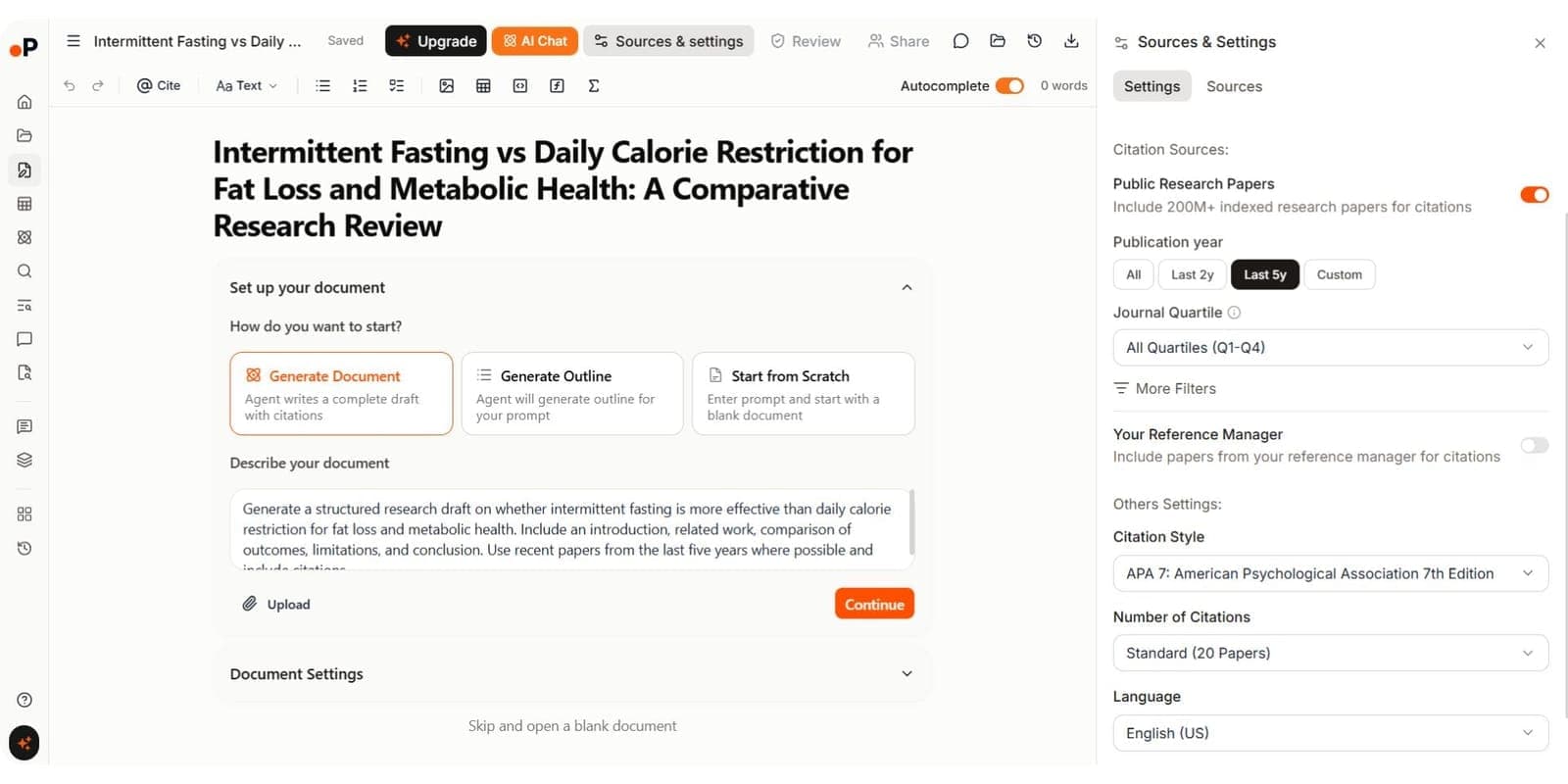
The Paperguide AI Paper Writer is the writing flagship of Paperguide, the AI-native platform for scientific research workflows and systematic reviews. It drafts complete research papers, literature review sections, methodology summaries, and full review chapters from a research question and source material, with citations applied automatically against the actual reference library throughout. Unlike general-purpose AI writers, every citation in the draft points to a real paper that exists in the library, not to a model that guessed a plausible reference.
For scientific writing specifically, the AI Paper Writer connects to the 200M+ paper database (PubMed, arXiv, OpenAlex, Semantic Scholar) and the researcher's own reference manager. Custom writing instructions and paper filters let the researcher control which sources the draft draws from, AI Edit handles section-level rewrites in the writing environment, Smart Continue completes sentences in the researcher's voice with citation support, and the built-in Plagiarism Checker (on every plan) catches similarity issues before submission.
Key Features
- Full research paper drafts: Generated from a research question and source material, with citations applied automatically throughout.
- Research before drafting: Finds papers, screens them against inclusion and exclusion criteria, extracts and synthesizes before writing, then emails you when the document is ready.
- Custom writing instructions and paper filters: Narrow the focus before drafting so the AI draws from the exact sources you choose.
- AI Edit: Rewrite, refine, or restructure any section without leaving the document.
- Three starting modes: Start a manuscript as a complete draft, an outline only, or from scratch.
- AI Chat inside the writer: Finds papers, verifies references, compares topics and drafts sections inside the manuscript, with citations applied to anything it adds.
- Smart Continue: Completes sentences in the researcher's voice with citation support, blending autocomplete with citation grounding.
- Citation grounding: Every reference verified against the actual library, eliminating fabrication at the architecture level.
- 1,000+ citation styles: APA, MLA, Chicago, Vancouver, Harvard, AMA, and every major scientific journal style.
- Plagiarism Checker: Built into every plan (4,000 words a month on Free, 20,000 on Plus, 100,000 on Pro and above), catches similarity issues before submission.
- Equation and formula support: LaTeX-style math blocks and inline equations for STEM manuscripts.
- AI Reference Manager: Every paper, citation, and source sits in one workspace with Zotero import, DOI/BibTeX/RIS support, and shared libraries.
- Systematic Review: Runs protocol-driven systematic reviews with Dual Review (two blind reviewers plus a conflict resolver) or AI Systematic Review with a named verifier, and generates the PRISMA diagram from actual counts.
- Export to Word, PDF, BibTeX, RIS, CSV, Excel: Ready for submission to any journal format.
- Import from Word: Bring an existing manuscript in from Word and keep writing with every feature available.
Pros
- Only AI for scientific writing that grounds every citation against a real reference library
- Connected to 200M+ peer-reviewed papers across PubMed, arXiv, OpenAlex, and Semantic Scholar
- Multi-section consistency across long-form scientific manuscripts
- Plagiarism Checker eliminates pre-submission similarity surprises
- Citation-grounded drafting reduces editorial-audit risk to near zero
- 30% academic discount with a valid university email
Cons
- Full-document draft generations capped by plan (2 on Free, 5 on Plus, 20 on Pro per month)
- Per-seat pricing; institutional licensing needs a custom Enterprise quote
Paperguide Pricing (2026)
| Plan | Price | What's Included |
|---|---|---|
| Free | $0/month | Basic AI Paper Writer access, 2,000 AI Credits, AI Reference Manager, AI Search, 2 full-document drafts/month |
| Plus | $12 per seat per month, billed annually ($144 a year) | 12,500 AI Credits, unlimited AI Searches, Plagiarism Checker (20,000 words a month), unlimited references, 5 full-document drafts/month |
| Pro | $29 per seat per month, billed annually ($348 a year) | 50,000 AI Credits, advanced AI features, 20 full-document drafts/month |
| Evidence Teams | $89 per seat per month, billed annually ($1,068 a year) | 150,000 AI Credits, PRISMA-grade dual reviewer screening, dedicated support |
| Enterprise | Custom | SSO, team workflows, dedicated support |
30% academic discount available with a valid university email.
Best For
Researchers, postdocs, faculty researchers, principal investigators, research labs, and systematic review teams writing scientific manuscripts, methodology sections, literature reviews, or grant proposals where citation integrity is non-negotiable.
Verdict
The Paperguide AI Paper Writer is the best AI for scientific writing in 2026 because no other writer grounds citations against a real reference library at this scale. For research labs, PIs, and systematic review teams writing scientific manuscripts that have to survive peer review and editorial audit, the Paperguide AI Paper Writer is the default starting point.
2. Jenni AI
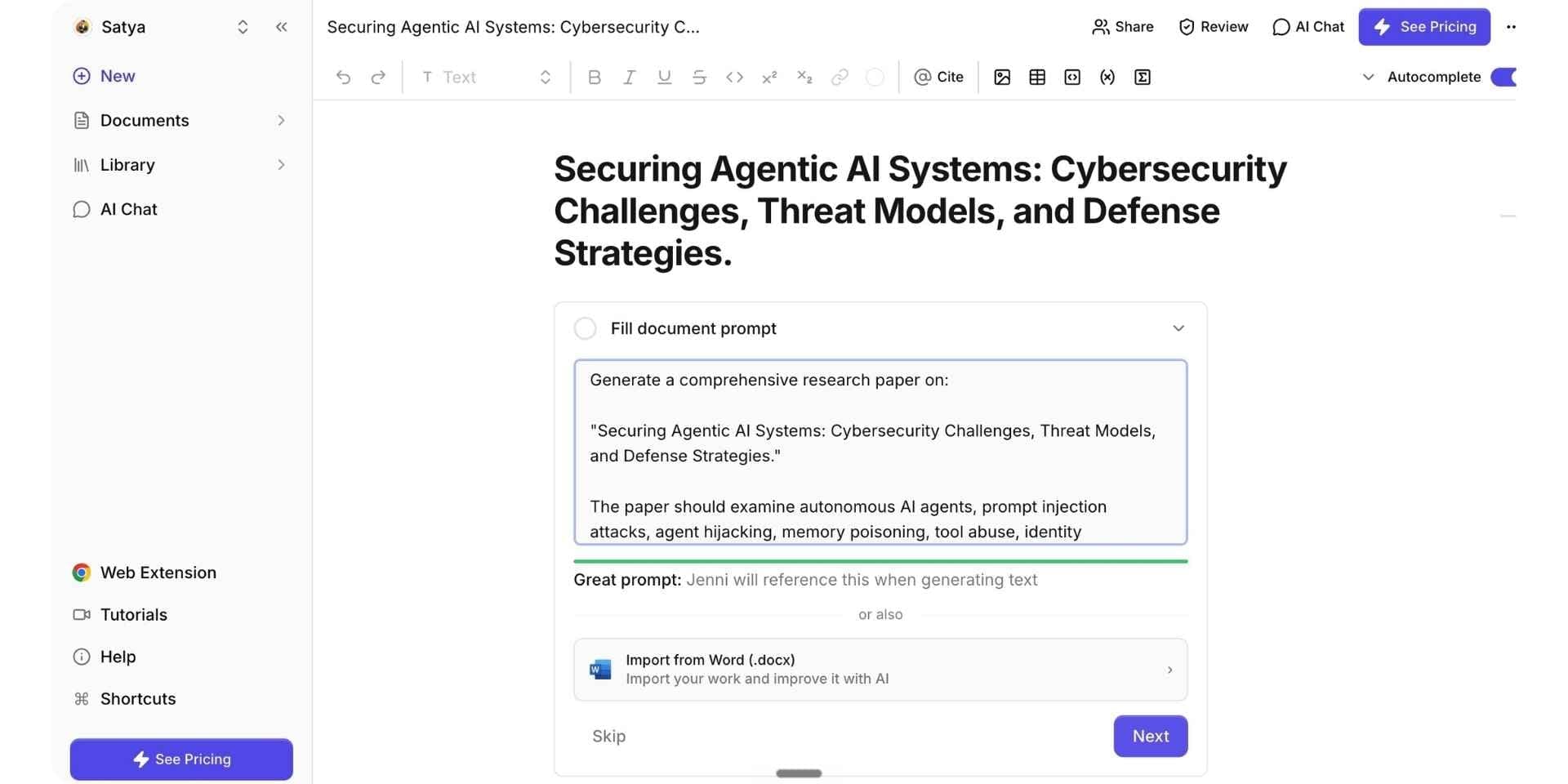
Jenni AI is an academic writing assistant built around in-line autocomplete. The researcher writes a few words, Jenni completes the sentence with academic-appropriate phrasing, and the researcher accepts or edits. Citations can be inserted in-line from Jenni's connected database as writing happens. Where Jenni stands out is the interactive autocomplete flow that keeps the researcher in control of sentence-level voice while Jenni accelerates phrasing, transitions, and academic register.
Jenni does not include a full scientific paper database or a citation-grounded multi-section drafting workflow at Paperguide's scale, so the researcher remains responsible for verifying suggested citations against the original sources.
Key Features
- Continuous autocomplete: Trained on academic writing, completes sentences in the researcher's voice.
- In-line citation insertion: Pulls citations from connected databases as writing happens.
- AI Edit toolbar: Paragraph-level rewriting and tone adjustments.
- Claim Confidence: Flags unsupported statements before submission.
- Outline generation: Builds a paper outline from a research question.
- Export to Word, LaTeX, BibTeX: Standard academic export formats.
Pros
- Fastest in-line drafting experience for writers who know what they want to say
- Claim Confidence catches unsupported statements before submission
- Free plan available for evaluation
Cons
- Free plan capped at 10 autocompletes per day
- Citation database smaller than Paperguide's 200M+ peer-reviewed corpus
- No structured literature review or systematic review workflow
Jenni AI Pricing (2026)
| Plan | Price | What's Included |
|---|---|---|
| Free | $0/month | 10 AI autocompletes/day, 10 PDF uploads, 3 AI Edits, 5 AI Chat, 3 Reviews, 2,600 citation styles |
| Plus | $12/month (annual, ~$30 monthly) | 5,000 autocompletes/month, unlimited PDF uploads, 500 AI Edits, 500 AI Chat, 10 Reviews, full document export, live chat support |
| Pro | $29/month (annual) | Unlimited AI autocomplete, unlimited PDF uploads, unlimited AI Edits, unlimited AI Chat, unlimited Reviews, priority support |
Best For
Researchers who write chapter-by-chapter and prefer autocomplete-style assistance over chat-based prompting.
Verdict
Jenni AI is the strongest in-line autocomplete tool for scientific writing in 2026. For researchers who need literature discovery, structured review, and citation-grounded multi-section drafting alongside autocomplete, Paperguide is the strongest Jenni AI alternative in 2026 because the AI Paper Writer plus AI Reference Manager plus Literature Review AI sit in one workspace.
3. Paperpal
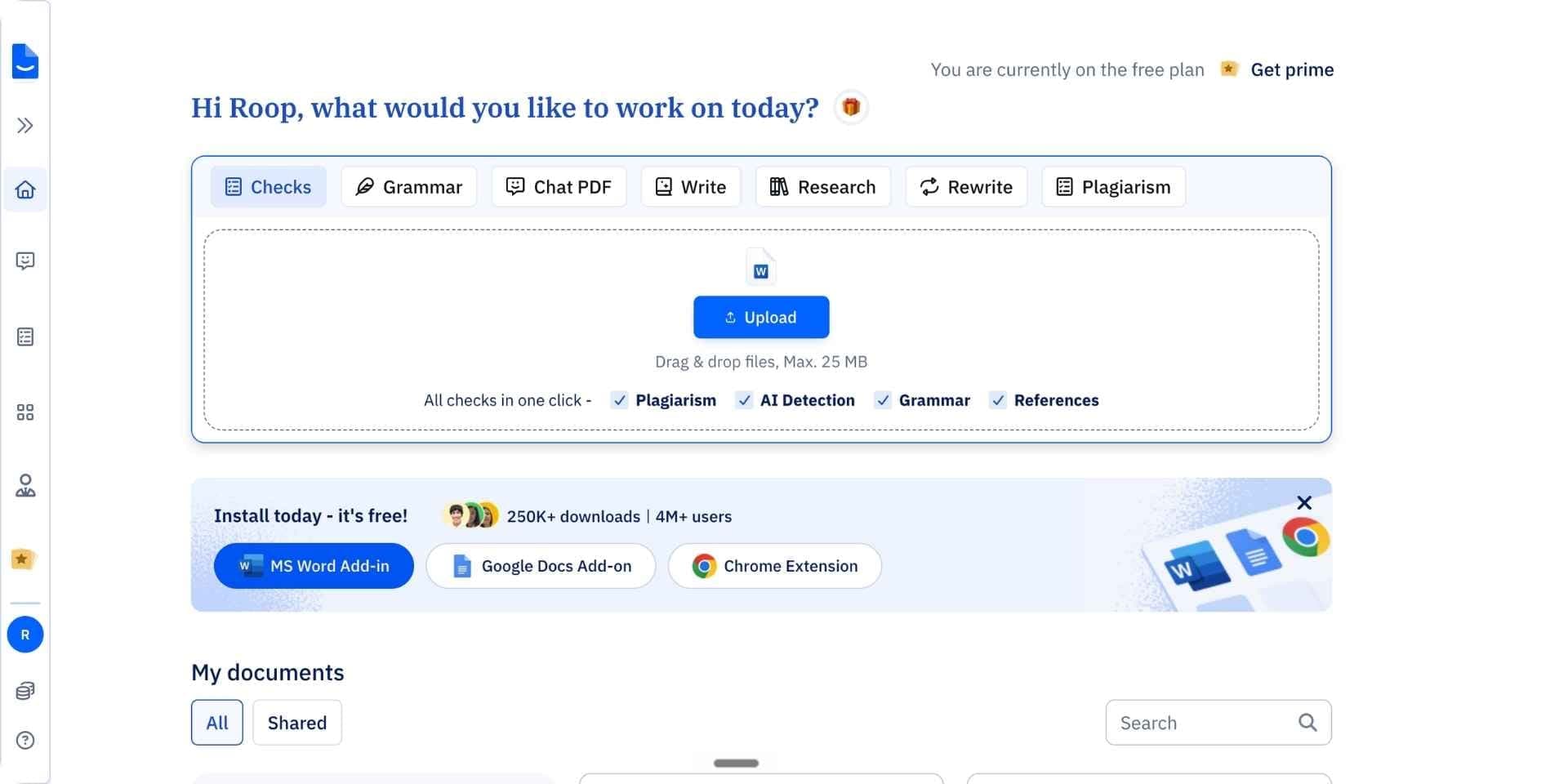
Paperpal is an academic writing assistant focused on late-stage manuscript editing, language polishing, and journal submission compliance. Originating from Editage's editorial services, Paperpal brings publishing-industry expertise into an AI tool that polishes scientific writing toward journal-ready quality, with real-time grammar and language suggestions tuned to the discipline, pre-submission checks, and a plagiarism scanner on paid plans.
Paperpal is an editor, not a drafter. It does not search for papers, generate full-section drafts from source material, or manage a reference library.
Key Features
- Real-time grammar and language suggestions: Tuned for academic English across STEM and humanities.
- Subject-area phrasing recommendations: Suggestions feel academic rather than generic.
- Pre-submission checks: Journal-readiness compliance checks before submission.
- Plagiarism scan: Available on paid plans.
- Word add-in: Edit in-line inside Microsoft Word.
- Citation suggestions: Suggestive citations during writing (manual verification required).
Pros
- Strongest manuscript editor for journal submission polish
- Subject-area awareness makes suggestions feel academic
- Word integration keeps editing in the tool most researchers actually use
Cons
- Built for editing, not drafting from scratch
- No literature search or scientific research workflow features
- Citation handling is suggestive rather than retrieval-grounded
Paperpal Pricing (2026)
| Plan | Price | What's Included |
|---|---|---|
| Basic | $0/month | Limited grammar and language suggestions |
| Prime | $11.58/month (annual) | Unlimited language suggestions, pre-submission checks, Word add-in |
| Pro | Higher tier | Advanced editing, plagiarism scan, journal compliance |
| Pro Max | Higher tier | Highest tier with all advanced features |
Best For
Researchers polishing scientific manuscripts before submission, especially non-native English researchers preparing for journal publication where language quality and submission compliance affect desk rejection.
Verdict
Paperpal is the best AI for late-stage scientific manuscript editing in 2026. For researchers who need editing alongside literature discovery, structured review, and citation-grounded drafting in one workspace, Paperguide is the strongest Paperpal alternative in 2026 because the AI Paper Writer, AI Reference Manager, and AI Search live in the same workspace as the editing layer.
4. Writefull
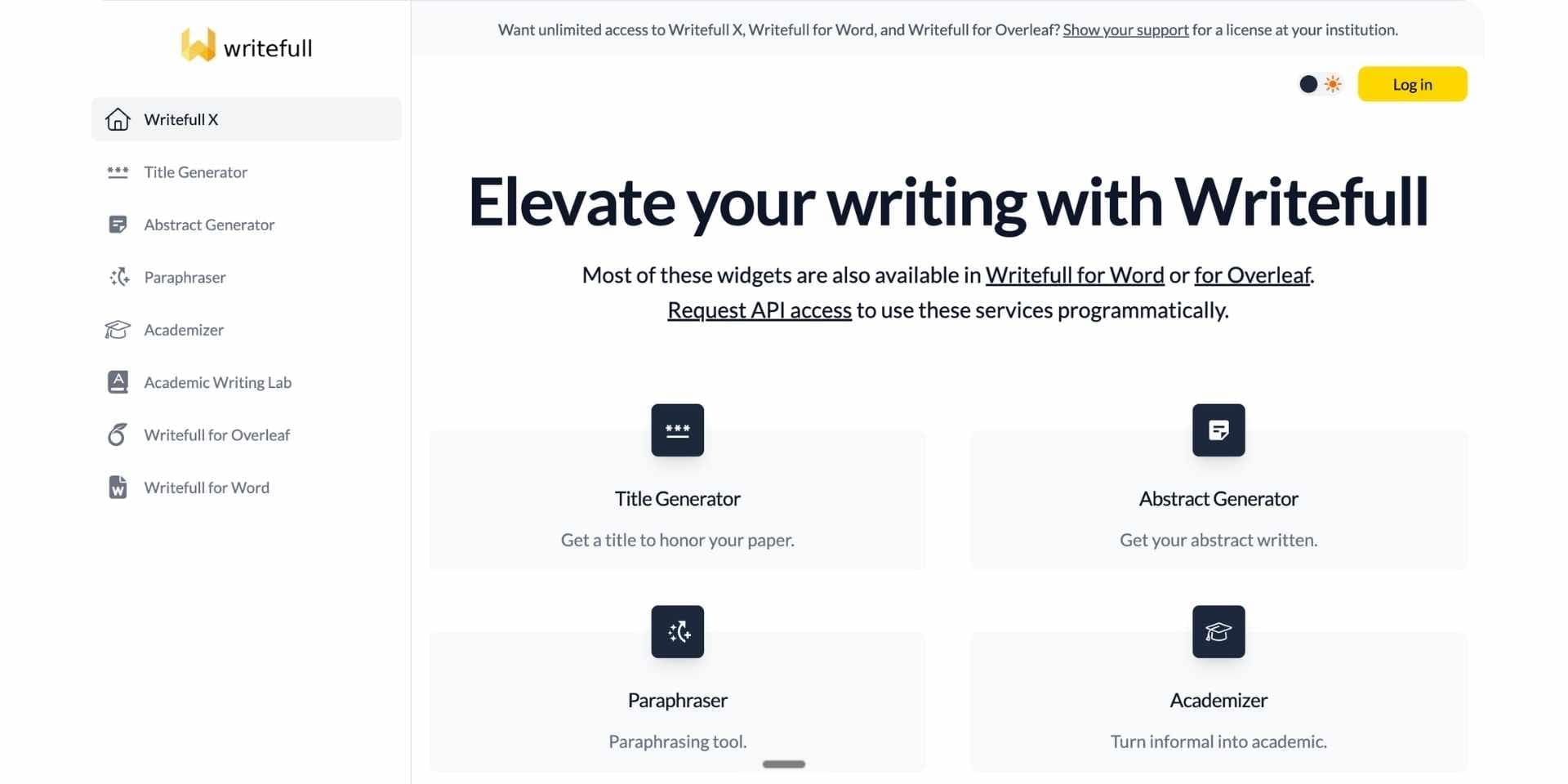
Writefull is a language polish tool trained specifically on published scientific literature. The platform catches hedging problems, flags informal register, and identifies sentences that are syntactically correct but stylistically unusual for academic English. Writefull is a finishing tool rather than a drafting tool: researchers write the manuscript elsewhere and run it through Writefull for language polish, particularly useful for non-native English researchers preparing journal submissions in STEM fields with LaTeX workflows.
Writefull is purely a language polish tool. It does not draft sections, handle citations, or manage references.
Key Features
- Trained on millions of published scientific articles: Suggestions feel native to scientific writing.
- Sentence palette: Surface published academic phrasing for context-appropriate substitutions.
- Title and abstract generators: Built specifically for scientific manuscript front matter.
- LaTeX integration: Rare among AI writers, fits STEM workflows.
- Overleaf integration: Edit directly inside Overleaf for collaborative manuscripts.
- Word add-in: Standard Microsoft Word integration.
Pros
- Sentence-level suggestions feel native to scientific writing
- LaTeX and Overleaf integration is rare among AI writers
- Affordable monthly price
Cons
- Language polish only, no drafting, no citation handling
- No reference manager or literature search
- Narrower feature set than the broader scientific writing platforms
Writefull Pricing (2026)
| Plan | Price | What's Included |
|---|---|---|
| Free | $0/year | Limited daily quota across Writefull tools |
| Premium | $150/year (~$12.50/mo) | Unlimited language edits, GPT Language Edits with Prompt, all rewriting features, Supercomplete, TeXGPT, Ask AI, Writefull X, Revise, Cite, full LaTeX tools |
| Group | $285/year per seat (save $15) | Premium access for groups of up to 100 users |
| Institution | Custom | Campus-wide access, contact sales |
Best For
Research groups and non-native English researchers preparing scientific manuscripts for journal submission, especially in STEM fields with LaTeX workflows.
Verdict
Writefull is the strongest AI for scientific language polish in 2026, especially for LaTeX-heavy STEM manuscripts. For researchers who want language polish plus citation-grounded drafting and a full-fledged reference manager in one workspace, Paperguide is the strongest Writefull alternative in 2026.
5. Trinka
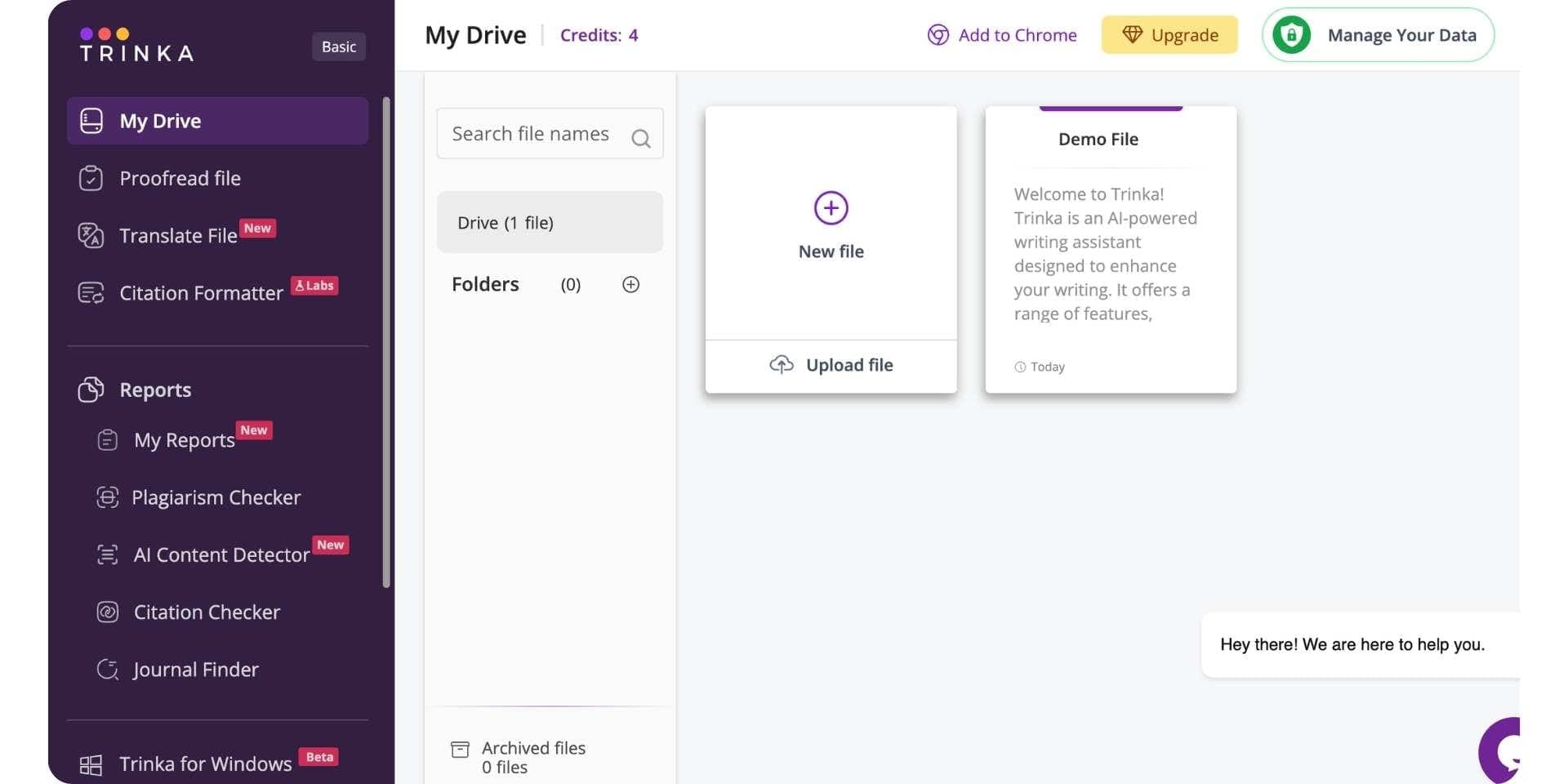
Trinka is an AI grammar checker built specifically for technical and scientific writing. The platform catches subject-specific grammar errors (article usage, prepositions, verb tense in research writing), suggests scientific phrasing alternatives, and includes plagiarism and citation checks. Trinka is widely used by non-native English researchers in STEM fields preparing manuscripts for ESL-sensitive journal review.
Trinka is a grammar-and-language tool. It does not draft sections or manage references.
Key Features
- Subject-area grammar: Medical, life sciences, engineering, and other STEM categories with discipline-specific suggestions.
- Scientific phrasing suggestions: Beyond generic grammar fixes, surfaces phrasing improvements specific to scientific writing.
- Plagiarism check: Built into paid tiers.
- Citation check: Surface citation formatting issues before submission.
- Word, browser, and cloud integrations: Standard cross-platform availability.
- Journal-specific checks: Compliance checks for specific journal styles.
Pros
- Strongest grammar tool for STEM and ESL writers
- Subject-area depth covers medical, life sciences, and engineering writing
- Reasonable monthly price
Cons
- Grammar focus only, no drafting or reference management
- Smaller user base than Grammarly or Paperpal
Trinka Pricing (2026)
| Plan | Price | What's Included |
|---|---|---|
| Basic | $0/month | 5,000 words/month grammar, 4 proofread files/month, Lite & Standard paraphrase modes, 1 plagiarism score/month |
| Premium | $6.67/month (annual, $80/year) | Unlimited grammar + paraphrase, Power Editing mode, Style Guide corrections (APA, AMA, ACS, AGU, IEEE), Windows Desktop app, 2 plagiarism scores/month |
| Premium Plus | $10.42/month (annual, $125/year) | Everything in Premium + 240 pages Standard Plagiarism or AI Detection, 600 Citation Formatting/year, file translation (30+ languages), 1,000 AI Writing Requests/month |
| Confidential Data | $41.67/month (annual, $500/year) | Everything in Premium Plus + instant data deletion, offline grammar checker, SOC2/HIPAA/ISO/GDPR compliance |
Best For
Non-native English researchers in STEM fields who need technical and scientific grammar correction with subject-area-specific suggestions.
Verdict
Trinka is the strongest AI grammar tool for technical and scientific writing in 2026. For researchers who need grammar polish plus the full citation-grounded scientific writing workflow in one workspace, Paperguide is the strongest Trinka alternative in 2026.
6. Grammarly
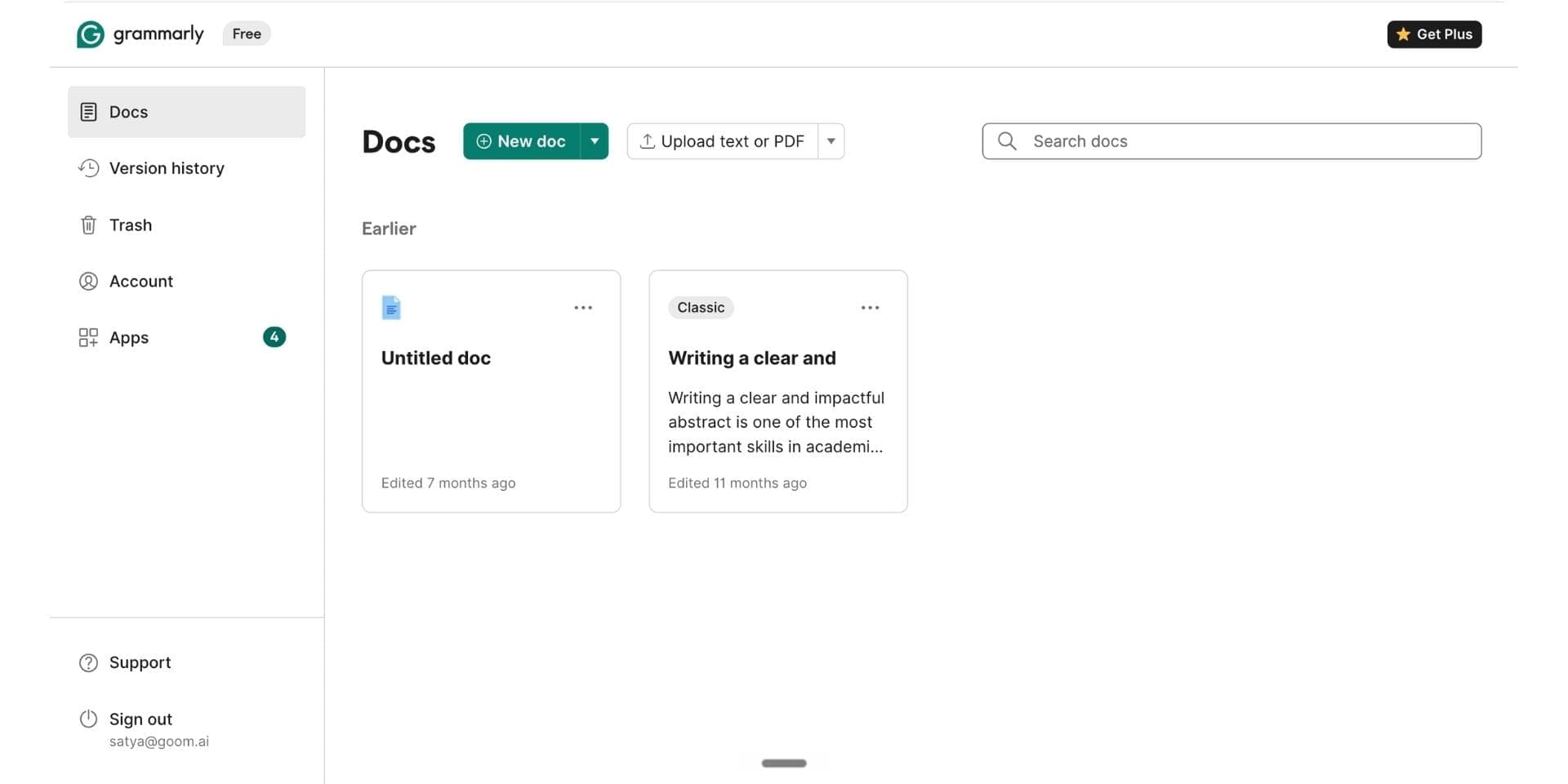
Grammarly is the most widely used AI writing assistant globally, with strong general grammar, clarity, and tone suggestions across web, desktop, and mobile surfaces. For scientific writing specifically, Grammarly's general-purpose suggestions cover the language layer competently but miss the subject-area depth that Paperpal, Writefull, and Trinka offer. Grammarly is most useful as a final-pass language check on top of a citation-grounded drafting workflow.
Grammarly does not handle citations, reference management, or any scientific research workflow stage.
Key Features
- Grammar, clarity, tone, and engagement suggestions: Cross-surface writing assistance.
- Browser, Word, mobile, and desktop integrations: Most comprehensive integration coverage in the category.
- Tone detector: Surface tone issues that academic writing should avoid.
- Plagiarism check: Built into Premium.
- Generative AI prompts: Available on Premium but not academic-tuned.
Pros
- Most widely used writing assistant globally
- Cross-platform integration is unmatched
- Free plan is genuinely useful for everyday writing
Cons
- General-purpose, not specialized for scientific writing
- No citation handling or reference library
- Generative AI features are not academic-tuned
Grammarly Pricing (2026)
| Plan | Price | What's Included |
|---|---|---|
| Free | $0/month | Basic grammar, clarity, and tone suggestions |
| Pro | $12/month (annual, $30 monthly) | Full grammar, clarity, tone, plagiarism, generative AI prompts |
| Business | $15/user/month (annual) | Team management, style guide, brand voice |
Best For
Researchers who want a general-purpose grammar and clarity check across all writing surfaces (browser, Word, mobile, email) as a final language pass.
Verdict
Grammarly is the broadest general writing assistant for scientific writing in 2026. For researchers who need scientific writing depth plus citation-grounded drafting that Grammarly does not provide, Paperguide is the strongest Grammarly alternative in 2026 for academic and scientific research work.
7. QuillBot
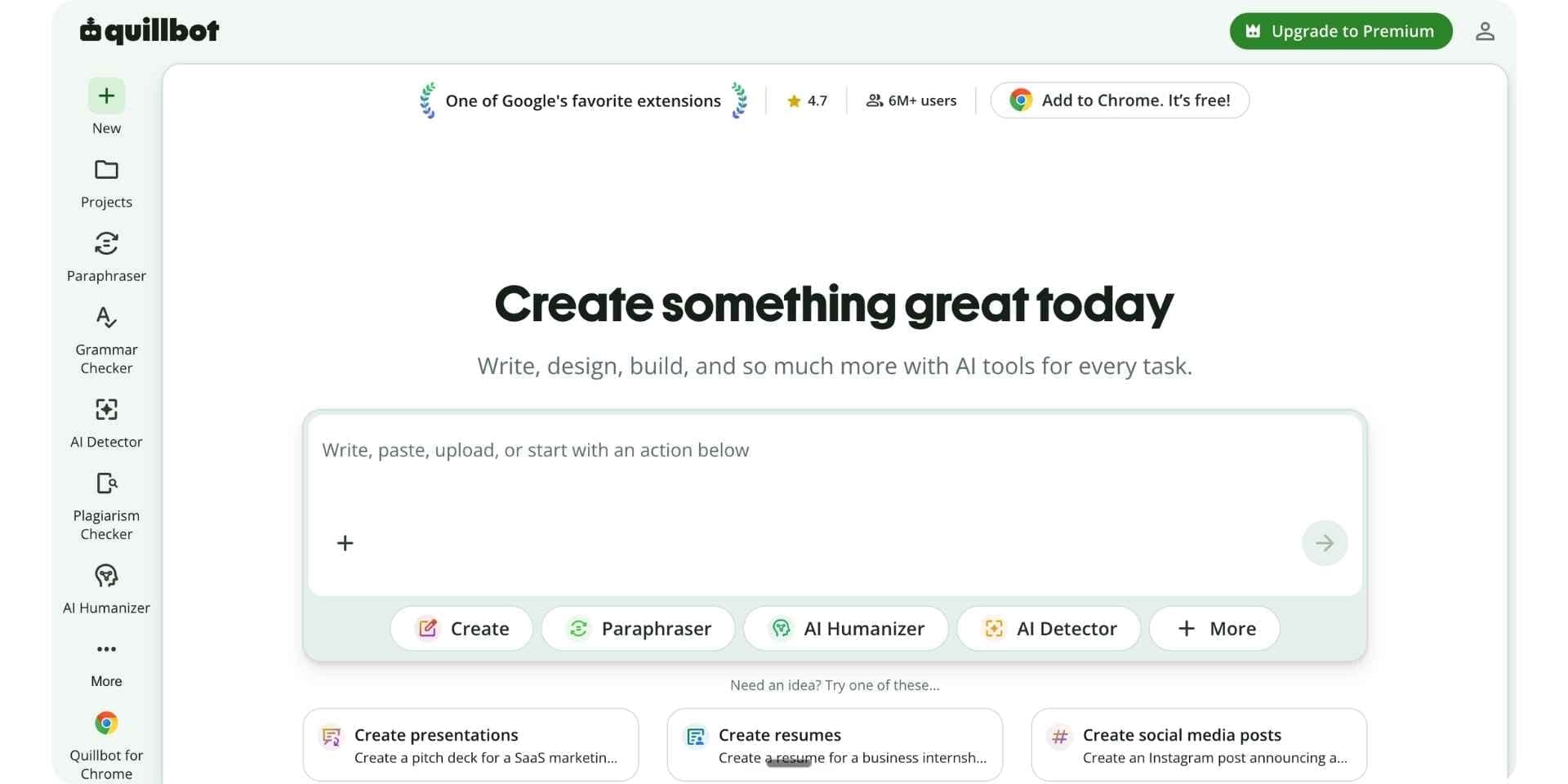
QuillBot is a paraphrasing tool with an academic mode that rephrases sentences while maintaining technical precision. The platform supports 23+ languages, includes a summarizer, grammar checker, and citation generator, and offers a free tier that is functional for occasional use. For scientific writing, QuillBot's academic paraphrasing mode is noticeably better than its standard mode at preserving terminology and avoiding inappropriate synonym substitution for technical terms.
QuillBot is single-purpose paraphrasing. It does not draft sections or ground citations against a real corpus.
Key Features
- Academic paraphrasing mode: Preserves technical terminology and avoids inappropriate synonym substitution.
- Summarizer: Quick summarization of dense passages.
- Grammar checker: Basic grammar correction layered on top of paraphrasing.
- Citation generator: Generate citations in common academic styles.
- 23+ languages: Multi-language paraphrasing support.
- Browser extension and Word add-in: Use paraphrasing inside the tools researchers already write in.
Pros
- Strongest free paraphrasing tool for scientific writing
- Academic mode preserves technical terminology
- Multi-language support across 23+ languages
Cons
- Single-purpose paraphrasing, no drafting, no citation grounding
- Free plan has word limits
- Premium tier is mid-priced for what it offers
QuillBot Pricing (2026)
| Plan | Price | What's Included |
|---|---|---|
| Free | $0/month | Limited words, basic paraphrasing modes |
| Premium (Annual) | $8.33/month ($99.95/year) | Unlimited words, all paraphrasing modes, summarizer, grammar checker, plagiarism checker, faster processing |
| Premium (Semi-Annual) | $13.31/month ($79.95) | Same Premium features at 6-month commitment |
| Premium (Monthly) | $19.95/month | Full Premium with no annual commitment |
| Student | $6.25/month | Verified student discount on all Premium features |
Best For
Researchers who need a free paraphrasing tool for scientific writing, especially for rephrasing dense academic passages without losing technical precision.
Verdict
QuillBot is the strongest free paraphrasing tool for scientific writing in 2026. For researchers who need paraphrasing plus the full citation-grounded scientific writing workflow in one workspace, Paperguide is the strongest QuillBot alternative in 2026.
How to Choose the Right AI for Scientific Writing
The right AI for scientific writing depends on the specific stage of the manuscript you're working on.
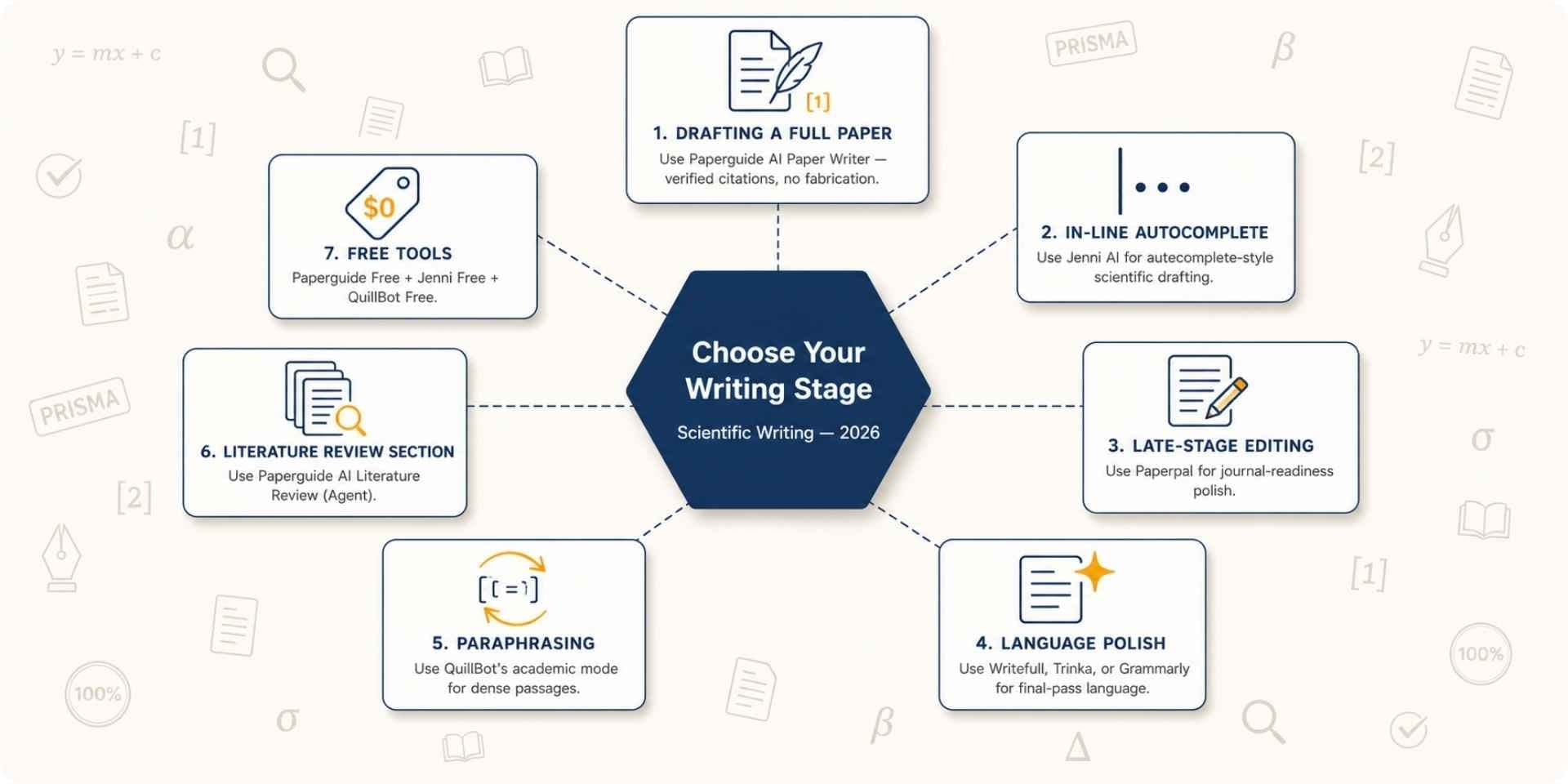
Need to draft a full research paper with verified citations? The Paperguide AI Paper Writer is the strongest pick because it drafts from a research question and source material with citations applied automatically against your actual library, eliminating fabrication risk.
Need fast in-line autocomplete while writing? Jenni AI is the strongest autocomplete-style scientific writer for researchers who know what they want to say and want help with phrasing and transitions.
Need late-stage editing and journal submission polish? Paperpal is built for late-stage manuscript polish, particularly for non-native English researchers preparing for high-impact journal submission.
Need language polish on a near-final draft? Writefull is the strongest tool trained on published scientific literature, especially for LaTeX-heavy STEM manuscripts. Trinka is the strongest grammar tool for ESL writers in STEM. Grammarly is the broadest general writing assistant.
Need to paraphrase dense academic passages? QuillBot's academic mode is the strongest free paraphrasing tool for scientific writing.
Need the literature review section drafted with citations? Paperguide Literature Review AI handles structured literature reviews end-to-end.
Looking for free AI for scientific writing? Paperguide Free + Jenni AI Free (200 words/day) + QuillBot Free together cover drafting, autocomplete, and paraphrasing at zero cost. Paperguide Free includes basic AI Paper Writer access, the AI Reference Manager, and 1,000+ citation styles.
For researchers who want one platform that handles the full scientific writing workflow, the Paperguide AI Paper Writer is the most comprehensive choice in 2026.
Best AI for Scientific Writing by Use Case (2026)
| Use Case | Best Tool | Why |
|---|---|---|
| Best AI for scientific writing overall | Paperguide AI Paper Writer | Citation-grounded multi-section drafting in one workspace |
| Best AI for in-line autocomplete scientific drafting | Jenni AI | Fastest autocomplete experience with Claim Confidence |
| Best AI for late-stage scientific manuscript editing | Paperpal | Subject-area polish + journal compliance for non-native English researchers |
| Best AI for academic language polish trained on published literature | Writefull | Trained on millions of published scientific articles with LaTeX integration |
| Best AI for technical and scientific grammar (ESL writers) | Trinka | Subject-area grammar across medical, life sciences, engineering |
| Best AI for general writing assistance | Grammarly | Broadest cross-platform integration, useful as a final language pass |
| Best AI for academic paraphrasing | QuillBot | Academic mode preserves technical terminology |
| Best AI for the literature review section of a scientific manuscript | Paperguide Literature Review AI | Standard mode (50 papers) + Extended mode (screens 200, uses top 50) |
| Best AI for the methodology section of a scientific manuscript | Paperguide AI Paper Writer | Grounded in retrieved papers from the 200M+ corpus |
| Best AI for citation accuracy in scientific writing | Paperguide AI Paper Writer | Retrieval grounded against the actual library, eliminates fabrication |
| Best AI reference manager for scientific writing | Paperguide AI Reference Manager | 1,000+ citation styles, Zotero import, every paper available across the workspace |
| Best free AI for scientific writing | Paperguide Free + Jenni AI Free + QuillBot Free | Together cover drafting, autocomplete, and paraphrasing at zero cost |
For deeper comparisons across the broader research AI cluster, see the full literature review tools comparison.
How the Paperguide Scientific Writing Workflow Works
Step 1. Plan the manuscript. Define the research question, target journal, and section scope (literature review, methodology, results, discussion).
Step 2. Pull source material. Select papers from the AI Reference Manager or pull new ones via AI Search across 200M+ peer-reviewed papers (PubMed, arXiv, OpenAlex, Semantic Scholar).
Step 3. Draft with citations. The AI Paper Writer drafts the section from the source material, applying citations automatically against the actual library. No fabrication.
Step 4. Refine with AI Edit. Section-level rewrites for clarity, tone, length, and academic register without leaving the writing environment.
Step 5. Check integrity. Built-in Plagiarism Checker (on every plan) catches similarity issues. Citation grounding ensures every reference points to a real paper in the library.
Step 6. Export and submit. Export to Word, PDF, BibTeX, or RIS with 1,000+ citation styles applied for journal submission.
Best AI for Scientific Writing in 2026: Final Comparison
| Feature | Paperguide AI Paper Writer | Jenni AI | Paperpal | Writefull | Trinka | Grammarly | QuillBot |
|---|---|---|---|---|---|---|---|
| Long-form draft generation | ✅ Multi-section | Partial | ❌ | ❌ | ❌ | ❌ | ❌ |
| Citation grounding | ✅ Verified retrieval | Partial | Partial | ❌ | ❌ | ❌ | ❌ |
| Paper corpus access | 200M+ peer-reviewed | Limited DB | None | None | None | None | None |
| Reference manager | ✅ AI Reference Manager | ❌ | ❌ | ❌ | ❌ | ❌ | ❌ |
| Academic language polish | Partial | Partial | ✅ | ✅ Strongest | ✅ | Partial | Partial |
| Subject-area specificity | ✅ | Partial | ✅ | ✅ | ✅ | ❌ | ❌ |
| Plagiarism check | ✅ All plans | ❌ | ✅ Paid | ❌ | ✅ Paid | ✅ Pro | ✅ Premium |
| In-line autocomplete | Partial (Smart Continue) | ✅ Strongest | ❌ | ❌ | ❌ | ❌ | ❌ |
| Paraphrasing | Partial (AI Edit) | Partial | ❌ | ❌ | ❌ | ❌ | ✅ Strongest |
| Free plan | ✅ Generous | ✅ 10/day | ✅ Limited | ✅ Limited | ✅ Limited | ✅ Genuine | ✅ Limited |
| Starting paid | $12 per seat/mo (billed annually) | $12/mo (annual) | $11.58/mo (annual) | $150/yr (~$12.50/mo) | $6.67/mo (annual) | $12/mo (annual) | $8.33/mo (annual) |
Common Mistakes When Using an AI for Scientific Writing
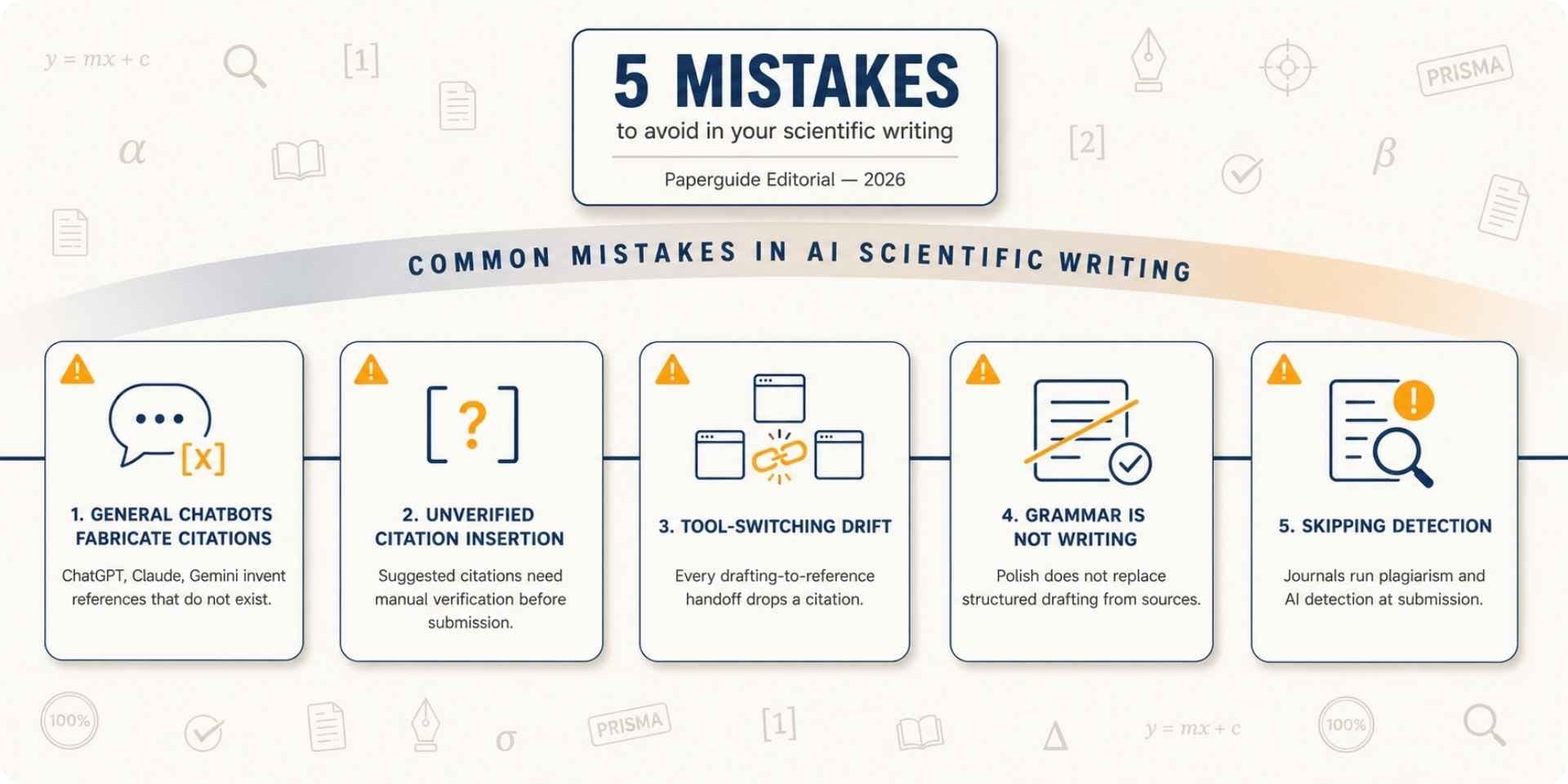
- Using a general-purpose chatbot to write scientific manuscripts. ChatGPT, Claude, and Gemini fabricate citations that do not exist. Multiple manuscript retractions through 2025 caught AI-generated fake references in published work. Use a citation-grounded AI for scientific writing instead.
- Trusting in-line citation insertion without verification. Tools that suggest citations without retrieving them from a real corpus need every reference manually verified before submission. Citation-grounded tools like the Paperguide AI Paper Writer eliminate this step at the architecture level.
- Drafting in one tool and managing references in another. Citation drift between tools is the most common scientific writing failure mode. Every handoff between a drafting tool and a reference manager is an opportunity for a citation to drop, get reformatted incorrectly, or get attached to the wrong claim.
- Treating grammar polish as scientific writing. Polishing prose does not replace structured drafting from retrieved sources. Grammar tools and citation-grounded writers solve different problems. Use both, but do not confuse them.
- Skipping plagiarism and AI detection before submission. Most journals now run both checks at submission. Choose an AI for scientific writing with a built-in Plagiarism Checker so similarity issues surface before the editor sees them.
Final Verdict
For researchers, postdocs, faculty researchers, and research teams writing scientific manuscripts in 2026, the Paperguide AI Paper Writer is the best AI for scientific writing, with full-section drafting from retrieved papers, citations applied automatically against the actual library, 1,000+ citation styles, a built-in Plagiarism Checker, and a connected AI Reference Manager. It is the only AI for scientific writing that survives editorial audit without manual citation cleanup.
The other six tools each occupy a specific slot in the scientific writing workflow. Jenni AI is the strongest pick for in-line autocomplete drafting where the researcher knows what to say and wants help with phrasing. Paperpal handles late-stage editing and journal submission polish, particularly for non-native English researchers preparing for high-impact journals. Writefull is the strongest language polish tool trained on published scientific literature, with LaTeX and Overleaf integration for STEM workflows. Trinka is the strongest grammar tool for ESL writers in STEM fields with subject-area suggestions. Grammarly is the broadest cross-platform general writing assistant, useful as a final language pass. QuillBot is the strongest free paraphrasing tool with an academic mode that preserves technical terminology.
For research labs, principal investigators, and systematic review teams who want one platform that handles the full scientific writing workflow without forcing tool-switching, the answer in 2026 is the Paperguide AI Paper Writer.
Frequently Asked Questions (FAQs)
What is the best AI for scientific writing in 2026? The best AI for scientific writing in 2026 is the Paperguide AI Paper Writer. As the writer inside Paperguide, the AI-native platform for scientific research workflows and systematic reviews, it drafts full scientific manuscripts with citations applied automatically against the actual reference library, eliminating the fabrication risk that disqualifies general-purpose AI writers from scientific work. The full 7-tool ranking includes Paperguide AI Paper Writer, Jenni AI, Paperpal, Writefull, Trinka, Grammarly, and QuillBot.
Which AI is best for scientific writing? The Paperguide AI Paper Writer is the strongest AI for scientific writing overall in 2026 because it grounds every citation against a real library and connects to 200M+ peer-reviewed papers across PubMed, arXiv, OpenAlex, and Semantic Scholar. For specific writing stages, Jenni AI handles autocomplete, Paperpal handles editing, Writefull handles language polish, and QuillBot handles paraphrasing.
What is the best AI tool for scientific writing? The best AI tool for scientific writing in 2026 is the Paperguide AI Paper Writer, the writing flagship of Paperguide, the AI-native platform for scientific research workflows and systematic reviews. It is the only AI for scientific writing that consolidates citation-grounded drafting, an AI Reference Manager with 1,000+ citation styles, a built-in Plagiarism Checker, and access to 200M+ peer-reviewed papers in one workspace.
What are the best practices for using AI when writing scientific manuscripts? The most important practice is to use AI tools that retrieve citations from a real corpus, not from training data. Pair drafting with a reference manager, verify every citation against the source, run a plagiarism and AI detection check before submission, and disclose AI use in the methodology or acknowledgments section per the target journal's policy. Tools like the Paperguide AI Paper Writer that ground every citation against the actual library reduce manuscript-level citation drift to near zero.
Can I use AI to write a full research paper? Yes, with citation-grounded AI for scientific writing like the Paperguide AI Paper Writer that drafts from a research question and source material with references applied automatically against the actual library. Full-paper drafting still requires researcher input on methodology depth, results interpretation, and discussion framing. AI accelerates drafting; it does not replace researcher judgment.
Is AI for scientific writing considered ethical? Used transparently with verified citations and disclosed in an AI use statement, AI-assisted scientific writing is widely accepted across journals in 2026. Most major publishers (Nature, Science, Cell Press, JAMA, Springer Nature, Taylor & Francis) require an AI disclosure at submission. What disqualifies AI-assisted manuscripts is undisclosed use, fabricated citations, or content that bypasses plagiarism and AI detection. Citation-grounded AI for scientific writing produces manuscripts that survive editorial audit; fluency-only AI does not.
What is the best free AI for scientific writing? The Paperguide Free plan is the strongest free AI for scientific writing in 2026, with basic AI Paper Writer access, AI Reference Manager, and 1,000+ citation styles. Jenni AI Free offers 200 words/day for in-line autocomplete drafting. QuillBot Free offers academic paraphrasing for occasional use. Combined, these three free tools cover the writing stages a budget-conscious researcher needs.
How does AI help with scientific writing? AI for scientific writing accelerates the most time-consuming stages: drafting first sections from source material, inserting citations from a reference library, polishing academic register, paraphrasing dense passages, and running plagiarism and grammar checks before submission. The strongest AI for scientific writing consolidates these stages into one workspace with citation grounding throughout.
Which AI is best for writing scientific papers without citation fabrication? Citation-grounded platforms like Paperguide retrieve references from a real corpus and link every citation to a source paper. Paperguide is the strongest for scientific writing because it grounds every claim against the actual reference library while drafting multi-section manuscripts. General-purpose foundation models (ChatGPT, Claude, Gemini) fabricate citations and should not be used as the primary citation source for scientific writing.
Do journals allow AI for scientific writing? Most major publishers (Nature, Science, Cell Press, JAMA, Springer Nature, Taylor & Francis) now permit AI-assisted scientific writing, provided you use a citation-grounded tool that retrieves from a verifiable database, disclose AI use in the Methods or Acknowledgments section, and take full responsibility for the accuracy of every reference. Citation-grounded tools like the Paperguide AI Paper Writer are preferred over general LLMs that frequently fabricate references.
Which AI is best for reading scientific papers before writing about them? Paperguide Chat with PDF handles paper reading inside the same workspace as the AI Paper Writer, so insights from a source paper flow directly into the manuscript with citations intact.
Writing a paper?
Write your paper with real citations
Drafts grounded in real papers, with citations in APA, MLA and Chicago.
Start writingNo credit card required