5 Best AI Dissertation Writers in 2026 (Free + Paid)


A dissertation is a 200-reference citation pipeline, not an 80,000-word writing problem.
Most AI dissertation writers optimise for word count and prose fluency. The actual hard problem in dissertation writing is citation integrity at scale: 200 or more references that need to stay consistent across five or six chapters, with zero fabricated citations, no broken bibliographies, and methodology sections that do not read generic because they were drafted from training data. The way doctoral candidates write dissertations has changed sharply in the last year, and the published evidence now reflects it. A peer-reviewed June 2025 mixed-methods study published in the Journal of Further and Higher Education (Akbar, 2025) surveyed 105 PhD students across UK universities and found that 65.7% reported using AI tools in their doctoral work, with 49.28% using AI for proofreading dissertation work and 40.58% for academic writing, making writing assistance, not data analysis or literature search, the single most common way doctoral candidates now use generative AI.
That shift puts AI dissertation writers under scrutiny that earlier writing tools did not face. Reviewers, supervisors, and external examiners are now running citation audits on doctoral submissions as routine practice, and the dissertations that survive viva examination in 2026 are the ones built on AI architecture that retrieves citations from a real connected reference library rather than generating them from training data.
This guide lists the best AI dissertation writers in 2026, ranks them by what working doctoral candidates actually need across drafting, autocomplete, editing, and language polish, and shows where each tool earns its spot in the dissertation writing workflow.
TL;DR
The Paperguide AI Paper Writer is the best AI dissertation writer in 2026. Inside Paperguide, the AI-native platform for scientific research workflows and systematic reviews, the AI Paper Writer drafts dissertation chapters with citations applied automatically against the actual reference library, supports multi-chapter consistency across 200 or more references, and ships an AI Reference Manager with 1,000+ citation styles. ThesisAI, Jenni AI, Paperpal, and Writefull are the strongest specialised alternatives for fastest long-form first drafts in LaTeX, in-line autocomplete dissertation drafting, late-stage manuscript editing, and academic language polish trained on published research literature.
Key Takeaways
- Paperguide AI Paper Writer is the #1 AI dissertation writer in 2026 for citation-grounded dissertation chapters with multi-chapter consistency across 200+ references.
- ThesisAI generates the longest first drafts (up to 80 pages from a single prompt) with native LaTeX and Overleaf integration, with Basic at $14/month and Pro at $18/month.
- Jenni AI is the strongest in-line autocomplete writer for chapter-by-chapter dissertation work, with Plus at $12/month and Pro at $29/month.
- Paperpal is the best AI for late-stage dissertation editing and pre-submission compliance, with Prime at $11.58/month billed annually ($139/year).
- Writefull is the strongest academic language polish trained specifically on published research literature, particularly for STEM dissertations in LaTeX, with Premium at $150/year.
Why AI Dissertation Writers Matter in 2026
A dissertation in 2026 sits inside a higher-stakes audit environment than at any point in the past decade. The peer-reviewed Akbar 2025 PhD survey above measured roughly two-thirds of doctoral candidates using AI tools in their work, with proofreading and academic writing the two most common applications. That adoption rate has changed how supervisors, examiners, and dissertation committees evaluate submitted work. Reviewers now expect verifiable citations, methodology sections that match published comparables, and bibliographies that survive automated reference checks. AI dissertation writers that draft from training memory and produce citation-shaped output without retrieval routinely fail these audits. AI dissertation writers that retrieve citations from a real connected reference library and ground every claim in source material pass them.
The 2026 case for the right AI dissertation writer is therefore not about word-count speed or prose quality. It is about whether the dissertation survives viva examination, external review, and the automated reference audits that universities increasingly run as part of dissertation deposit and degree conferral. A doctoral candidate who drafts five chapters in a citation-grounded workspace produces a manuscript where every cited paper is in the reference library, every in-text citation maps to a real bibliography entry, and every methodology section references comparable published studies that the examiner can verify on demand. A doctoral candidate who drafts five chapters across four disconnected tools produces a manuscript where citation drift, broken references, and generic methodology language are baked in by design.
How to Choose an AI Dissertation Writer in 2026?
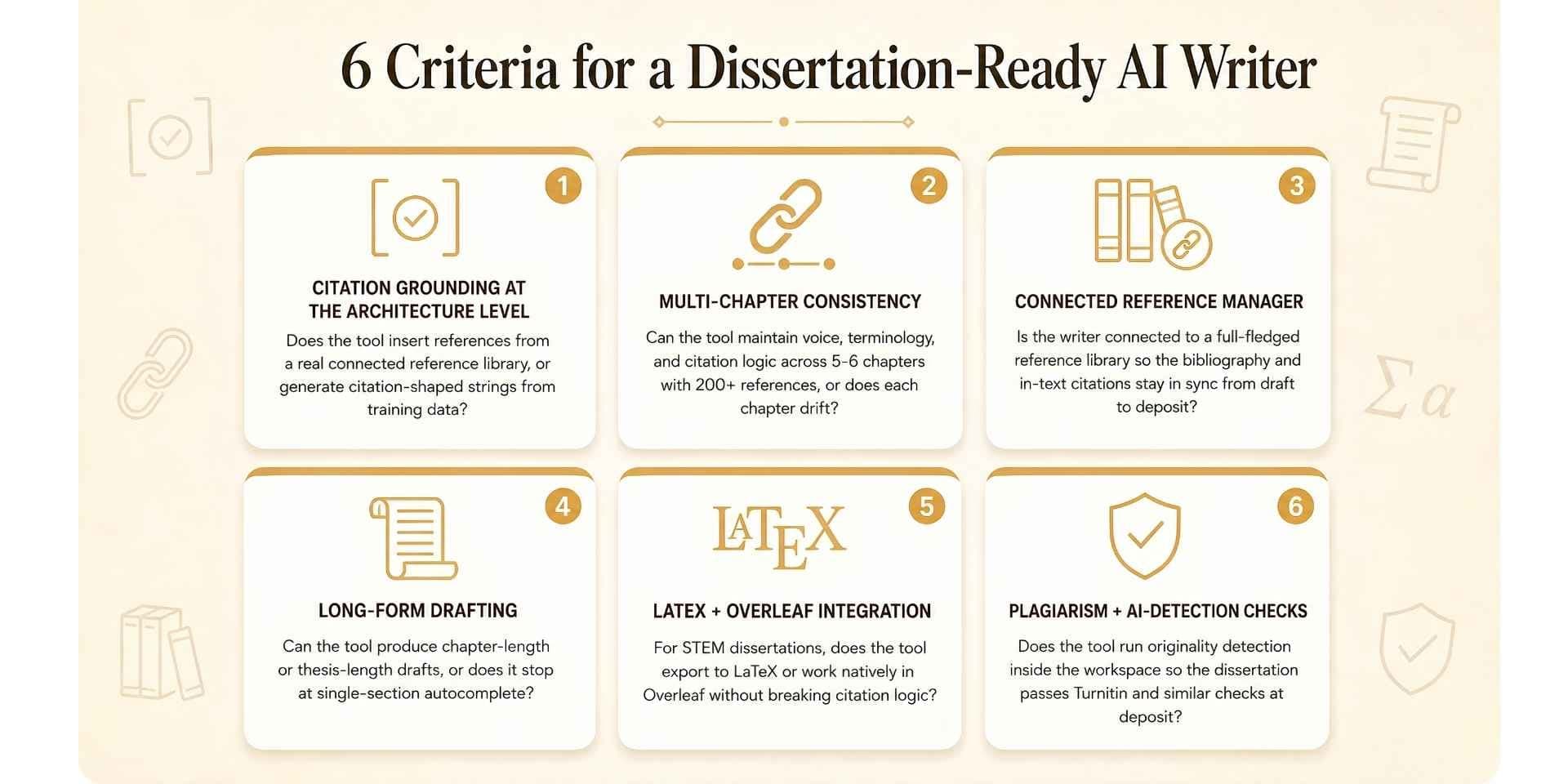
Before comparing the five tools below, here are the criteria that separate research-grade AI dissertation writers from general AI writers.
- Citation grounding at the architecture level: Does the tool insert references from a real connected reference library, or generate citation-shaped strings from training data?
- Multi-chapter consistency: Can the tool maintain voice, terminology, and citation logic across five or six chapters with 200+ references, or does each chapter drift?
- Connected reference manager: Is the writer connected to a full-fledged reference library so the bibliography and in-text citations stay in sync from draft to deposit?
- Long-form drafting: Can the tool produce chapter-length or thesis-length drafts, or does it stop at single-section autocomplete?
- LaTeX and Overleaf integration: For STEM dissertations, does the tool export to LaTeX or work natively in Overleaf without breaking citation logic?
- Plagiarism and AI-detection checks: Does the tool run originality detection inside the workspace so the dissertation passes Turnitin and similar checks at deposit?
Quick Comparison: Top AI Dissertation Writers in 2026
| Tool | Best For | Citation Grounding | Long-form Drafting | Paid Entry |
|---|---|---|---|---|
| Paperguide AI Paper Writer | Citation-grounded dissertation chapters | Verified retrieval | Multi-chapter | $12 per seat/mo Plus, billed annually |
| ThesisAI | 80-page first drafts in LaTeX | Suggestive | 80 pages from one prompt | $14/mo Basic |
| Jenni AI | Chapter-by-chapter autocomplete | Partial | Partial | $12/mo Plus |
| Paperpal | Late-stage dissertation editing | Partial (Research & Cite) | Editor only | $11.58/mo Prime (annual) |
| Writefull | Academic language polish (especially STEM/LaTeX) | None | None | $150/year Premium |
Best AI Dissertation Writers in 2026
1. Paperguide AI Paper Writer
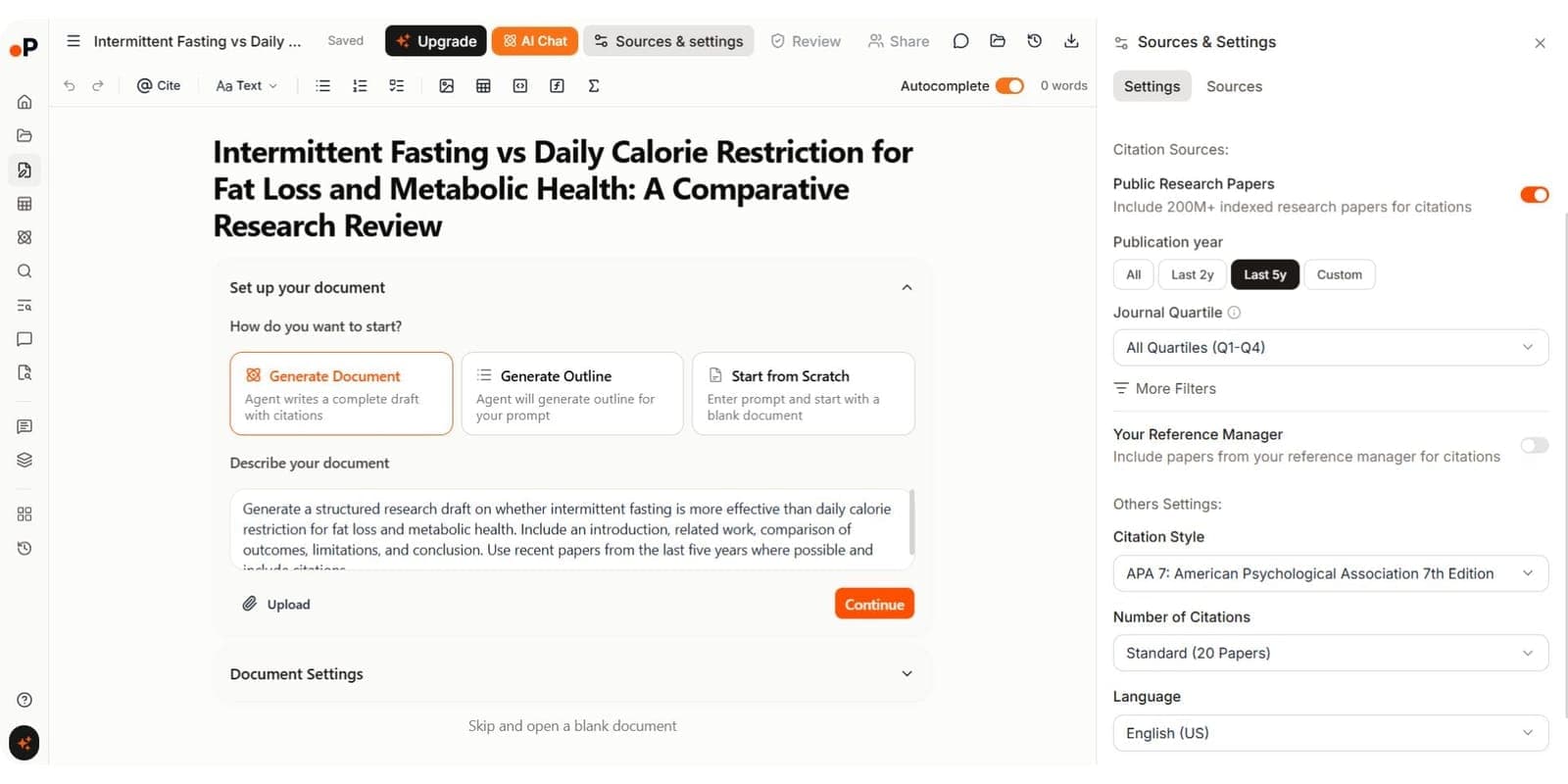
The Paperguide AI Paper Writer is the writing flagship of Paperguide. For dissertation writing specifically, the platform consolidates the citation-integrity work that defines a viva-ready manuscript: draft chapter-length content from a research question and source material, apply citations automatically against the actual reference library throughout the draft, maintain consistency across multiple chapters with 200 or more references, and export to Word, PDF, BibTeX, or RIS for supervisor review or dissertation deposit. Every reference inserted in the dissertation is verified against the connected library at insertion time, which eliminates the fabricated-citation failure mode that deposit-stage citation audits are designed to catch.
The architecture connects to the rest of the platform, and that is what makes the Paperguide AI Paper Writer the best AI dissertation writer in 2026. A reference saved through Zotero import or DOI lookup is immediately citable in the writer. A literature chapter built with the Extended-mode literature review pulls from a screened set of up to 200 papers. A methodology section drafted against retrieved comparable studies grounds every methodological choice in real published precedent rather than generic training-data prose. The result is a dissertation drafting experience where citation integrity is the default state across all chapters, not an audit problem solved manually after the manuscript is built.
Key Features
- AI Paper Writer: Drafts complete dissertation chapters, literature reviews, methodology sections, and discussion chapters from a research question and source material, with citations applied automatically against the actual reference library. Every reference is verified against the actual library, eliminating fabricated citations at the architecture level. Supports 1,000+ citation styles for any university or journal house style.
- Three starting modes and Smart Continue: Start a chapter as a complete draft, an outline only, or from scratch, then let Smart Continue pick up from the cursor, follow the draft's logic and cite your selected sources.
- AI Chat inside the writer: Finds papers, verifies references, compares topics and drafts sections without leaving the dissertation document, and anything it adds arrives with citations applied.
- Import from Word: Bring an existing chapter in from Word and keep writing with every feature available, then export back to Word or PDF.
- Drafting controls: Set custom writing instructions, word count and citation count limits, filter sources by year, folder and journal quartile, and tell the AI to cite specific papers. Equations go in as KaTeX math blocks, or describe one in plain English and the AI writes it.
- Literature Review AI: Dedicated structured agent for the dissertation literature chapter. Follows a five-step Plan / Search / Screen / Extract / Synthesise pipeline producing a citation-grounded review document organised into clear themes. Standard mode handles up to 50 papers; Extended mode screens up to 200 papers for dissertation-scale literature coverage.
- AI Reference Manager: Built-in reference library supporting import through DOI, URL, BibTeX, RIS, PDF upload, and one-click Zotero or Mendeley migration. Automatic metadata retrieval, open-access PDF fetching, PDF reader with annotations, AI summaries, and shared libraries with role-based permissions for supervisor or co-author collaboration.
- AI Search: Hybrid semantic and keyword search across 200M+ peer-reviewed papers (PubMed, arXiv, OpenAlex, Semantic Scholar) for finding comparable methodology and supporting evidence.
- Research Agent: The most complete workflow on the Paperguide platform. Runs a single connected session end to end across discovery, screening, comparison, gap analysis, extraction, drafting, and citation handling. A paper surfaced in search is already in the library, and a claim added to a dissertation chapter is already cited.
- Extract Data: Pull methodology details, sample sizes, study designs, and findings from multiple papers into evidence tables for the dissertation's results or discussion chapter. Every extracted value links back to its source passage.
- Chat with PDF: Section-grounded Q&A across uploaded papers with answers highlighted back to source passages, useful for methodology validation and finding cross-references during the dissertation drafting phase.
- Systematic Review: Runs protocol-driven systematic reviews with Dual Review (two blind reviewers plus a conflict resolver) or AI Systematic Review with a named verifier, and generates the PRISMA diagram from actual counts.
- Paper quality evaluation: SJR (SCImago Journal Rank), SNIP (Source Normalized Impact per Paper), and citation-based scoring helps prioritise high-quality sources for dissertation reference lists.
- Plagiarism Checker: Available on every plan (4,000 words a month on Free, 20,000 on Plus, 100,000 on Pro and above) for pre-submission scanning across academic literature and web sources, catching paraphrasing overlap before the dissertation goes to supervisor review or formal deposit.
- Collaboration: Shared folders, papers, annotations, and drafts with supervisors, advisors, and co-authors, with role-based permissions across the reference library.
- Multi-chapter consistency: Voice, terminology, and citation logic preserved across all dissertation chapters, with the reference library staying in sync across the full manuscript.
- Export options: Submission-ready output to Word, PDF, BibTeX, RIS, CSV, and Excel formats with reference list consistency preserved for any university dissertation template.
Pros
- Only AI dissertation writer that grounds citations against a real connected library at this scale.
- 200M+ peer-reviewed papers across four scientific databases gives cross-disciplinary coverage for any dissertation field.
- Multi-chapter consistency across 200 or more references with citation logic preserved end to end.
- Extended-mode Literature Review AI supports dissertation-scale literature chapters (up to 200 papers screened).
- Free plan covers small dissertation phases with 2,000 AI credits per month.
Cons
- Free plan limits (2,000 AI credits per month) cap extensive literature work at zero cost.
- AI Paper Writer documents are capped by plan tier (5 per month on Plus, 20 on Pro), so a multi-chapter drafting schedule may need Pro.
Best For
Doctoral candidates, postdocs, faculty researchers, and research teams writing dissertation-length academic work (200+ references, multi-chapter consistency) where citation accuracy decides whether the dissertation survives viva examination and post-deposit audit.
Pricing
| Plan | Price | What It Covers |
|---|---|---|
| Free | $0 | 2,000 AI credits per month, Literature Review AI, Deep Research Report, Chat with PDF, reference manager with 1,000+ citation styles, extraction tables with 5 columns across 10 papers. |
| Plus | $12 per seat per month, billed annually ($144 a year) | 12,500 AI credits, unlimited AI searches and PDF chats, extraction tables with 50 custom columns across 100 papers, 5 AI Paper Writer documents per month, plagiarism checker (20,000 words a month). |
| Pro | $29 per seat per month, billed annually ($348 a year) | 50,000 AI credits, 20 AI Paper Writer documents per month, plagiarism checker (100,000 words a month), for heavier dissertation work. |
| Evidence Teams | $89 per seat per month, billed annually ($1,068 a year) | 150,000 AI credits, PRISMA-grade dual reviewer screening, dedicated support. |
| Enterprise | Custom | Institutional licensing for universities, research labs, and corporate research teams. Students get a 30% academic discount with a valid university email. |
Verdict
The Paperguide AI Paper Writer is the best AI dissertation writer in 2026 because it grounds every citation against a real connected reference library at dissertation scale, supports multi-chapter consistency across 200 or more references, and consolidates literature review, drafting, reference management, and plagiarism checking inside one workspace. It is the same connected backbone profiled across AI tools for research paper writing and the broader academic research AI landscape, applied here to the dissertation-length writing workflow.
2. ThesisAI
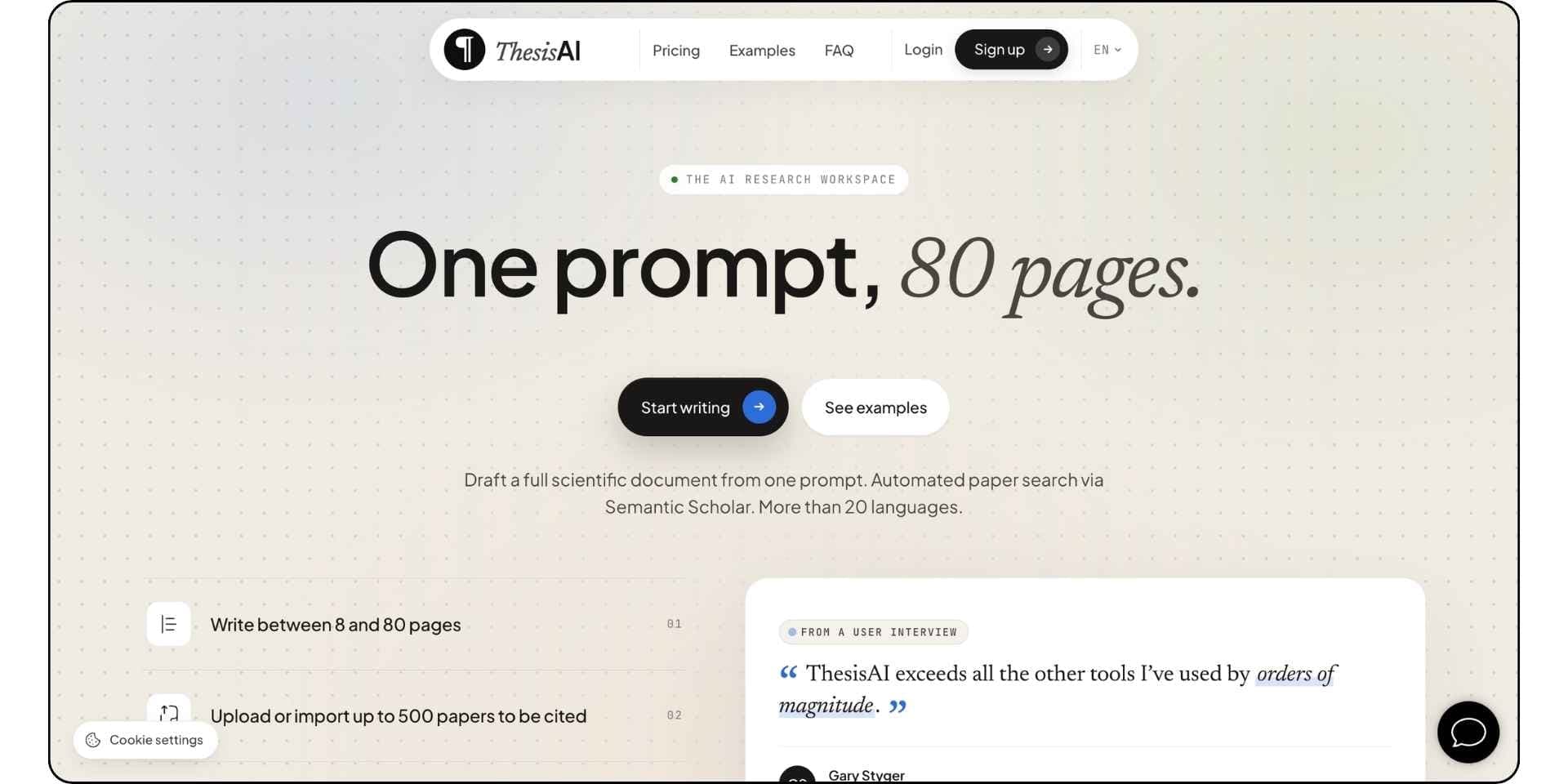
ThesisAI generates academic drafts of up to 80 pages from a single prompt with native LaTeX, Overleaf, and Zotero integration. The single-prompt long-form generation is the headline capability and the differentiator from every other writer in this list. A doctoral candidate provides the research question, dissertation topic, and target length, and ThesisAI produces a structured 80-page draft with section organisation, citation suggestions, and LaTeX formatting ready for Overleaf import. For STEM dissertations where the draft volume is the primary bottleneck, ThesisAI compresses what would otherwise be weeks of drafting into hours.
What ThesisAI does well is first-draft speed at dissertation scale. Where most writers produce one section at a time, ThesisAI produces an entire long-form chapter or even a full dissertation draft from a single prompt, which is useful as a structural starting point. What ThesisAI does less well than Paperguide is citation grounding; the references in the generated draft are suggestive and require manual verification against actual sources before the dissertation goes to supervisor review.
Key Features
- 80-page document generation from a single prompt (Pro tier).
- Native LaTeX and Overleaf integration.
- Zotero integration as a citation source.
- Multiple document types (dissertation chapter, full thesis, review paper, report).
- Section-by-section regeneration for refinement.
- Low AI-detectability output mode on Pro.
- Full citation report on Pro.
Pros
- Fastest long-form first-draft generator in this list at dissertation scale.
- Native LaTeX and Overleaf workflow integration for STEM dissertations.
- Affordable Basic tier at $14/month (50% off from $28).
Cons
- Single-prompt drafts require substantial editing for citation verification, voice, and methodology accuracy.
- Citation handling is suggestive, not retrieval-grounded into a connected reference library.
- No literature review or research workflow features beyond drafting.
Best For
STEM doctoral candidates wanting a fast 80-page first draft of a dissertation chapter or extended methodology section in LaTeX, with the understanding that the output is a starting point requiring substantial editing and citation verification.
Pricing
| Plan | Price | What It Covers |
|---|---|---|
| Basic | $14/mo annual ($168/yr, 50% off from $28) | Up to 50 pages per document, PDF/LaTeX/BibTeX export. |
| Pro | $18/mo annual ($216/yr, 50% off from $36) | Up to 80 pages per document, Word export, full citation report, low AI-detectability output. |
Verdict
ThesisAI is the strongest first-draft generator for long dissertation drafts in LaTeX in 2026. Paperguide is the best ThesisAI alternative for retrieval-grounded citations and multi-chapter consistency where every cited reference is verifiable against the connected reference library.
3. Jenni AI
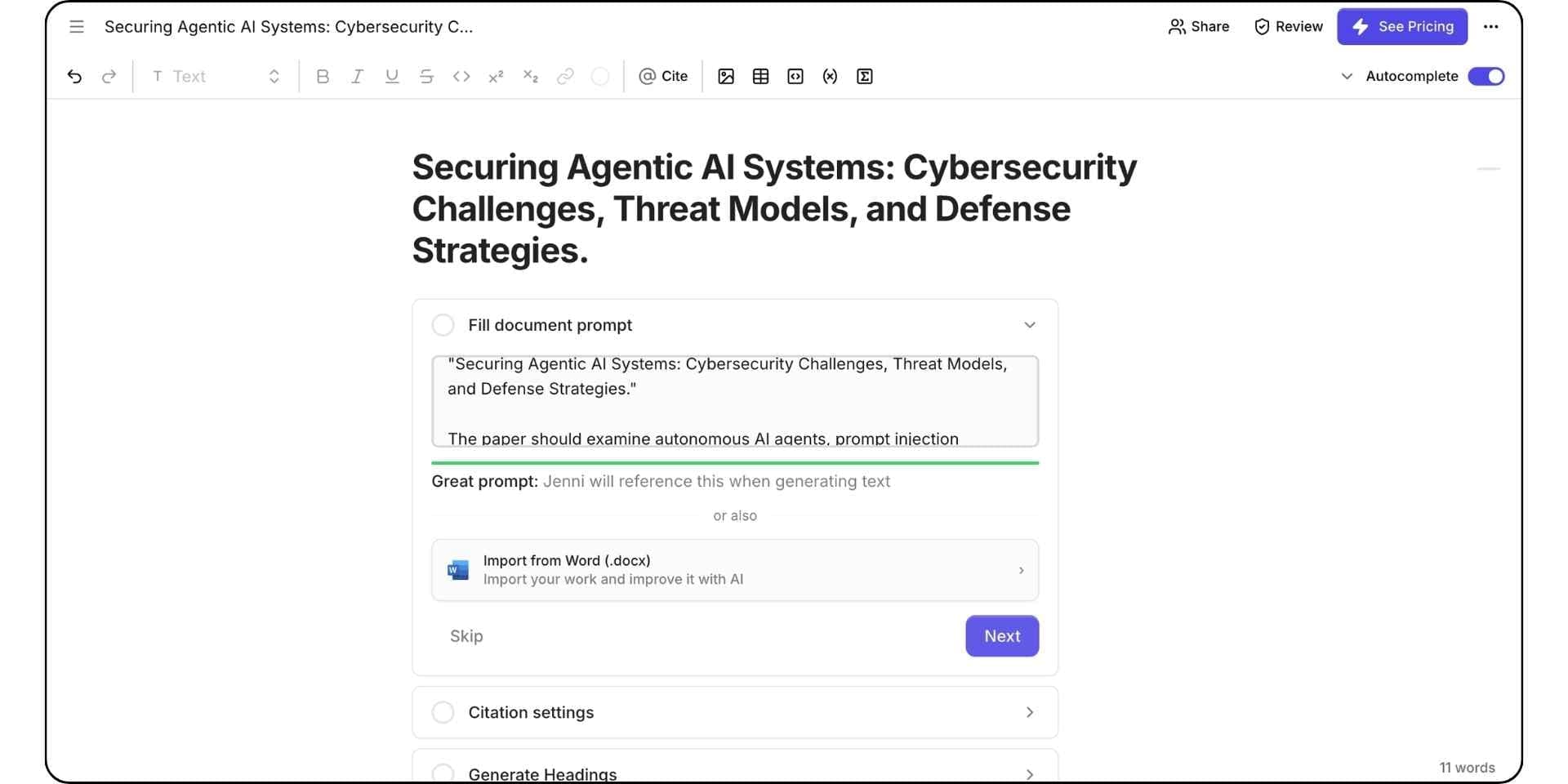
Jenni AI is the in-line autocomplete writer for chapter-by-chapter dissertation drafting in 2026. The doctoral candidate writes a few words and Jenni completes the sentence with academic-appropriate phrasing pulled from a writer trained specifically on academic prose. Citations can be inserted in-line from Jenni's connected database, and the AI Edit toolbar handles paragraph-level rewriting, summarisation, and tone adjustment during the active drafting phase.
What Jenni does well is the typing experience for dissertation work. The autocomplete is fast, the suggestions feel native to academic writing, and the Claim Confidence feature flags statements that lack supporting evidence in the connected sources. What Jenni does less well than Paperguide is corpus breadth and connected workflow depth; the citation database is smaller than Paperguide's 200M+ peer-reviewed papers, and there is no full Research Agent or Literature Review AI handoff into the writer.
Key Features
- Continuous autocomplete trained on academic writing.
- In-line citation insertion from a connected database.
- AI Edit toolbar for paragraph-level rewriting during dissertation drafting.
- AI Chat for paper-grounded Q&A.
- Reviews feature for paper-level critique.
- 10,000+ citation styles for dissertation reference lists.
- Export to Word, LaTeX, BibTeX, RIS.
Pros
- Fastest in-line autocomplete drafting experience for dissertation chapters.
- 10,000+ citation styles available across all plans.
- Active free tier supports trial use during dissertation planning (10 autocompletes per day).
Cons
- Citation database smaller than Paperguide's 200M+ peer-reviewed corpus.
- No Research Agent or Literature Review AI handoff into the writer for dissertation literature chapters.
- Pro tier at $29/month is the highest in this list for single-feature pricing.
Best For
Doctoral candidates who write dissertation chapters one at a time and prefer autocomplete-style assistance over multi-section generation from a research question.
Pricing
| Plan | Price | What It Covers |
|---|---|---|
| Free | $0/mo | 10 AI autocompletes/day, 10 PDF uploads, 3 AI Edits, 5 AI Chat messages, 3 Reviews, 10,000+ citation styles, unlimited citations. |
| Plus | $12/mo | 5,000 autocompletes/month, unlimited PDF uploads, 500 AI Edits/month, 500 AI Chat/month, 10 Reviews/month, live chat support. |
| Pro | $29/mo | Unlimited autocomplete, PDF uploads, AI Edits, AI Chat, Reviews; priority support. |
Verdict
Jenni AI is the strongest in-line autocomplete writer for dissertation chapter drafting in 2026. Paperguide is the best Jenni AI alternative for doctoral candidates who need literature review, methodology research, and citation-grounded drafting in one connected workspace alongside the autocomplete experience.
4. Paperpal
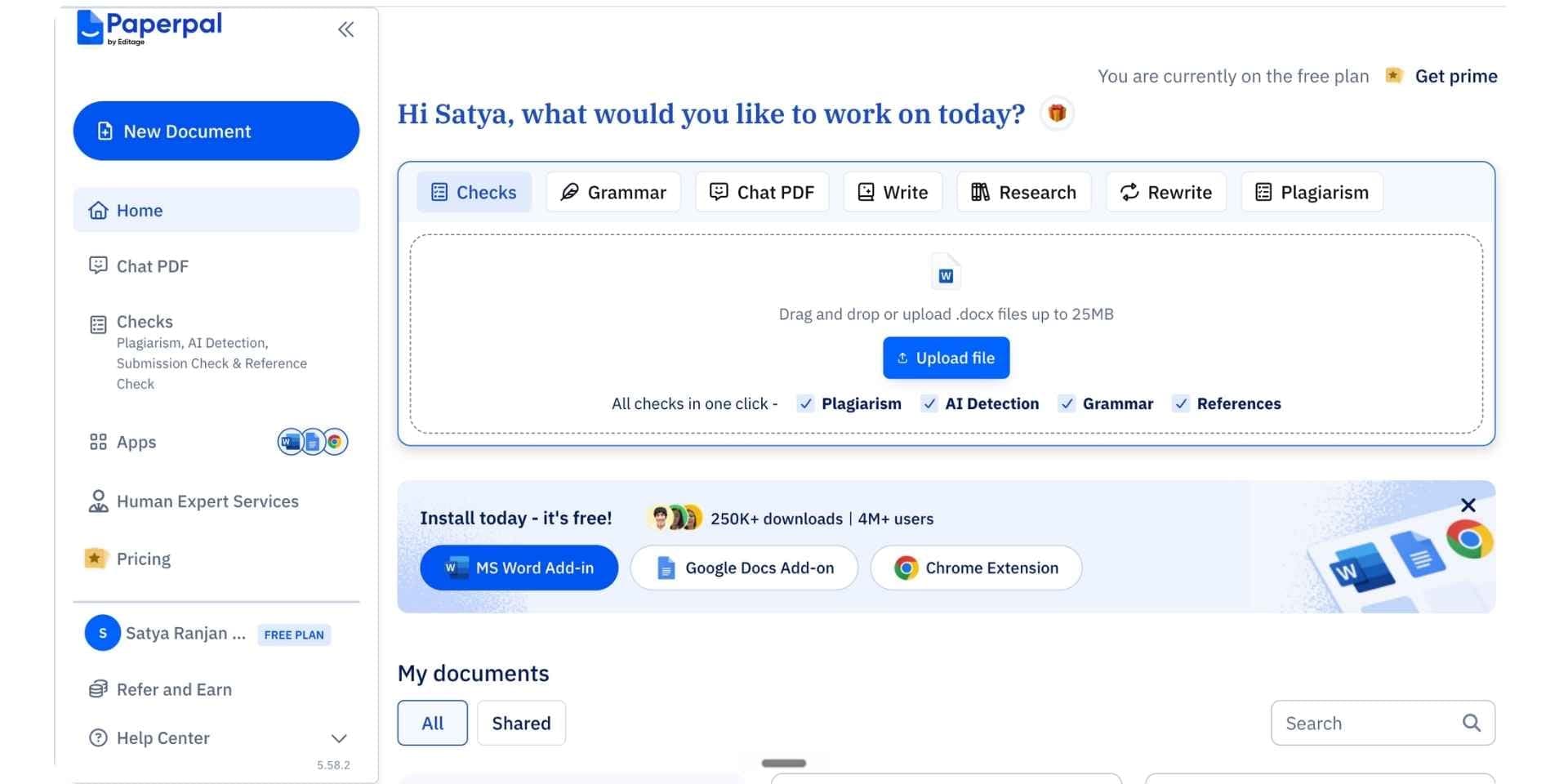
Paperpal is the late-stage editor for dissertation manuscripts in 2026. Subject-area-specific grammar suggestions, predictive writing, AI Review feedback, 30+ pre-submission checks, plagiarism and AI detection scans, and a Word add-in plus Overleaf integration make Paperpal the strongest tool in this list for polishing a dissertation toward supervisor review and formal deposit. The Research & Cite feature pulls from 250M+ articles for citation discovery, although citation insertion still requires verification against the actual reference library.
What Paperpal does well is the manuscript-to-deposit workflow. The Prime tier includes unlimited language editing, unlimited writing features, 250 PDF uploads per month, unlimited AI Review, 10,000 words per month of plagiarism checks with detailed reports, unlimited AI detection scans up to 10,000 words per scan, and 10,000 words per month of reference checks. What Paperpal does less well than Paperguide is full-draft generation from a research question and connected reference manager workflow; it is built for polishing finished or near-finished prose, not for drafting dissertation chapters from scratch.
Key Features
- Real-time grammar and academic register suggestions.
- Subject-area-specific phrasing for dissertation fields.
- 30+ pre-submission checks aligned with journal and dissertation deposit standards.
- Plagiarism scan with detailed reports.
- AI detection (up to 10,000 words per scan on Prime).
- Reference checks (Prime only).
- Word add-in, Google Docs, Chrome extension, Overleaf integration.
- Research & Cite across 250M+ articles.
Pros
- Strongest manuscript editor for dissertation polish and pre-deposit compliance.
- Subject-area awareness across multiple academic disciplines.
- Full integration suite (Word, Google Docs, Chrome, Overleaf) for dissertation workflows.
Cons
- Built for editing, not full-chapter generation from a research question.
- Citation handling is suggestive, not retrieval-grounded into a connected reference library.
- Free plan has tight daily usage caps on writing features.
Best For: Doctoral candidates polishing dissertation chapters before supervisor review or formal deposit, especially non-native English speakers needing subject-area-specific academic register feedback.
Pricing
| Plan | Price | What It Covers |
|---|---|---|
| Free | $0 | 200 language editing suggestions/month, 5 uses/day of writing features, 5 PDF uploads/month, 7,000 words/month plagiarism (Standard report). |
| Prime | $11.58/mo billed annually ($139/yr) | Unlimited language editing, unlimited writing features, 250 PDF uploads/month, unlimited AI Review, 10,000 words/month plagiarism (Detailed), unlimited AI detection up to 10,000 words/scan, 10,000 words/month reference checks. |
| Prime Multi-year | $229 once for 2 years or $289 once for 3 years | All Prime features at a lower per-month cost. |
| Teams | Group discounts | 10% off for 2-3 users, with larger discounts as team size grows; custom pricing for 10+. |
| Institutional | Custom | University and institution licences. |
Verdict
Paperpal is the best AI for late-stage dissertation editing and pre-submission compliance in 2026. Paperguide is the best Paperpal alternative for doctoral candidates who need full-chapter drafting alongside literature discovery and citation-grounded writing, the connected workflow pattern profiled across the AI tools for academic writing cluster.
5. Writefull
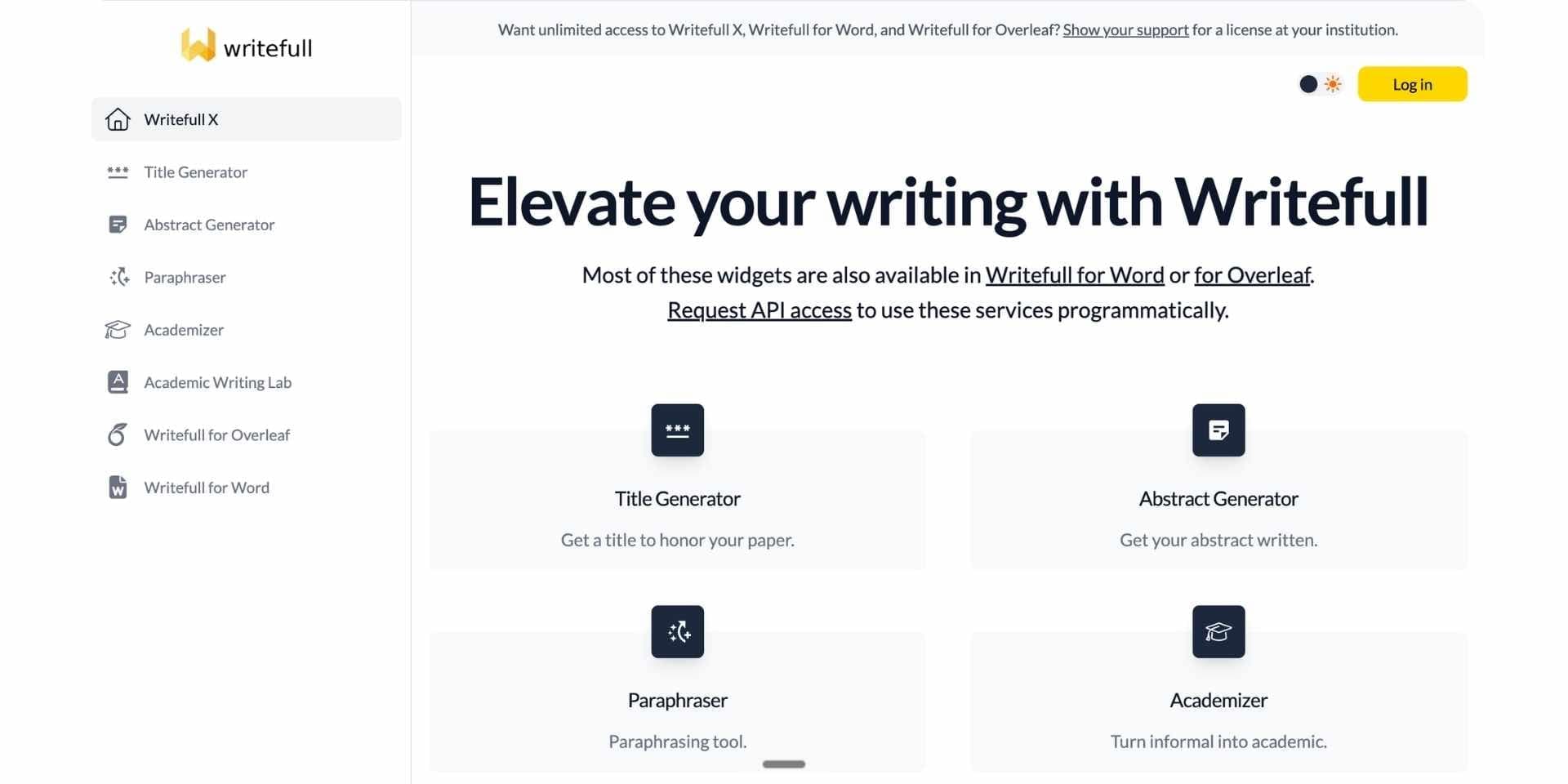
Writefull is trained specifically on millions of published academic articles, which makes it the strongest tool in this list for academic language polish in dissertation writing, particularly for STEM dissertations in LaTeX. Sentence palette suggestions come directly from published academic prose, which means the suggestions read native to the kind of writing that appears in peer-reviewed dissertations and journal manuscripts rather than the generic AI-flavoured prose that most writers produce. Title and abstract generators, language quality scoring, and native LaTeX and Overleaf integration complete the polish-focused feature set.
What Writefull does well is academic register fidelity at dissertation scale. Where most writers produce competent prose, Writefull produces prose that sounds like a finished doctoral chapter, which is exactly what matters for non-native English speakers and STEM doctoral candidates preparing dissertations for external examination. What Writefull does less well than Paperguide is breadth; it is a language polish tool, not a dissertation drafting platform, and there is no citation handling, reference manager, or literature workflow.
Key Features
- Trained on millions of published academic articles.
- Sentence palette suggestions from published research prose.
- Title and abstract generators tuned for academic conventions.
- Language quality scoring across dissertation drafts.
- Native LaTeX and Overleaf integration for STEM dissertations.
- Word add-in for in-line editing during dissertation polish.
Pros
- Sentence suggestions feel native to published academic writing.
- Strong LaTeX and Overleaf integration for STEM dissertation workflows.
- Group plans offer per-seat discounts for research labs and doctoral cohorts.
Cons
- Language polish only; no drafting, citation handling, or reference manager.
- No literature review or research workflow features.
- Pricing model favours annual payment ($150/year Premium) over monthly flexibility.
Best For
Doctoral candidates and STEM research groups preparing dissertations for external examination, especially non-native English speakers writing in LaTeX where academic register and discipline-specific phrasing matter for examiner acceptance.
Pricing
| Plan | Price | What It Covers |
|---|---|---|
| Free | $0 | Limited language suggestions and basic features. |
| Premium | $150/year | Unlimited writing support for individuals (Word add-in, LaTeX, Overleaf, sentence palette, language scoring). |
| Group | $285 for two seats ($15 saving versus individual) | Same Premium features with group billing and per-seat discount. |
Verdict
Writefull is the strongest AI for dissertation language polish in 2026, particularly for STEM doctoral candidates preparing LaTeX-formatted dissertations for external examination. Paperguide is the best Writefull companion for citation-grounded drafting plus the full dissertation writing workflow alongside Writefull's language polish during the final editing pass before deposit.
How the Paperguide Dissertation Writing Workflow Works
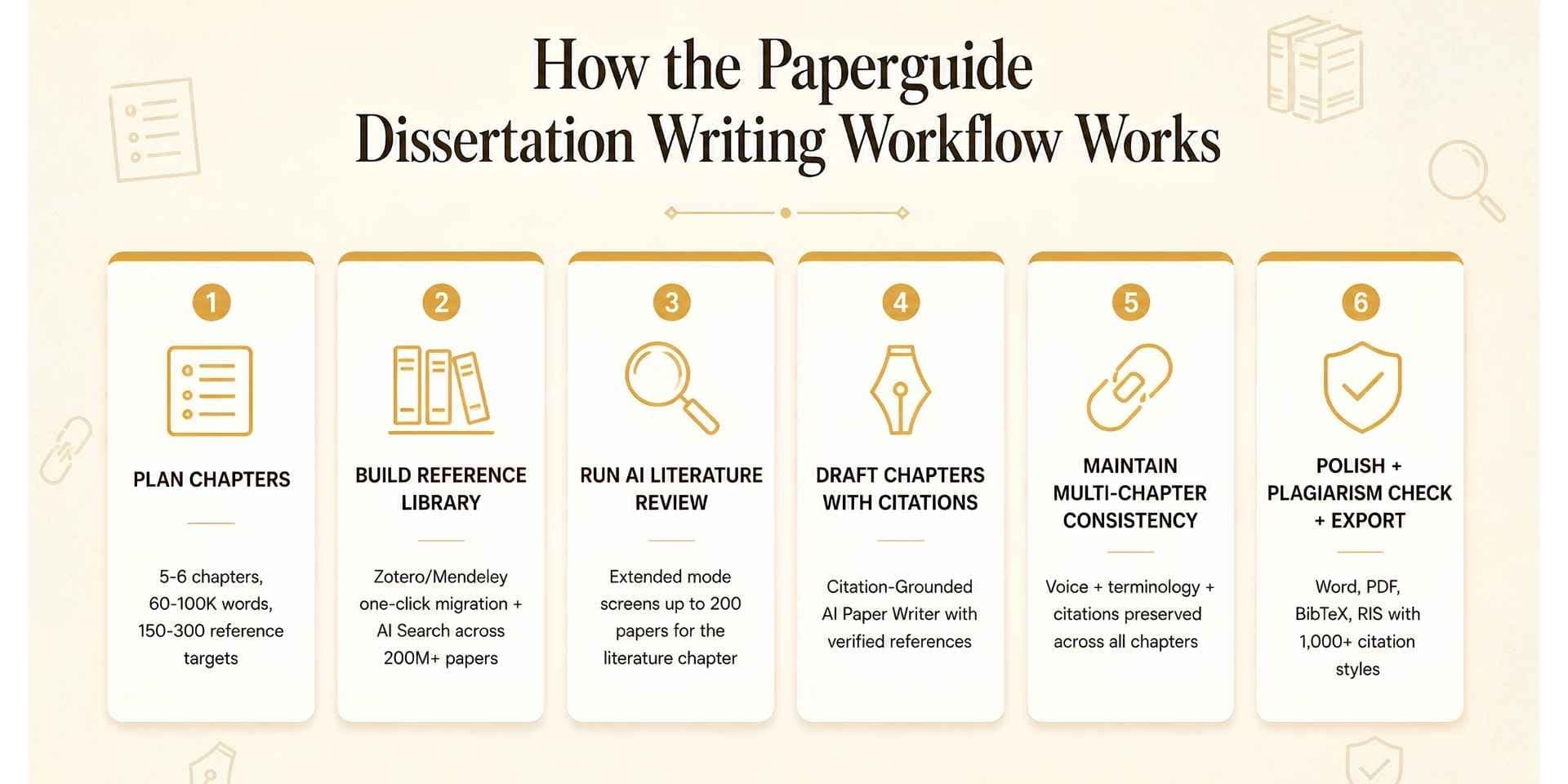
The best dissertation writing results in 2026 come from layering tools across a connected scientific research workflow rather than expecting one tool to handle the full dissertation lifecycle.
Step 1: Plan the chapters
Define chapter scope, research questions per chapter, target word counts (typical dissertation: 60,000 to 100,000 words across 5 to 6 chapters), and reference targets (typical dissertation: 150 to 300 references). The structure choice determines citation density and chapter depth, supported by the how to write a research paper and types of research papers reference patterns.
Step 2: Build the reference library
Import existing Zotero or Mendeley collections via one-click migration. Pull additional papers via AI Search across 200M+ peer-reviewed papers. The Reference Manager keeps every paper available across all dissertation chapters.
Step 3: Run Literature Review AI for the literature chapter
Extended mode screens up to 200 papers using a structured Plan / Search / Screen / Extract / Synthesise pipeline, producing a citation-grounded literature review chapter that fits the dissertation structure.
Step 4: Draft chapters with citations
The AI Paper Writer drafts each chapter with citations applied automatically against the connected library. Methodology chapters draw from comparable retrieved studies. Results and discussion chapters draw from the dissertation's own reference set with verifiable links.
Step 5: Maintain multi-chapter consistency
The Reference Manager keeps citations consistent across all chapters, with voice and terminology preserved end to end. Catch any cross-chapter contradictions before supervisor review.
Step 6: Polish, plagiarism-check, and export
The built-in Plagiarism Checker (on every plan) catches similarity issues before formal deposit. Final polish runs through Paperpal or Writefull. Export to Word, PDF, BibTeX, or RIS with 1,000+ citation styles ready for university template formatting.
This research-first workflow is what separates AI dissertation writers that survive viva examination from those that produce confident-sounding chapters with citation drift baked in, the same connected workflow profiled across AI tools for systematic review and AI tools for meta-analysis clusters.
Best AI Dissertation Writer by Use Case
| Use Case | Recommended Tool | Why |
|---|---|---|
| Best AI dissertation writer overall | Paperguide AI Paper Writer | Citation-grounded drafting + multi-chapter consistency + connected reference library at dissertation scale. |
| Best AI for the literature review chapter | Paperguide Literature Review AI | Extended mode screens up to 200 papers with citation grounding. |
| Best AI for the methodology chapter | Paperguide AI Paper Writer | Grounded in retrieved comparable studies rather than generic training-data prose. |
| Best AI for the fastest dissertation first draft | ThesisAI | 80-page generation from one prompt in LaTeX. |
| Best AI for chapter-by-chapter autocomplete | Jenni AI | Fastest in-line autocomplete trained on academic writing. |
| Best AI for STEM dissertation in LaTeX | ThesisAI for drafting + Writefull for polish | Native LaTeX/Overleaf workflow plus published-research language polish. |
| Best AI for late-stage dissertation editing | Paperpal | 30+ pre-submission checks plus subject-area-specific editor. |
| Best AI for academic language polish | Writefull | Trained on millions of published academic articles. |
| Best AI for citation accuracy in dissertation writing | Paperguide AI Paper Writer | Architecture-level citation grounding against the connected library. |
| Best AI-native reference manager for dissertation writing | Paperguide | 1,000+ citation styles, Zotero/Mendeley migration, connected to the writer. |
| Best free AI dissertation writer stack | Paperguide Free + Jenni AI Free | Free citation-grounded drafting + autocomplete. |
Best AI Dissertation Writers in 2026: Final Comparison
| Feature | Paperguide AI Paper Writer | ThesisAI | Jenni AI | Paperpal | Writefull |
|---|---|---|---|---|---|
| Long-form drafting | Yes (multi-chapter) | Yes (80 pages from one prompt) | Partial | No (editor) | No |
| Citation grounding | Verified retrieval | Suggestive | Partial | Suggestive | None |
| Multi-chapter consistency | Yes | Partial | Partial | No | No |
| Paper corpus | 200M+ peer-reviewed | Zotero source | Limited DB | 250M (search) | None |
| Reference manager | AI Reference Manager | None | None | None | None |
| LaTeX / Overleaf | BibTeX/RIS export | Yes (native) | Export | Yes | Yes (native) |
| Plagiarism check | Yes (all plans) | None | None | Yes (Detailed on Prime) | None |
| Free plan | Yes | None | Yes (10/day) | Yes (limited) | Yes (limited) |
| Starting paid | $12 per seat/mo, billed annually | $14/mo Basic | $12/mo Plus | $11.58/mo annual | $150/year Premium |
Common Mistakes When Using an AI Dissertation Writer
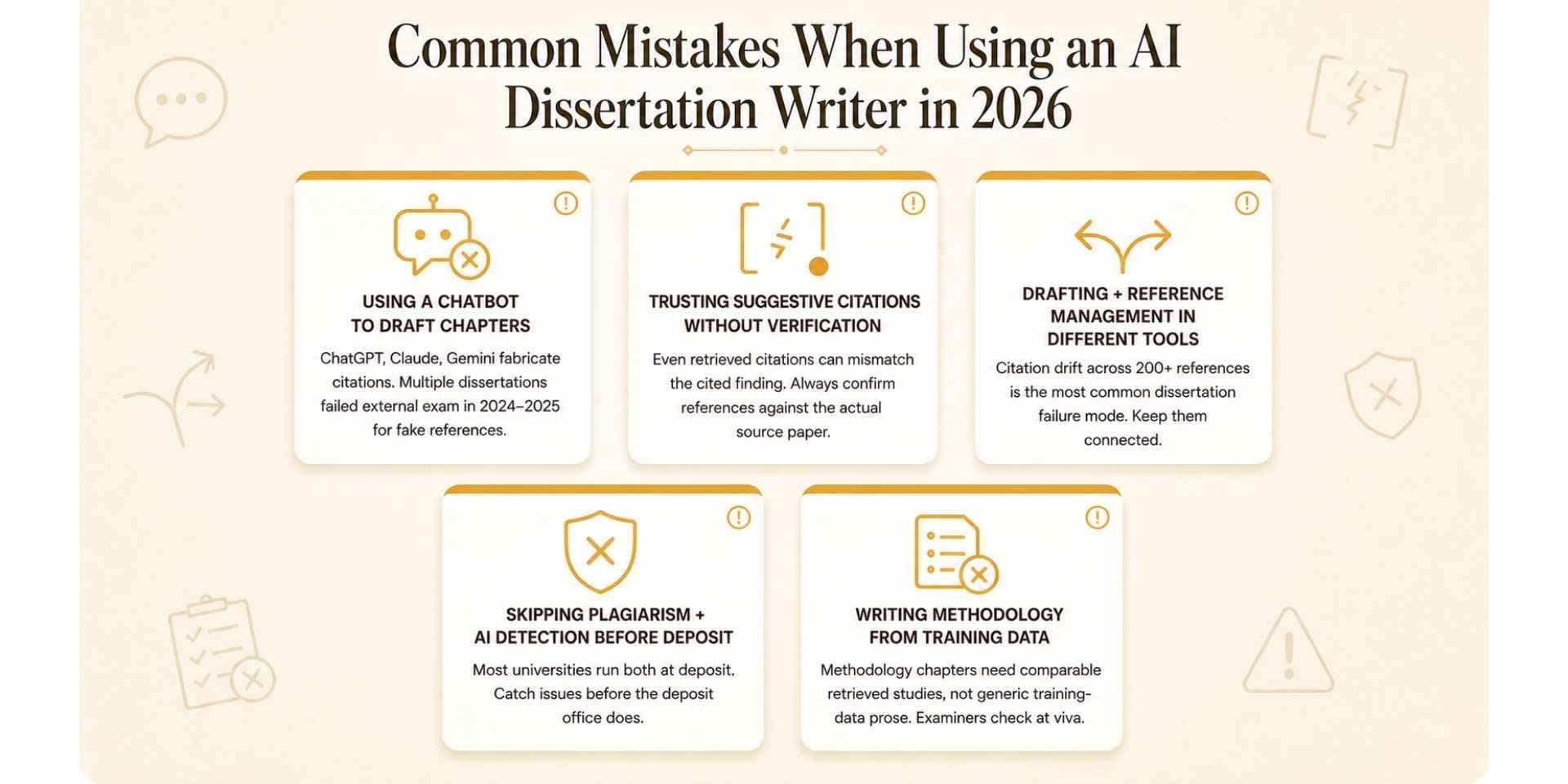
- Using a general-purpose chatbot to draft dissertation chapters. ChatGPT, Claude, and Gemini fabricate citations and DOIs at well-documented rates, and fabricated references are exactly what deposit-stage citation audits are designed to catch. Use citation-grounded AI dissertation writers where every reference is anchored in a real retrieved paper.
- Trusting suggestive citations without verification. Even AI dissertation writers that retrieve from a database can suggest citations that do not match the cited finding. Always confirm references against the actual source paper before the dissertation goes to supervisor review.
- Drafting in one tool, managing references in another. Citation drift is inevitable when the writer is not connected to the reference manager. The bibliography and in-text citations fall out of sync across 200+ references, and the examiner catches it at viva.
- Skipping plagiarism and AI detection before deposit. Most universities run both checks at deposit. Catch issues before the deposit office does, not after.
- Writing methodology from training data instead of retrieved studies. Methodology chapters need comparable retrieved studies that examiners can verify. Generic methodology language from training data fails the comparable-methodology test that external examiners routinely apply during viva.
Final Verdict
For doctoral candidates, postdocs, and faculty researchers writing dissertation-length work in 2026, the Paperguide AI Paper Writer is the best AI dissertation writer. The combination of citation-grounded chapter drafting from 200M+ peer-reviewed papers, multi-chapter consistency across 200 or more references, built-in Plagiarism Checker, and a connected AI Reference Manager makes it the only AI dissertation writer that survives viva examination by architecture rather than by retroactive verification.
For specific stages of the dissertation writing workflow where dedicated tools dominate, ThesisAI handles fastest long-form first drafts in LaTeX, Jenni AI handles chapter-by-chapter in-line autocomplete, Paperpal handles late-stage editing and pre-deposit compliance, and Writefull handles academic language polish trained on published research literature.
The 2026 best-practice pattern for dissertation writing is rarely a single tool. It is Paperguide for the dissertation backbone (literature review, drafting, reference management, citation grounding, plagiarism check), Jenni AI for fast autocomplete during the active chapter-drafting phase, ThesisAI for STEM dissertations where LaTeX-native long-form generation matters, and Paperpal or Writefull for the final language polish and pre-deposit compliance pass. That layered workflow is what produces dissertations that survive 2026 viva examination, external review, and the automated citation audits that universities increasingly run at deposit.
Frequently Asked Questions (FAQs)
What is the best AI dissertation writer in 2026?
The Paperguide AI Paper Writer is the best AI dissertation writer in 2026. It grounds every citation against the actual connected reference library, supports 200 or more references with multi-chapter consistency, and includes an AI Reference Manager with 1,000+ citation styles for any university dissertation template.
Can AI write my dissertation?
Citation-grounded AI like the Paperguide AI Paper Writer can draft dissertation chapters from a research question and source material with verified references applied automatically. Full dissertation completion still requires doctoral candidate judgment on methodology design, results interpretation, theoretical contribution framing, and the discussion chapter's analytical depth. The Akbar 2025 PhD survey showed 65.7% of doctoral candidates already use AI in their dissertation work, with proofreading and academic writing the most common applications.
Is using AI for dissertation writing considered cheating?
Most universities in 2026 accept AI-assisted dissertation writing when AI use is disclosed appropriately and citations are real and verifiable. Cheating refers to undisclosed AI use, fabricated citations, or bypassing plagiarism detection. Used transparently with verified citations from a real reference library, AI dissertation writing is standard practice in 2026.
Will my dissertation get flagged by Turnitin?
Turnitin and similar detectors flag statistically machine-generated text patterns. Draft with citation-grounded AI like Paperguide that grounds claims in real source material, edit in your own voice, and run Turnitin before deposit. The combination of citation grounding plus substantive editing reduces detection risk to near-zero because the references are real and the analytical voice is the doctoral candidate's own.
What is the best free AI dissertation writer?
The Paperguide Free plan plus Jenni AI Free (10 autocompletes/day) combination is the strongest free stack for dissertation writing in 2026. Paperguide handles citation-grounded drafting and reference management, and Jenni handles in-line autocomplete during active chapter work.
Can AI generate a long-form dissertation in one go?
ThesisAI can generate up to 80-page academic documents from a single prompt on the Pro tier. The output requires substantial editing for citation verification, voice consistency, and methodology accuracy. Paperguide produces chapter-length drafts grounded in retrieved literature, prioritising citation integrity over single-prompt length.
Does Paperguide support LaTeX for STEM dissertations?
Paperguide exports to Word, PDF, BibTeX, and RIS, so references and bibliographies move cleanly into a LaTeX project. For native LaTeX drafting and Overleaf integration, pair Paperguide (for research, literature review, and citation grounding) with ThesisAI (for LaTeX-native long-form generation) and Writefull (for LaTeX language polish trained on published academic articles).
Can AI write the literature review chapter of my dissertation?
Yes. Paperguide Literature Review AI (Extended mode screens up to 200 papers) is the strongest AI for dissertation literature review chapters in 2026 because it follows the structured Plan / Search / Screen / Extract / Synthesise pipeline with citation grounding throughout the review.
How many doctoral candidates use AI in their dissertation work?
A peer-reviewed Journal of Further and Higher Education study published in June 2025 (Akbar, 2025) surveyed 105 PhD students across UK universities and found that 65.7% reported using AI tools in their doctoral work. AI use for proofreading reached 49.28% and academic writing reached 40.58%, making writing assistance, not data analysis, the single most common application of AI in dissertation work.
Can AI replace doctoral candidates in writing dissertations?
No. AI dissertation writers accelerate drafting, editing, paraphrasing, and citation handling but cannot replace doctoral candidate judgment on methodology design, results interpretation, theoretical contribution, or the discussion chapter's analytical depth. Use AI for the upstream drafting work and let the doctoral candidate lead the substantive parts of the dissertation, with supervisor guidance throughout.
Writing a paper?
Write your paper with real citations
Drafts grounded in real papers, with citations in APA, MLA and Chicago.
Start writingNo credit card required