7 Best AI Essay Writers in 2026 (Free + Paid)


The AI essay writer category collapsed into a few winners in 2026, and the winners look different depending on whether the essay is a casual class assignment or a scientific research essay with cited evidence.
Five years ago, the category had hundreds of generators competing on word count and prose fluency. Today it has split cleanly into two halves: tools that retrieve evidence from real peer-reviewed sources and ground every claim in verifiable citations, and tools that generate plausible-sounding essays from training data with citation-shaped output that does not survive a reference check. The first half produces essays that pass AI detection, editorial scrutiny, and academic integrity reviews, including scientific research essays where every cited paper must be real, recent, and verifiable. The second half produces essays that get flagged, rejected, or returned for fabricated references. The split matters more in 2026 than at any prior point because adoption has crossed the mainstream threshold for both casual essays and scientific writing. A Gallup 2025 college student survey found that 54% of college students now use AI to edit or improve their writing and 54% use it to summarise lectures or notes, with 49% using AI for brainstorming. At the high school level, College Board reported in October 2025 that 84% of students use generative AI for schoolwork tasks such as brainstorming and revising. Across academia and scientific research, AI essay writers are no longer experimental; they are the default tool for how researchers and academic writers draft essays, term papers, lab reports, and short research essays in 2026.
This guide tests the 7 best AI essay writers in 2026 across scientific research essays, long-form academic essays, in-line autocomplete drafting, general-purpose writing, paraphrasing, autopilot-style assistance with personality customisation, free generation with built-in AI detection, and minimalist editing of short essays.
TL;DR
The Paperguide AI Essay Writer is the best AI essay writer in 2026 for scientific research essays and evidence-grounded academic essays. Inside Paperguide, the AI-native platform for scientific research workflows and systematic reviews, the AI Essay Writer drafts essays with citations applied automatically against the actual reference library across 200M+ peer-reviewed papers, never from a language model's internal memory, eliminating the citation fabrication that disqualifies general-purpose essay generators at editorial review. It fits the full range of academic writers, from students and PhD researchers through faculty and lab teams to the research analysts and evidence-synthesis groups who draft on the same platform they run their reviews on. Jenni AI, ChatGPT, QuillBot, HyperWrite, Smodin, and Yomu AI are the strongest specialised alternatives for in-line autocomplete drafting, general-purpose writing, academic paraphrasing, autopilot-style writing assistance with personality customisation, free AI essay generation with built-in detection, and minimalist editing of short essays respectively.
Key Takeaways
- Paperguide AI Essay Writer is the #1 AI essay writer in 2026 for scientific research essays and evidence-grounded academic essays with citations from real peer-reviewed sources.
- Jenni AI is the strongest in-line autocomplete essay writer with academic-trained autocomplete; Plus at $12/month, Pro at $29/month.
- ChatGPT is the most widely used general-purpose AI essay writer; Plus at $20/month, Pro at $200/month.
- QuillBot is the strongest academic paraphraser for essay drafts and scientific paragraphs; Premium at $8.33/month billed annually.
- HyperWrite offers autopilot-style writing with personality customisation and real-time research citations; Premium at $16/month annual or $19.99/month monthly.
- Smodin is the strongest free essay generator with AI detector and humaniser built in; Starter at $10/month annual, Premium at $16/month annual.
- Yomu AI is the minimalist AI editor for short essays and reflective writing; Pro at $11/month annual, Ultra at $18/month annual.
Why AI Essay Writers Matter in 2026
AI essay writers in 2026 sit at the centre of an academic integrity debate the discipline has not fully settled. The Gallup college student survey showed AI use becoming routine across the student population, with the most common applications being writing edits, lecture summarisation, and brainstorming, the three tasks that define the essay-writing workflow. The College Board faculty survey added the other half of the picture: near-universal concern that undisclosed AI use undermines learning, paired with growing reliance on AI-detection tools at submission. Universities, journals, and high schools now run both plagiarism and AI-detection checks as routine practice at essay submission, and the essays that pass these checks are the ones drafted with AI architecture that retrieves citations from real sources rather than generating plausible-sounding references from training memory.
The 2026 case for the right AI essay writer is therefore not about which tool writes the most fluent prose. Every modern AI writer produces competent essay-shaped output. The case is about citation integrity, AI-detection survivability, and academic integrity disclosure. An essay drafted with citation-grounded AI where every cited source is real and verifiable passes the citation audit, survives the AI-detection scan when the writer edits the output in their own voice, and meets the disclosure standard that most institutions now require. An essay drafted with general-purpose AI where citations are fabricated and prose patterns are statistically AI-typical fails on at least one of these dimensions, often two, and increasingly all three.
What to Look for Before Choosing an AI Essay Writer in 2026?
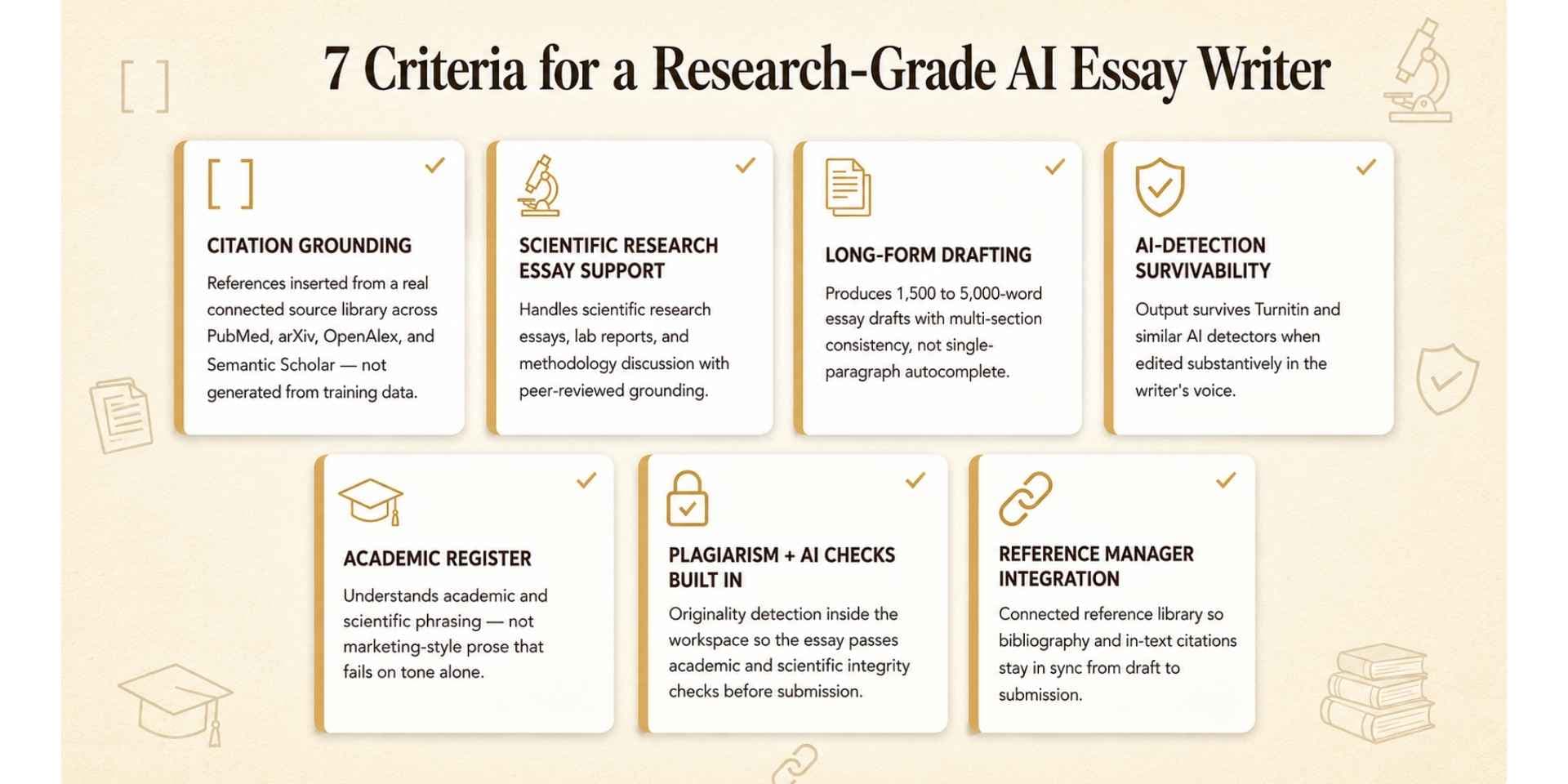
Before comparing the seven tools below, here are the criteria that separate research-grade AI essay writers from general AI writers.
- Citation grounding at the architecture level: Does the tool insert references from a real connected source library, or generate citation-shaped strings from training data?
- Long-form essay drafting: Can the tool produce 1,500 to 5,000-word essay drafts with multi-section consistency, or stop at single-paragraph autocomplete?
- AI-detection survivability: Does the tool produce output that survives Turnitin and similar AI detectors when edited substantively in the writer's voice?
- Academic register: Does the tool understand academic register and discipline-specific phrasing, or default to marketing-style prose that fails on tone alone?
- Built-in plagiarism and AI-detection checks: Does the tool run originality detection inside the workspace so the essay passes academic integrity checks before submission?
- Reference manager integration: For academic essays, is the writer connected to a reference library so the bibliography and in-text citations stay in sync from draft to submission?
Quick Comparison: Top AI Essay Writers at a Glance in 2026
| Tool | Best For | Citation Grounding | Paid Entry |
|---|---|---|---|
| Paperguide AI Essay Writer | Scientific research essays + evidence-grounded academic essays | Verified retrieval (200M+ papers) | $12 per seat/mo Plus, billed annually |
| Jenni AI | In-line autocomplete essay writing | Partial | $12/mo Plus |
| ChatGPT | General-purpose essay drafting | Fabrication risk | $20/mo Plus |
| QuillBot | Academic paraphrasing for essay drafts | None | $8.33/mo Premium (annual) |
| HyperWrite | Autopilot essay writing with personality customisation | Real-time research citations | $16/mo Premium (annual) |
| Smodin | Free essay generation + AI detector + humaniser | None | $10/mo Starter (annual) |
| Yomu AI | Minimalist AI editor for short essays | Partial | $11/mo Pro (annual) |
Best AI Essay Writers in 2026
1. Paperguide AI Essay Writer
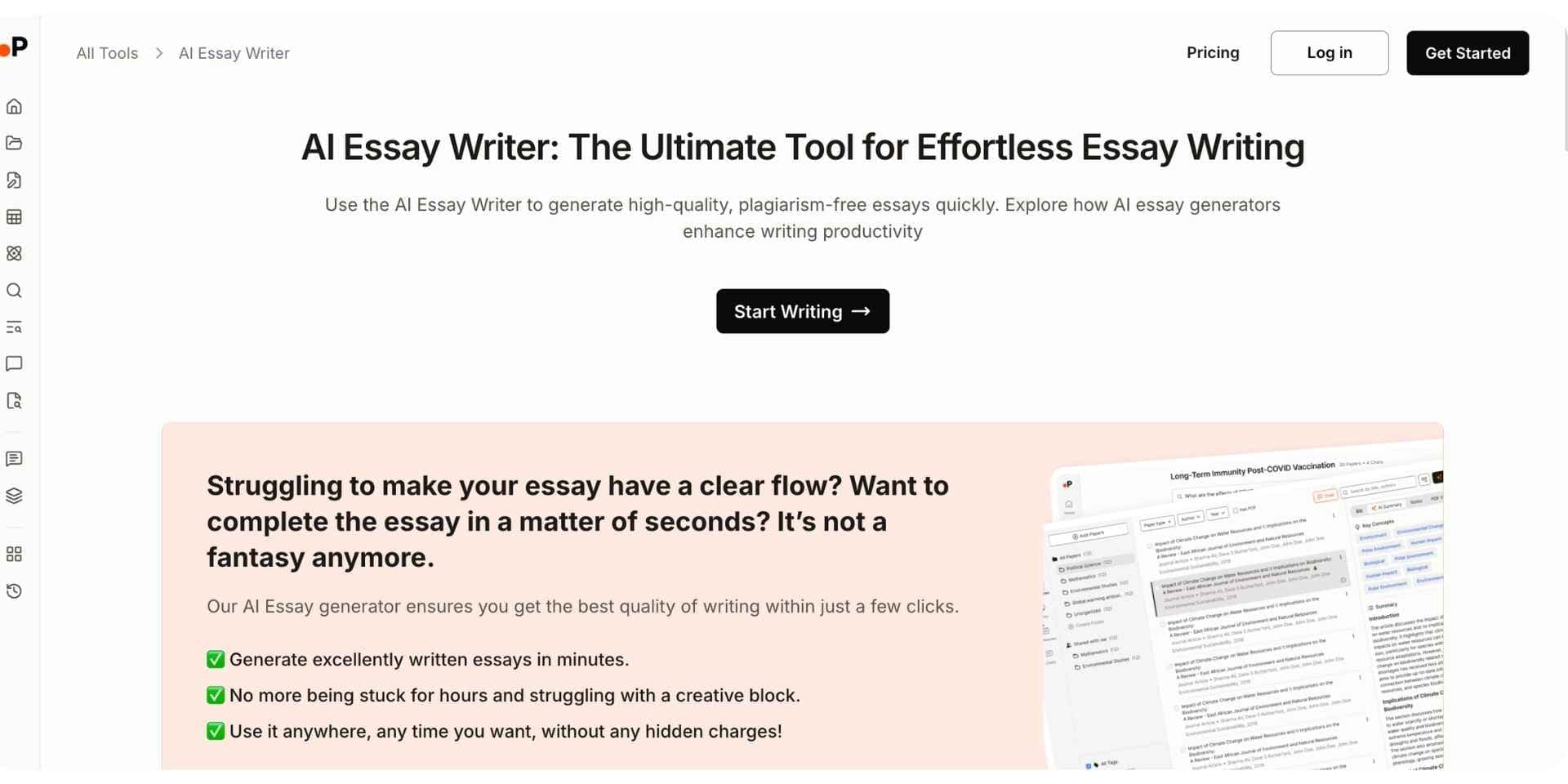
The Paperguide AI Essay Writer is the essay-focused entry point into Paperguide, and the strongest AI essay writer in 2026 for scientific research essays and evidence-grounded academic essays. The AI Essay Writer drafts essays from a research question and source material with citations applied automatically against the actual reference library across 200M+ peer-reviewed papers (PubMed, arXiv, OpenAlex, Semantic Scholar), eliminating the citation fabrication that disqualifies general-purpose essay generators at editorial review. For scientific research essays, lab report essays, argumentative essays, analytical essays, comparative essays, and any essay where every source citation must be real and verifiable, the architecture-level citation grounding is what separates the Paperguide AI Essay Writer from the rest of the category.
The connected workspace makes the AI essay writing experience continuous from research to submission. A reference saved through Zotero import, DOI lookup, or PDF upload is immediately citable in the essay. A paper surfaced through search across 200M+ peer-reviewed papers lands in the library and becomes available to the writer. A literature synthesis run by Literature Review AI feeds grounded scientific background into the essay introduction. The 1,000+ citation styles (APA, MLA, Chicago, Harvard, Vancouver, AMA, IEEE, and journal-specific formats) plus the built-in Plagiarism Checker ensure the essay leaves the workspace ready for submission to any university, journal, or scientific research standard.
Key Features
- AI Paper Writer: Drafts essays from a research question and source material with citations applied automatically against the actual reference library, eliminating fabricated citations at the architecture level. Supports 1,000+ citation styles for any university or journal standard.
- Three starting modes and Smart Continue: Start an essay as a complete draft, an outline only, or from scratch, then let Smart Continue pick up from the cursor and cite your selected sources.
- AI Chat inside the writer: Finds papers, verifies references, compares topics and sharpens arguments inside the essay, and anything it adds arrives with citations applied.
- Essay controls and AI Edit: Set custom writing instructions, a word count and a citation count limit before drafting. Select any passage to rewrite, simplify or improve it with AI Edit, and add a citation by hand by typing
@or using the cite button. - AI Reference Manager: Built-in reference library supporting import through DOI, URL, BibTeX, RIS, PDF upload, and one-click Zotero or Mendeley migration. Automatic metadata retrieval, PDF reader with annotations, AI summaries, shared libraries with role-based permissions.
- AI Search: Hybrid semantic and keyword search across 200M+ peer-reviewed papers (PubMed, arXiv, OpenAlex, Semantic Scholar) for finding evidence to cite in essay arguments.
- Literature Review AI: Five-step Plan / Search / Screen / Extract / Synthesise pipeline producing a citation-grounded review section that grounds essay introductions and background sections, available in Standard mode (50 papers) or Extended mode (200 papers).
- Research Agent: End-to-end connected session on the Paperguide platform across discovery, screening, comparison, gap analysis, extraction, drafting, and citation handling, where a paper surfaced in search is already citable in the essay.
- Extract Data: Pull supporting evidence (sample sizes, statistical findings, methodology details) from multiple papers into evidence tables for essay arguments that require structured evidence support.
- Chat with PDF: Section-grounded Q&A across uploaded papers with answers highlighted back to source passages, useful for essay research and fact-checking against original sources.
- Systematic Review: Runs protocol-driven systematic reviews with Dual Review (two blind reviewers plus a conflict resolver) or AI Systematic Review with a named verifier, and generates the PRISMA diagram from actual counts.
- Plagiarism Checker: Built-in originality detection on every plan (4,000 words a month on Free, 20,000 on Plus, 100,000 on Pro and above) for pre-submission scanning across academic literature and web sources.
- Multi-section consistency: Voice, terminology, and citation logic preserved across long-form essays and comparative essay structures.
- Export options: Submission-ready output to Word, PDF, BibTeX, RIS with reference list consistency preserved.
Pros
- Only AI essay writer with verified citation grounding against a real connected reference library.
- 200M+ peer-reviewed papers across four scientific databases gives cross-disciplinary coverage for any essay topic.
- Multi-section consistency across long-form essay drafts.
- Free plan covers small essay projects with 2,000 AI credits per month.
Cons
- Built for evidence-grounded academic essays, not casual or marketing-style essay generation.
- Full-document essay drafts capped by plan tier; multiple long essays may require Plus or Pro.
Best For
Researchers, postdocs, faculty researchers, lab teams, evidence synthesis teams, and academic writers drafting scientific research essays, evidence-grounded academic essays, lab report essays, argumentative essays, analytical essays, and comparative essays where source citations matter for editorial and scientific integrity review.
Pricing
| Plan | Price | What It Covers |
|---|---|---|
| Free | $0 | 2,000 AI credits per month, Literature Review AI, Deep Research Report, Chat with PDF, reference manager with 1,000+ citation styles, extraction tables with 5 columns across 10 papers. |
| Plus | $12 per seat per month, billed annually ($144 a year) | 12,500 AI credits, unlimited AI searches and PDF chats, extraction tables with 50 custom columns across 100 papers, 5 AI Paper Writer documents per month, plagiarism checker, systematic reviews up to 1,000 papers. |
| Pro | $29 per seat per month, billed annually ($348 a year) | 50,000 AI credits, 20 AI Paper Writer documents per month, Image and Table Extraction (coming soon), systematic reviews up to 5,000 papers. |
| Evidence Teams | $89 per seat per month, billed annually ($1,068 a year) | 150,000 AI credits, PRISMA-grade dual-review screening, systematic reviews up to 5,000 papers. |
| Enterprise | Custom | Institutional licensing for universities, research labs, and corporate research teams, with SSO and SAML and systematic reviews up to 20,000 papers. |
A 30% academic discount applies to paid tiers with a valid university email.
Verdict
Paperguide is the best AI essay writer in 2026 for evidence-grounded academic essays because no other writer grounds citations against a real connected reference library at this scale. The connected workflow with AI Search, Literature Review AI, Reference Manager, and Plagiarism Checker means citation integrity is the default state rather than an audit problem solved after the fact. It is the same connected backbone profiled across the broader academic writing cluster, applied here to the essay-writing use case.
2. Jenni AI
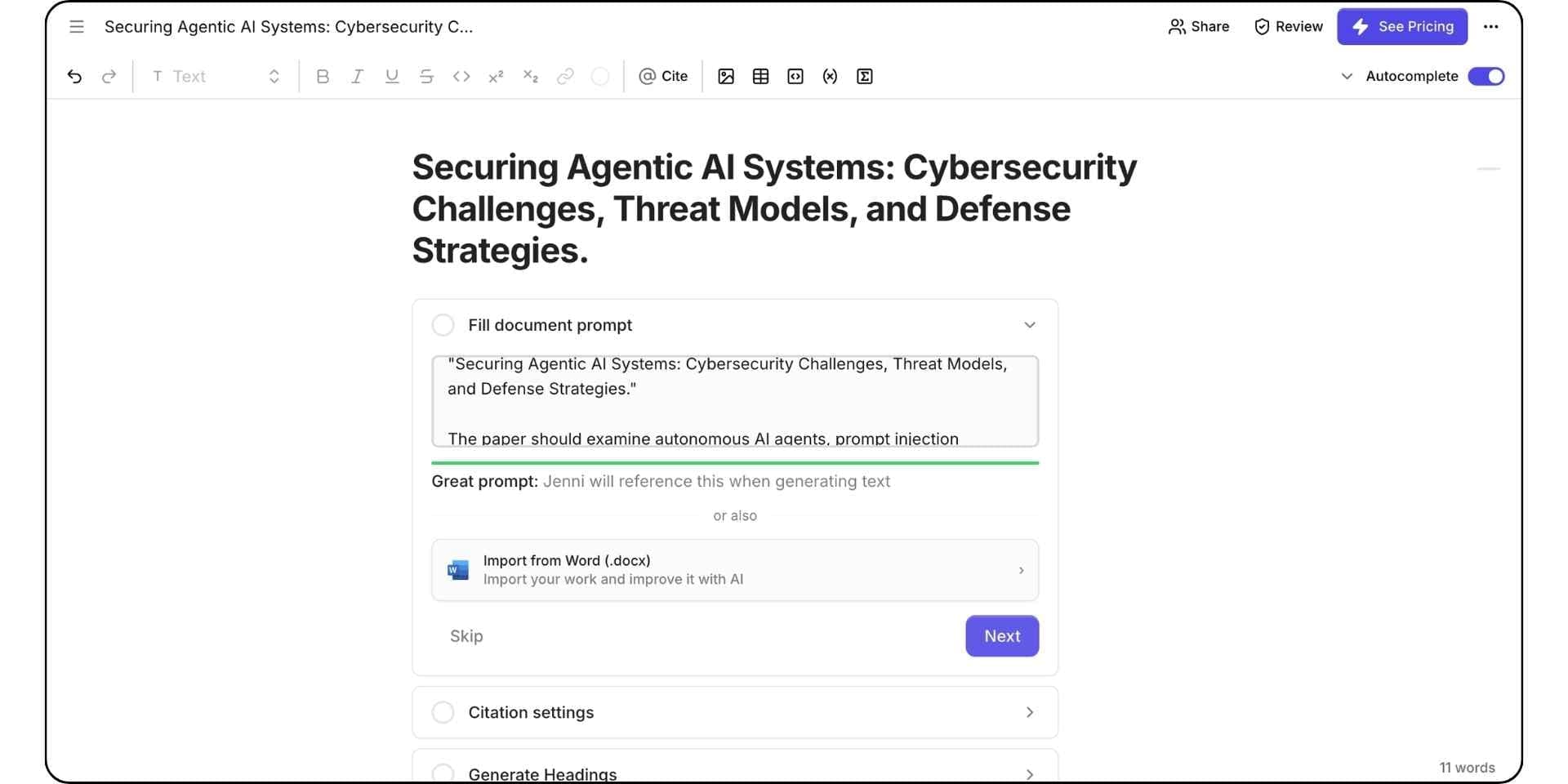
Jenni AI is the in-line autocomplete essay writer with academic-trained autocomplete and in-line citation insertion. The writer types a few words and Jenni completes the sentence in academic register, drawing from a writer trained specifically on academic prose. For essay writers who draft paragraph by paragraph with autocomplete assistance, Jenni produces faster output than blank-page drafting. The AI Edit toolbar handles paragraph-level rewriting, summarisation, and tone adjustment during the active essay drafting phase.
What Jenni does well is the typing experience for essay drafting. The autocomplete is fast, suggestions feel native to academic writing, and the Claim Confidence feature flags statements that lack supporting evidence in the connected sources. What Jenni does less well than Paperguide is corpus breadth; the citation database is smaller than Paperguide's 200M+ peer-reviewed corpus, and there is no full Research Agent or Literature Review AI handoff into the writer.
Key Features
- Continuous autocomplete trained on academic writing.
- In-line citation insertion from a connected database.
- AI Edit toolbar for paragraph-level rewriting.
- AI Chat for paper-grounded Q&A.
- Outline generation.
- 10,000+ citation styles.
- Export to Word, LaTeX, BibTeX, RIS.
Pros
- Fastest in-line autocomplete drafting experience for essays.
- 10,000+ citation styles available across all plans.
- Free tier supports trial use (10 autocompletes per day).
Cons
- Citation database smaller than Paperguide's 200M+ peer-reviewed corpus.
- Pro tier at $29/month is at the high end for a writing-focused single tool.
Best For
Researchers and essay writers who draft paragraph by paragraph and prefer autocomplete-style assistance over full-essay generation from a single prompt.
Pricing
| Plan | Price | What It Covers |
|---|---|---|
| Free | $0/mo | 10 AI autocompletes/day, 10 PDF uploads, 3 AI Edits, 5 AI Chat messages, 3 Reviews, unlimited citations. |
| Plus | $12/mo | 5,000 autocompletes/month, unlimited PDF uploads, 500 AI Edits/month, 500 AI Chat/month, 10 Reviews/month. |
| Pro | $29/mo | Unlimited autocomplete, PDF uploads, AI Edits, AI Chat, Reviews; priority support. |
Verdict
Jenni AI is the strongest in-line autocomplete AI essay writer in 2026. Paperguide is the best Jenni AI alternative for essay writers who need literature discovery, evidence search, and citation-grounded drafting in one workspace.
3. ChatGPT
ChatGPT is the most widely used AI essay writer in 2026 for general-purpose drafting. GPT-5.1 added Research mode with web search, longer context windows, and Custom GPTs for repeatable essay templates. The platform handles exploratory writing, argumentative essay drafting, comparative essays, and analytical writing competently as long as the writer accepts that citations the model produces are routinely fabricated and need verification against real sources before the essay goes anywhere near a submission.
What ChatGPT does well is general reasoning over essay topics. The model can outline arguments, draft introductions, suggest counter-arguments, and produce competent essay-shaped prose across virtually any subject. What ChatGPT cannot do is search a scholarly database natively. The well-documented hallucinated-citation problem makes ChatGPT unsuitable for essays that require verifiable references, although it remains a strong general drafting partner for non-cited essays.
Key Features
- GPT-5.1 reasoning over essay topics with vision support.
- Research mode with web search for current debates.
- Custom GPTs and Projects for repeatable essay templates.
- File uploads with multi-document context.
- Code Interpreter for structured reasoning.
Pros
- Most widely used AI essay writer in 2026.
- Strong general reasoning across any essay topic.
- Plus tier at $20/month is widely accessible.
Cons
- No scholarly database for native citation grounding.
- Citation fabrication risk on any references the model produces.
- No reference manager or structured extraction for essay evidence.
Best For
Essay writers drafting general essays, exploratory writing, brainstorming, and non-cited content where citation grounding is not required.
Pricing
| Plan | Price | What It Covers |
|---|---|---|
| Free | $0 | Limited access to standard models. |
| Plus | $20/mo | Extended access, Research mode, file uploads, Custom GPTs. |
| Pro | $200/mo | Highest reasoning access, extended Code Interpreter, Pro model usage. |
| Team | $25-30/user/mo | Shared workspace, admin tools. |
| Enterprise | Custom | SSO, audit logs, enterprise security. |
Verdict
ChatGPT is the most-used general-purpose AI essay writer in 2026 but should not be the citation layer for any academic essay because of fabrication risk. Paperguide is the best ChatGPT alternative for academic essays that require verified citations from a real scholarly corpus.
4. QuillBot
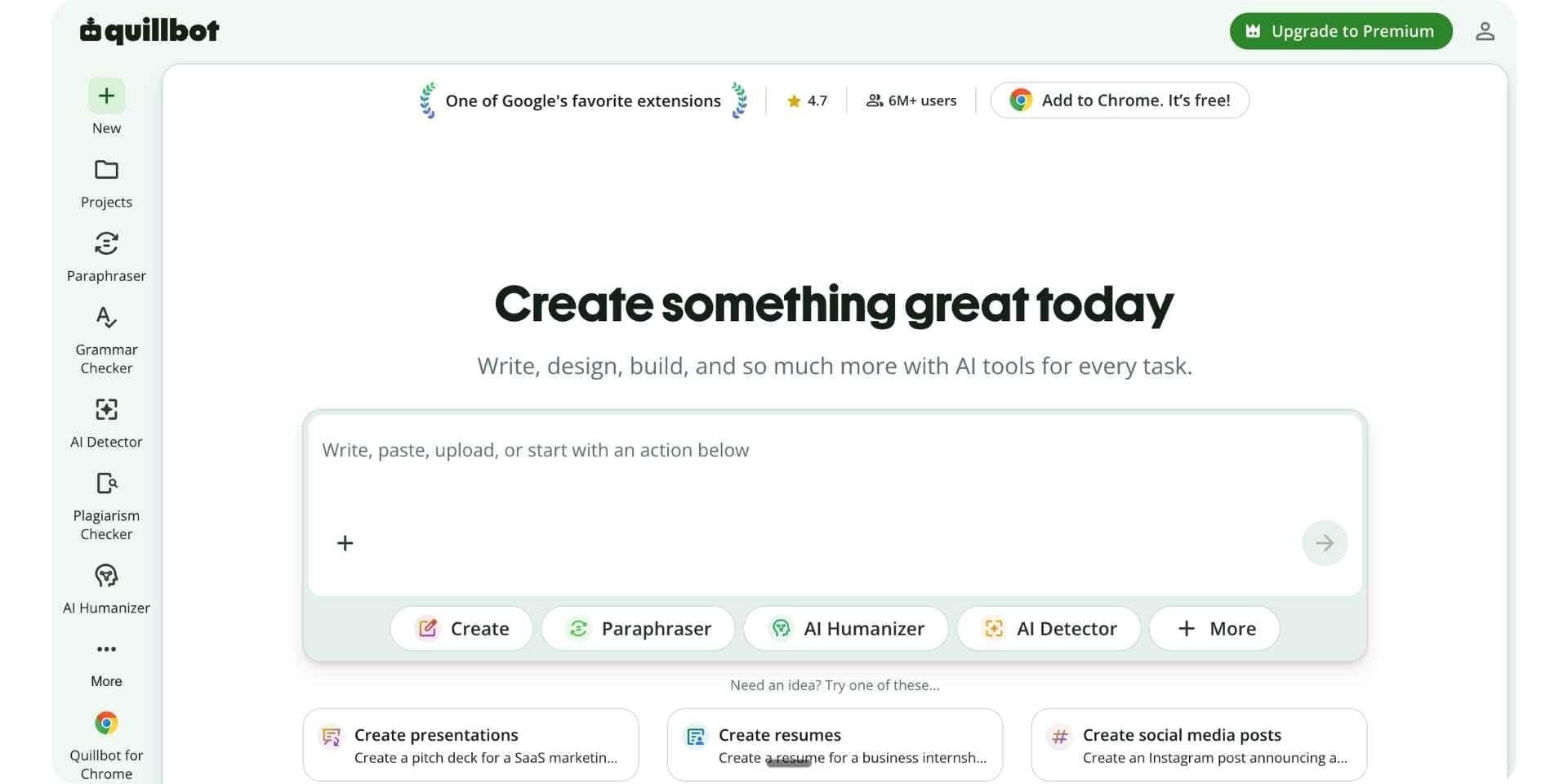
QuillBot offers academic paraphrasing with strong technical term preservation, making it useful for rephrasing dense essay passages without losing the precise vocabulary that academic writing requires. The seven paraphrasing modes (Standard, Fluency, Formal, Simple, Creative, Expand, Shorten) plus the synonym slider give granular control over how aggressively the tool rewrites text. The free tier covers casual paraphrasing, and Premium adds longer inputs, all modes, plagiarism checking, and unlimited paraphrase volume.
What QuillBot does well is paraphrase quality on academic essay prose. Where general paraphrasers either flatten meaning or break terminology, QuillBot preserves both because its academic mode is trained specifically for research writing. What QuillBot does less well than Paperguide is everything beyond paraphrasing; there is no drafting, no citation grounding, no reference manager, and no literature workflow. It is a paraphrasing tool layered onto an essay-writing workflow, not an essay writer.
Key Features
- Paraphrasing across seven modes (Standard, Fluency, Formal, Simple, Creative, Expand, Shorten).
- Synonym control slider for vocabulary aggressiveness.
- Grammar checker and sentence rewriter.
- Summariser and AI content detector.
- Citation generator across 1,000+ styles.
- Word add-in and Chrome extension.
Pros
- Strongest academic paraphrasing in this list for essay use.
- Free tier is generous for short-passage paraphrasing.
- Plagiarism check included on Premium.
Cons
- Paraphrasing only; no essay drafting or citation grounding.
- Free plan excludes plagiarism check.
Best For
Researchers and essay writers rephrasing dense passages, summarising source material, or rewriting drafted essay sections to avoid self-plagiarism.
Pricing
| Plan | Price | What It Covers |
|---|---|---|
| Free | $0 | 125 words per paraphrase, Standard mode only, basic grammar check. |
| Monthly | $19.95/mo | Unlimited paraphrase, all modes, plagiarism check, longer inputs. |
| Annual | $8.33/mo billed annually (58% off) | Lowest per-month cost for Premium features. |
Verdict
QuillBot is the strongest free academic paraphrasing tool for AI essay writing in 2026. Paperguide is the best QuillBot companion for citation-grounded essay drafting where paraphrasing is one stage of a larger essay workflow rather than the entire workflow.
5. HyperWrite
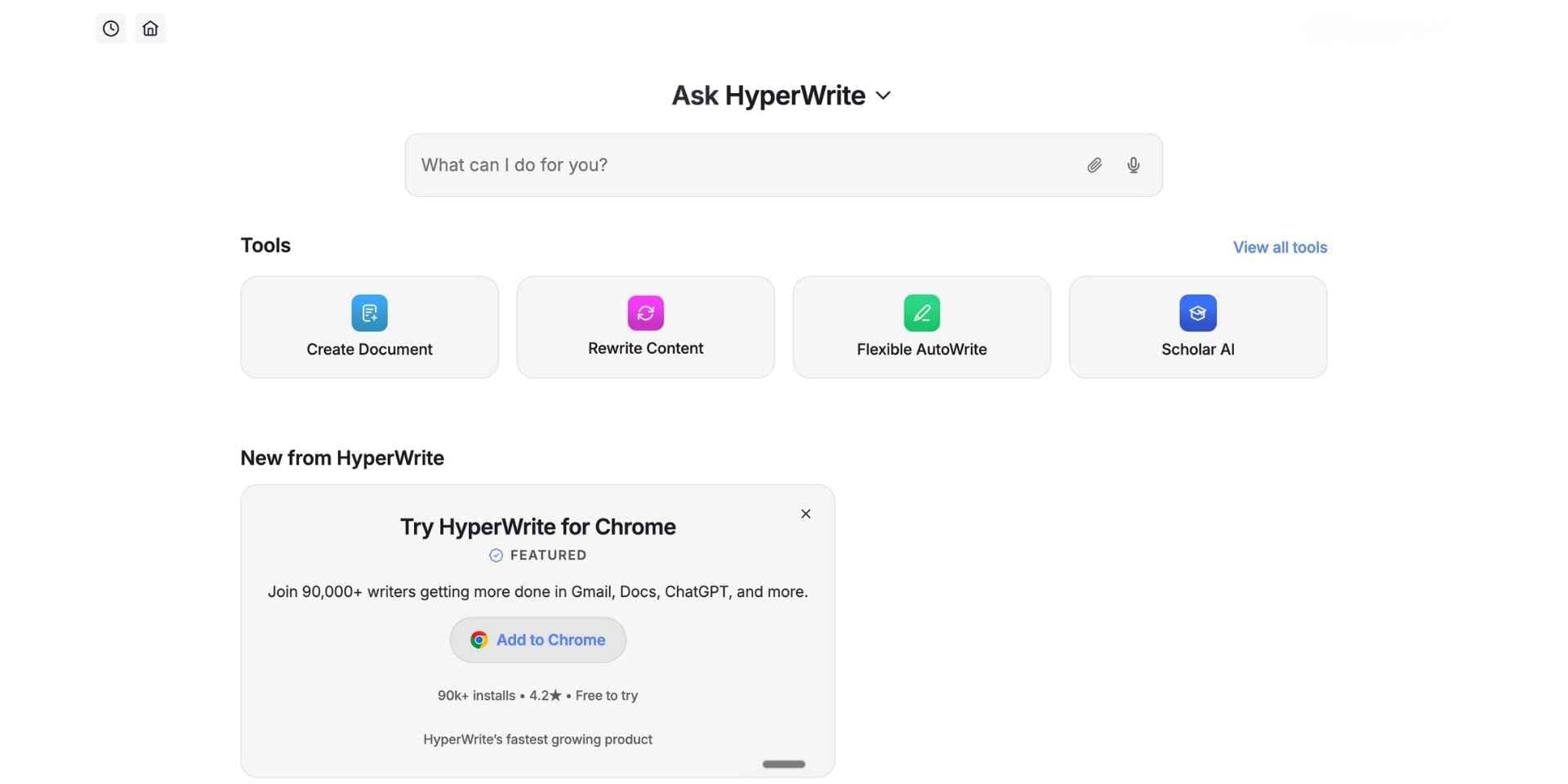
HyperWrite is the autopilot-style AI essay writer with personality customisation, real-time research citations, and a personal-assistant workflow that adapts to the writer's voice over time. The Premium tier includes 250 AI messages per month with citations and real-time information sourced from web search, three custom personas that let the writer train the AI on their own writing samples, and access to hundreds of pre-made AI tools for specific essay use cases (argumentative, analytical, comparative, descriptive).
What HyperWrite does well is consistency of voice. Where most AI essay writers produce competent but generic prose, HyperWrite's personality customisation lets the writer match their own writing style across multiple essays. The TypeAheads browser extension brings the autocomplete experience to any web-based essay editor. What HyperWrite does less well than Paperguide is academic citation depth; the real-time citations are useful but not anchored to a connected academic reference library the way Paperguide's are.
Key Features
- Personality customisation through up to 10 custom personas (Ultra).
- Autopilot autocomplete with TypeAheads browser extension.
- Real-time research with citation insertion from web search.
- Hundreds of AI tools for specific essay use cases.
- HyperWrite Scholar for academic research.
- Citation + real-time info on Premium and Ultra.
Pros
- Personality customisation stands apart among the AI essay writers in this list.
- Strong autocomplete with TypeAheads browser extension.
- TRYHYPERWRITE code gives 50% off the first month.
Cons
- Citations are real-time web-sourced, not anchored to a connected academic library.
- No structured reference manager for essay bibliographies.
- Free plan has tight message caps.
Best For
Essay writers who produce multiple essays in a consistent voice and want an AI assistant that learns their writing style over time through custom personas.
Pricing
| Plan | Price | What It Covers |
|---|---|---|
| Free | $0 | Limited monthly AI credits, basic AI. |
| Premium | $19.99/mo monthly or $16/mo annual ($192/yr, 20% off) | 250 AI messages/month, citations + real-time info, 3 custom personas, hundreds of AI tools, unlimited TypeAheads. |
| Ultra | $44.99/mo monthly or $29/mo annual ($348/yr) | Unlimited AI messages, 10 custom personas, first access to experimental features, unlimited TypeAheads. |
Verdict
HyperWrite is the strongest autopilot AI essay assistant in 2026 for writers maintaining consistent voice across multiple essays. Paperguide is the best HyperWrite alternative for academic essays where citation grounding against a real reference library matters more than personality customisation.
6. Smodin
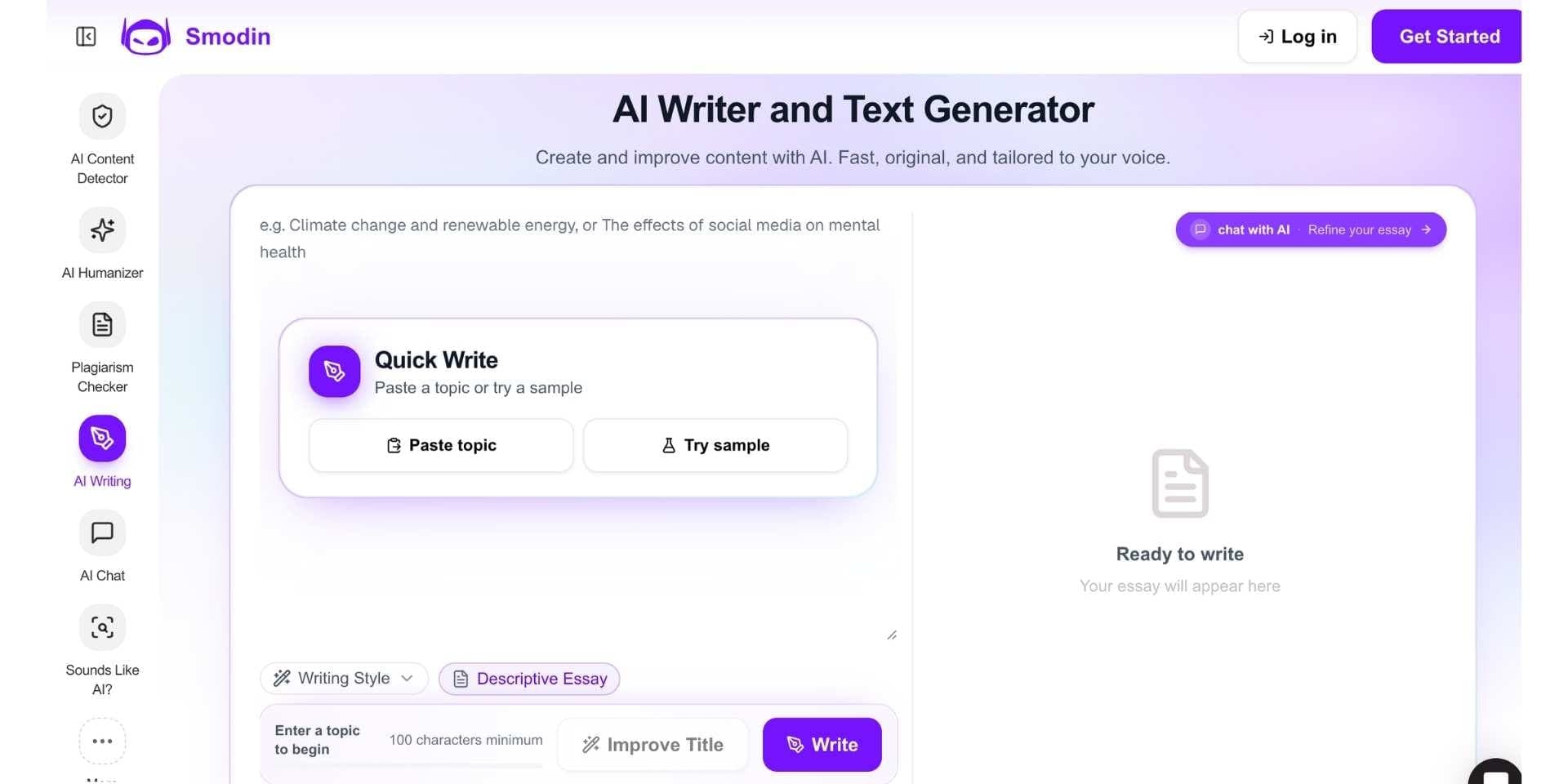
Smodin is the strongest free AI essay generator in 2026 with AI detector and AI humaniser built into the platform. The Starter plan at $10/month annual covers all core tools (AI Writer, AI Detector, Humanizer, Plagiarism Checker, AI Chat) with unlimited writing output gated behind the Premium tier at $16/month annual. The integrated workflow makes Smodin practical for writers who want one tool covering generation, detection, and humanisation rather than three separate subscriptions.
What Smodin does well is the integration of generation with detection. The AI Detector checks essay output for AI signatures, and the Humanizer attempts to rewrite passages to reduce detection probability. What Smodin does less well than Paperguide is citation integrity; there is no scholarly reference library, no academic citation grounding, and the humaniser approach to detection evasion is increasingly caught by modern Turnitin and AI-detection updates. The protective path remains drafting with citation-grounded AI and editing in your own voice rather than relying on humaniser passes.
Key Features
- AI Writer for essay generation with simple prompts.
- AI Content Detector for checking essay output.
- AI Humaniser for rewriting AI-detected passages.
- Plagiarism Checker across web and academic sources.
- AI Chat for tutoring and topic explanation.
- Text Rewriter, Summariser, Translator.
- Chrome Extension (Premium) for Google Docs integration.
Pros
- Strongest free essay generator with AI detector built in.
- Integrated workflow (generate + detect + humanise + check plagiarism) in one tool.
- Affordable Starter at $10/month annual.
Cons
- No citation grounding for academic essay references.
- AI humanisers do not reliably bypass modern detection (Turnitin updated repeatedly in 2025-2026).
- Writing output limited on Starter; Premium required for unlimited.
Best For
Essay writers needing a free essay generator with AI detector and humaniser integrated into the workflow rather than as separate tools.
Pricing
| Plan | Price | What It Covers |
|---|---|---|
| Starter | $10/mo annual (20% off) | All AI tools, AI Detector + Humanizer, Plagiarism Checker, AI Writer, AI Chat, guaranteed usable output. |
| Premium | $16/mo annual (20% off) | Premium AI Models, advanced AI Detection + Humanization, extensive Plagiarism Check, unlimited writing output, extended AI Chat memory, Chrome Extension. |
Verdict
Smodin is the strongest free AI essay generator with integrated AI detection in 2026. Paperguide is the best Smodin alternative for essay writers who need real citation grounding rather than post-generation humanisation to manage AI detection risk.
7. Yomu AI
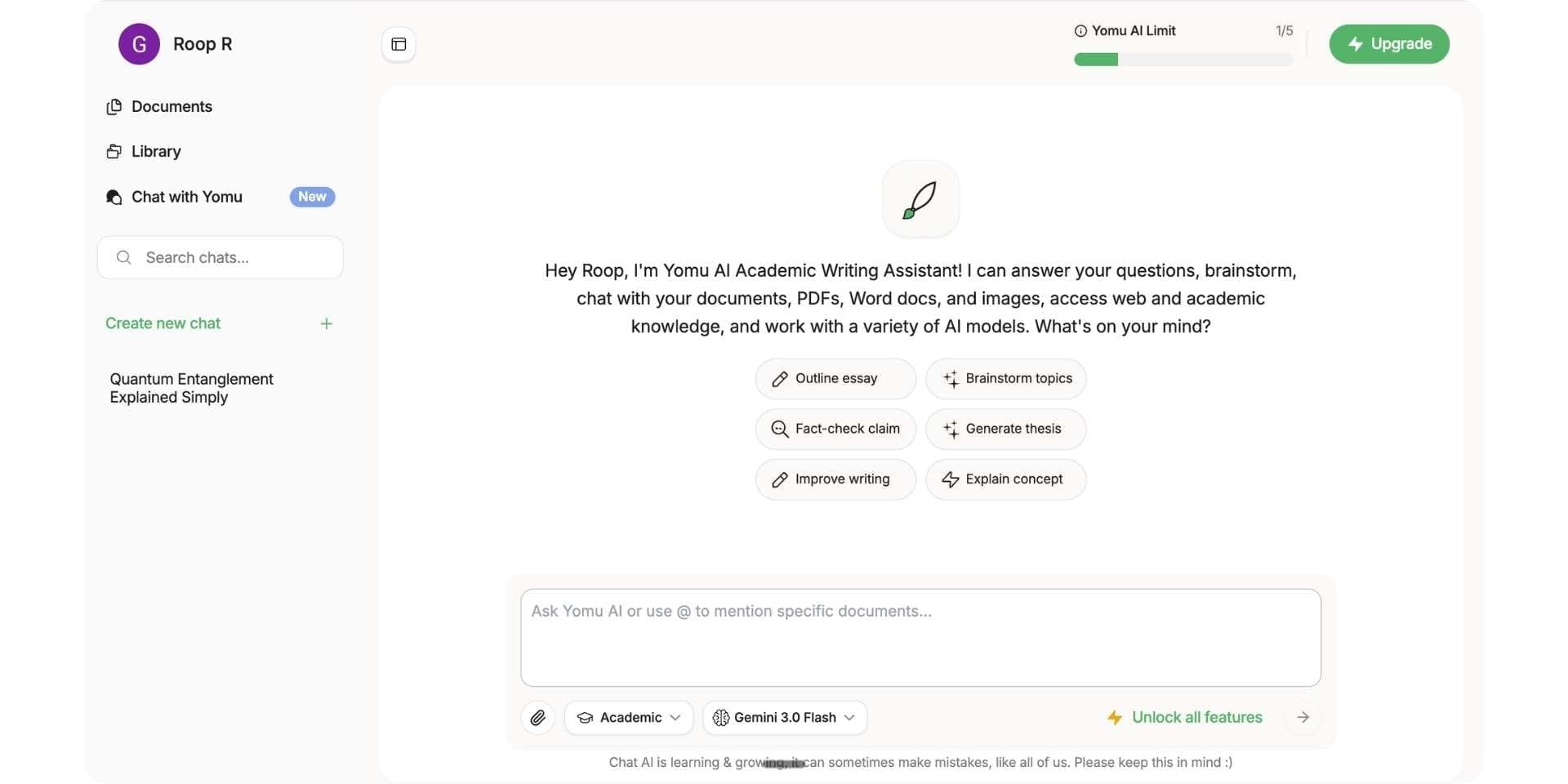
Yomu AI is the minimalist AI editor for essays and short academic work, with a clean distraction-free interface that focuses on autocomplete drafting and citation insertion without the complexity of full research platforms. The Pro tier covers most essay writing needs at $11 per month annual, and the Ultra tier raises generation limits at $18 per month annual. A Believer one-time lifetime tier exists for $499.
What Yomu AI does well is the writing experience. The interface is clean, the autocomplete is fast, and the focus on writing rather than workflow complexity makes it appealing for short essays, class assignments, and reflective writing. What Yomu AI does less well than Paperguide is depth across the essay writing lifecycle; there is no AI Search across a real peer-reviewed corpus, no Literature Review AI, and no full-fledged reference manager for longer academic essays.
Key Features
- Minimalist autocomplete drafting.
- Citation insertion (limited database).
- AI editing for clarity and tone.
- Distraction-free essay editor.
- Document export.
- Believer one-time lifetime tier ($499).
Pros
- Cleanest minimalist essay editor in this list.
- Focused writing experience without workflow complexity.
- One-time lifetime tier available.
Cons
- Limited features compared to full essay writing platforms.
- Smaller citation database than Paperguide's 200M+ peer-reviewed corpus.
- No literature review, structured extraction, or research workflow features.
Pricing
| Plan | Annual Price | Monthly Price |
|---|---|---|
| Free | $0 | $0 |
| Pro | $11/mo (40% off) | $19/mo |
| Ultra | $18/mo (40% off) | $29/mo |
| Believer | $499 one-time | Lifetime premium access |
Verdict
Yomu AI is the minimalist AI essay editor for short essays in 2026. Paperguide is the best Yomu AI alternative for longer essays requiring citation-grounded drafting, literature review, and a full-fledged reference manager.
Worked Example: One Cited Research Essay Across All 7 Tools
To show where each tool fits, here is the same task, drafting one argumentative research essay that needs cited evidence, routed through all 7 tools. The task is identical each time; only the output changes.
- Paperguide AI Essay Writer: takes the essay question and the reference library, then drafts the essay with in-text citations applied automatically from real papers, each claim resolving to a source in the library. Output: a cited draft ready for editing and submission.
- Jenni AI: you write the opening clause and Jenni autocompletes each sentence in academic register, offering citation suggestions inline. Output: a draft built line by line with you controlling the voice.
- ChatGPT: generates a fluent full-essay draft from the prompt, but any references it produces are fabricated and need verification. Output: strong general prose, unverified citations.
- QuillBot: does not draft. Paste a written passage and it paraphrases and tightens it across academic modes. Output: reworded, grammar-checked text.
- HyperWrite: autopilot drafting in a custom persona with real-time web citations. Output: a voice-matched draft with web-sourced, not library-verified, references.
- Smodin: generates a draft plus an AI-detection and humaniser pass. Output: a generated essay with a detection score, but no scholarly citation grounding.
- Yomu AI: a clean editor for drafting a short essay with light autocomplete. Output: a distraction-free short draft, limited citation support.
Only the Paperguide AI Essay Writer starts from the essay question and returns a draft grounded in real, cited sources. The other six each handle one stage: autocomplete, general drafting, paraphrasing, voice-matched autopilot, free generation with detection, or minimalist editing.
How the Paperguide Essay Writing Workflow Works
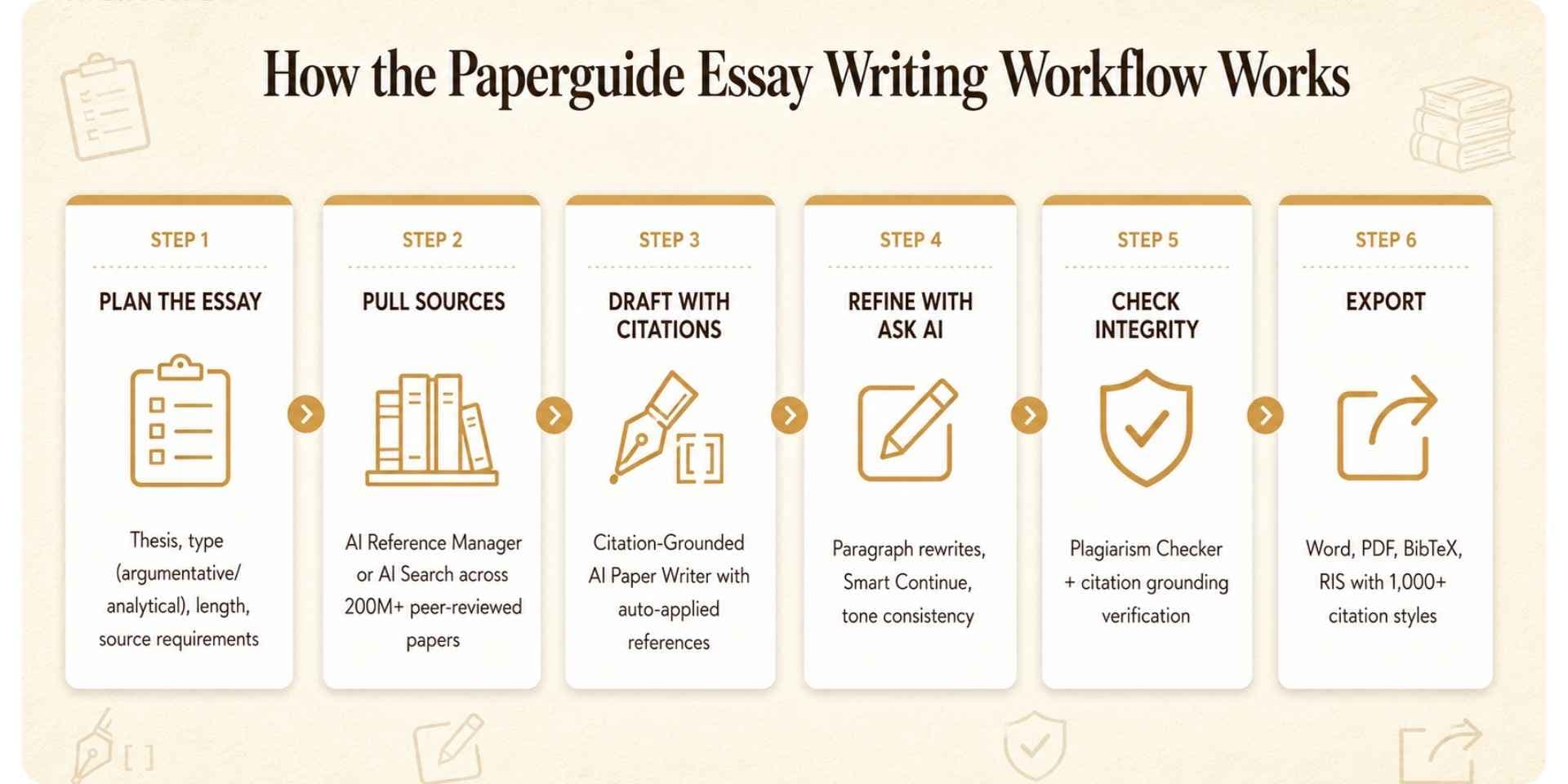
The best AI essay writing results in 2026 come from layering tools across a connected writing workflow rather than expecting one tool to do everything.
Step 1: Plan the essay
Define the thesis statement, essay type (argumentative, analytical, comparative, descriptive), target length, and source requirements. The essay structure guidance in the how to write a research paper guide and the types of research papers reference apply equally to long-form essay planning.
Step 2: Pull source material
Select papers from the AI-native Reference Manager or pull new sources via AI Search across 200M+ peer-reviewed papers. The library connects directly to the essay writer for inline citation insertion.
Step 3: Draft with citations
The AI Paper Writer drafts the essay with citations applied automatically from the actual reference library. Every cited source is verifiable, eliminating the fabricated-citation failure mode that disqualifies general AI essay generators.
Step 4: Refine with AI Edit
Paragraph-level rewrites for clarity, tone, academic register, and argument strength. Smart Continue completes sentences without breaking citation flow.
Step 5: Check integrity
The built-in Plagiarism Checker (on every plan) catches similarity issues. Citation grounding ensures every reference is real and verifiable.
Step 6: Export
Word, PDF, BibTeX, RIS export with 1,000+ citation styles applied for any university or institutional format.
This research-first essay writing workflow is what separates AI essay writers that survive editorial review and AI detection from those that produce confident-sounding prose with fabricated citations baked in, the same connected workflow profiled across the broader AI tools for academic writing and AI tools for research papers cluster pillars.
Best AI Essay Writer by Use Case
| Use Case | Recommended Tool | Why |
|---|---|---|
| Best AI essay writer overall | Paperguide AI Essay Writer | Citation-grounded essays with verified sources from 200M+ peer-reviewed papers. |
| Best AI essay writer for scientific research essays | Paperguide AI Essay Writer | Real-corpus citations from PubMed, arXiv, OpenAlex, Semantic Scholar. |
| Best AI for in-line autocomplete essay writing | Jenni AI | Fastest autocomplete trained on academic writing. |
| Best AI for general-purpose essay drafting | ChatGPT | Strongest general reasoning across any essay topic. |
| Best AI for academic paraphrasing | QuillBot | Seven paraphrasing modes preserving technical terminology. |
| Best AI for autopilot personality-customised essays | HyperWrite | Custom personas + TypeAheads autocomplete with real-time research. |
| Best free AI essay generator with AI detector | Smodin | Integrated AI Writer + Detector + Humanizer + Plagiarism Checker. |
| Best minimalist AI editor for short essays | Yomu AI | Clean distraction-free editor for short academic work. |
| Best AI for argumentative essays with verified evidence | Paperguide AI Essay Writer | Architecture-level citation grounding for argument support. |
| Best AI for citation accuracy in essay writing | Paperguide AI Essay Writer | Real-corpus citation insertion from the connected library. |
| Best AI reference manager for essay writing | Paperguide | 1,000+ citation styles, Zotero migration, connected to writer. |
| Best free AI essay writer stack | Paperguide Free + Jenni AI Free + QuillBot Free | Free citation-grounded drafting + autocomplete + paraphrasing. |
Best AI Essay Writers: Final Comparison
| Feature | Paperguide AI Essay Writer | Jenni AI | ChatGPT | QuillBot | HyperWrite | Smodin | Yomu AI |
|---|---|---|---|---|---|---|---|
| Citation grounding | Verified (200M+ peer-reviewed) | Partial | Fabrication risk | None | Real-time web | None | Partial |
| Scientific research essay support | Yes (strongest) | Partial | No | No | Partial | No | Partial |
| Long-form essay drafting | Yes | Partial | Yes | No | Yes | Yes | Partial |
| In-line autocomplete | Partial | Yes (strongest) | No | No | Yes (TypeAheads) | No | Yes |
| AI detector built in | No | No | No | No | No | Yes | No |
| Reference manager | AI Reference Manager | None | None | None | None | None | None |
| Plagiarism check | Yes (all plans) | None | None | Premium | None | Yes | None |
| Free plan | Yes | Yes (10/day) | Yes | Yes | Yes (limited) | Free tools | Yes (limited) |
| Starting paid | $12 per seat/mo, billed annually | $12/mo Plus | $20/mo | $8.33/mo annual | $16/mo annual | $10/mo annual | $11/mo annual |
How to Avoid the Most Common AI Essay Writer Mistakes in 2026
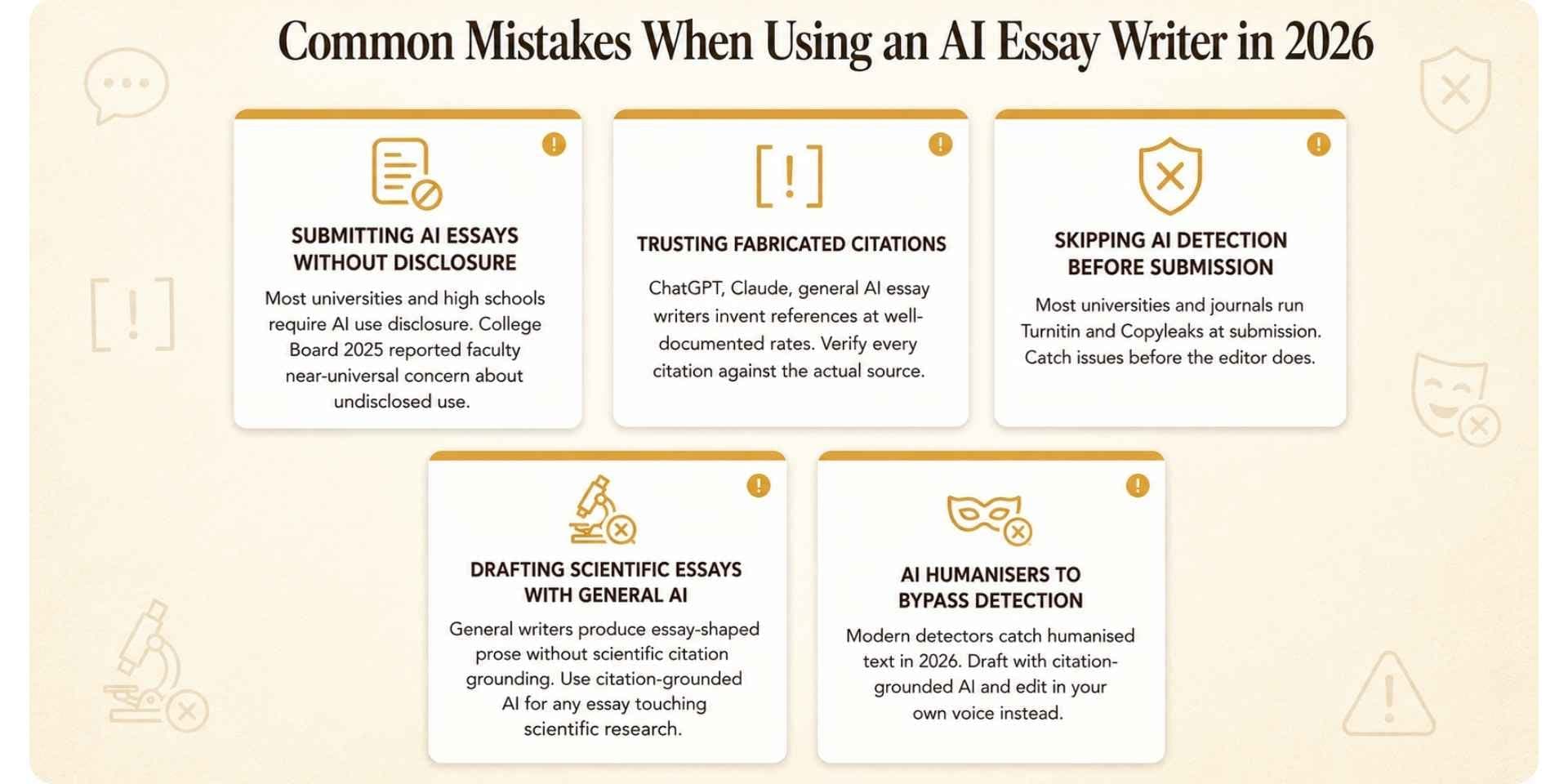
- Submitting AI-generated essays without disclosure. Most universities, high schools, journals, and scientific publishers require AI use disclosure at submission. The Gallup 2025 and College Board October 2025 surveys both flagged faculty concern that undisclosed AI use undermines learning and triggers academic integrity proceedings.
- Trusting fabricated citations in scientific research essays. General-purpose AI essay writers (ChatGPT, Claude, HyperWrite without retrieval) invent peer-reviewed references at well-documented rates. Verify every citation against the actual source paper before the essay leaves the workspace, particularly for scientific essays where examiners audit DOIs.
- Skipping AI detection before submission. Most universities and journals run AI detection (Turnitin, Copyleaks, GPTZero) at submission. Catch issues before the editor does, not after.
- Drafting scientific research essays with general-purpose AI. General writers produce essay-shaped prose without scientific citation grounding. Use citation-grounded AI for any essay that touches scientific research, lab reports, methodology discussion, or evidence synthesis.
- Using AI humanisers to bypass detection. Modern AI detectors catch text run through AI humanisers more often than not in 2026, and the humaniser approach has become a reliable signal for academic integrity reviewers rather than a defence against detection. Draft with citation-grounded AI and edit in your own voice instead.
Final Verdict
For researchers, postdocs, faculty researchers, lab teams, evidence synthesis teams, and academic writers producing essays in 2026, the Paperguide AI Essay Writer is the best AI essay writer for scientific research essays and evidence-grounded academic essays. The platform's combination of architecture-level citation grounding against 200M+ peer-reviewed papers (PubMed, arXiv, OpenAlex, Semantic Scholar), multi-section consistency across long-form essay drafts, AI Reference Manager with 1,000+ citation styles, and built-in Plagiarism Checker makes it the only AI essay writer that survives editorial review, AI-detection screening, and scientific integrity audit on the first submission pass.
For specific essay use cases where dedicated tools dominate, Jenni AI handles in-line autocomplete drafting, ChatGPT handles general-purpose drafting and brainstorming, QuillBot handles academic paraphrasing of dense scientific passages, HyperWrite handles autopilot writing with personality customisation and real-time research citations, Smodin handles free essay generation with integrated AI detection, and Yomu AI handles minimalist editing for short essays and reflective writing.
The 2026 best-practice pattern for essay writing, especially scientific research essays, is rarely a single tool. It is the Paperguide AI Essay Writer for the citation-grounded backbone (drafting, reference management, plagiarism check), Jenni AI for fast autocomplete during active essay drafting, QuillBot for paraphrasing dense scientific source passages, and ChatGPT or HyperWrite for general ideation and exploratory writing before the cited essay drafting begins. That layered workflow is what produces essays that survive 2026 academic integrity review and editorial AI-detection screening on the first submission pass.
About This Evaluation
This comparison was compiled by the Paperguide editorial team, who work with AI writing and research tools daily across drafting, citation, and academic integrity workflows. Each tool was assessed on the criteria that decide a real essay-writing workflow: citation grounding at the architecture level, long-form drafting, AI-detection survivability, academic register, built-in plagiarism and AI-detection checks, and pricing. Pricing reflects each vendor's public page as of July 2026 and can change, so confirm current tiers before subscribing. Statistics are drawn from the primary sources cited inline (Gallup and the College Board). As with any AI-assisted writing, verify every cited source against the original paper before you submit, and disclose AI use per your institution's policy.
Frequently Asked Questions (FAQs)
What is the best AI essay writer in 2026?
The Paperguide AI Essay Writer is the best AI essay writer for scientific research essays and evidence-grounded academic essays in 2026 because it grounds citations against a real connected reference library of 200M+ peer-reviewed papers at the architecture level. For general-purpose essays, ChatGPT and Jenni AI are the most widely used alternatives.
Which AI essay writer has the best features?
The Paperguide AI Essay Writer has the strongest features for scientific research essay writing in 2026, including citation grounding against 200M+ peer-reviewed papers (PubMed, arXiv, OpenAlex, Semantic Scholar), AI Reference Manager with 1,000+ citation styles, Literature Review AI for grounded scientific background sections, and built-in Plagiarism Checker. For general-purpose essays, ChatGPT and HyperWrite have the broadest feature sets across reasoning and personality customisation respectively.
What is the best free AI essay writer?
The Paperguide Free plan plus Jenni AI Free (10 autocompletes/day) plus QuillBot Free combination is the strongest free stack for essay writing in 2026. Paperguide handles citation-grounded drafting, Jenni handles autocomplete, QuillBot handles paraphrasing. Smodin Free covers AI detection and basic generation if the essay does not require cited sources.
Can AI essay writers bypass AI detection?
Modern AI detectors (Turnitin, Copyleaks, GPTZero) catch most AI-generated text in 2026, including humanised output. The protective approach is to draft with citation-grounded AI like Paperguide that ties prose to real source material, edit the output substantively in your own voice, and run plagiarism and AI-detection checks before submission. Relying on AI humanisers to bypass detection has become unreliable as detection systems updated repeatedly through 2025 and 2026.
Is using an AI essay writer considered cheating?
Using an AI essay writer with appropriate disclosure is widely accepted in 2026. Cheating refers to undisclosed AI use, fabricated citations, or attempts to bypass detection. The College Board October 2025 survey reported 84% of high school students using generative AI for schoolwork with faculty expressing near-universal concern about undisclosed use specifically. Check your institution's AI policy and disclose AI assistance at submission.
What is the best AI essay writer that can't be detected?
No AI essay writer reliably bypasses modern detection in 2026. The protective approach is to draft with citation-grounded AI (Paperguide) that ties prose to real source material and edit the output in your own voice before submission. AI-detection survivability comes from substantive editing and citation integrity, not from humaniser passes.
What is an AI essay writer?
An AI essay writer is a tool that drafts essays from a prompt, research question, or source material. Citation-grounded AI essay writers like Paperguide pull references from a real connected library and ground claims in retrieved sources. General-purpose AI essay writers like ChatGPT generate prose from training data without verified citations. The two categories produce essays that look similar at first glance but diverge sharply on editorial review and AI-detection screening.
How many students use AI essay writers in 2026?
A Gallup 2025 college student survey found 54% of college students use AI to edit or improve their writing and 54% use it to summarise lectures or notes. The College Board reported in October 2025 that 84% of high school students use generative AI for schoolwork including brainstorming and revising. AI essay writing has crossed from experimental to mainstream practice across student populations.
Can AI essay writers write argumentative essays?
Yes. Citation-grounded AI essay writers like the Paperguide AI Essay Writer handle argumentative essays particularly well because the architecture-level citation grounding produces argument support that examiners can verify against real peer-reviewed sources. General-purpose AI essay writers can also draft argumentative essays, but the citations produced are routinely fabricated and require manual verification before submission.
What is the best AI essay writer for scientific research essays?
The Paperguide AI Essay Writer is the best AI essay writer for scientific research essays in 2026 because it pulls citations from 200M+ peer-reviewed papers across PubMed, arXiv, OpenAlex, and Semantic Scholar, with every cited source verifiable against the actual reference library. For scientific essays where examiners audit DOIs and reference accuracy, architecture-level citation grounding is non-negotiable.
What is the best AI essay writer for college students?
The Paperguide AI Essay Writer leads for evidence-grounded academic essays and scientific research essays where citation accuracy matters for grading. ChatGPT and Jenni AI lead for general drafting and brainstorming. QuillBot handles paraphrasing dense source passages. Smodin offers free generation with built-in AI detection for self-checking before submission. The protective pattern combines Paperguide for cited essays with Jenni AI or QuillBot for paragraph-level refinement before submission.
Writing a paper?
Write your paper with real citations
Drafts grounded in real papers, with citations in APA, MLA and Chicago.
Start writingNo credit card required