Paperguide vs Consensus: Best Consensus Alternative for AI Research in 2026


Paperguide and Consensus are two of the most popular AI tools for research in 2026, but they approach academic and scientific research from opposite ends of the workflow. Paperguide is built around a connected research workflow where AI search, literature review, PDF analysis, structured extraction, reference management, and AI writing all stay linked inside one workspace. Consensus focuses on search-layer intelligence, delivering citation-backed answers to natural-language questions with a consensus meter that shows directional agreement across the literature and visual citation graph exploration.
The gap between them widens once you move past the initial search. One platform is designed to carry research forward from discovery through extraction, writing, and citation management. The other is built to deliver fast, evidence-grounded answers at the search stage without downstream workflows for drafting or structured data extraction. The biggest difference is not search quality or citation coverage. It is what happens after you find your papers.
To compare them properly, I tested both platforms hands-on across AI Search, Literature Review, Research Agent, Chat with PDF, Data Extraction, AI Paper Writer, Reference Management, research quality filtering, and pricing. Below is a detailed breakdown of how each tool performed in real research workflows.
TL;DR
Paperguide is stronger for connected research workflows that span discovery through writing, including structured literature reviews with SJR/SNIP screening, data extraction with source verification across up to 100 papers, citation-grounded AI writing with plagiarism and grammar checking, and full reference management. Consensus is stronger for fast, citation-backed answers to natural-language research questions, with a consensus meter showing directional agreement and Pro Search filters for methodology and journal rank. Both now offer a citation graph, and Paperguide's goes further: it is free, shows earlier and later work, explains every link and saves your graphs.
Overall, Paperguide offers the better connected AI scientific research workflow in 2026 for researchers who need structured extraction, quality transparency, and integrated writing from search to draft. Consensus is more useful for researchers who primarily need quick evidence summaries and search-focused synthesis without downstream writing or extraction workflows.
| If you need... | Better choice |
|---|---|
| Literature review workflows | Paperguide |
| AI writing | Paperguide |
| Research quality filtering (SJR, SNIP) | Paperguide |
| Structured data extraction | Paperguide |
| Reference management | Paperguide |
| Fast citation-backed answers | Consensus |
| Consensus meter for directional agreement | Consensus |
| Citation graph with earlier and later work | Paperguide |
| Best overall connected workflow | Paperguide |
Paperguide Vs Consensus: Quick Comparison
| Feature | Paperguide | Consensus |
|---|---|---|
| AI Search | Hybrid semantic + keyword, agentic multi-query | Natural-language search with Pro and Deep modes |
| Research Agent | Yes (search, compare, extract, draft) | No multi-step agent (search and synthesis only) |
| Paper Database | 200M+ (PubMed, arXiv, OpenAlex, Semantic Scholar) | 400M+ (stated on the Consensus pricing page) |
| Research Quality Signals | SJR, SNIP, citation metrics, journal quartiles | Q1 to Q4 journal rank filter (Pro Search only) |
| Literature Review | 5-step structured (Standard + Extended modes) | Deep Search narrative synthesis |
| Chat with PDF | Multi-paper comparison, passage-level verification | Multi-paper Q&A (limited to ~8 papers) |
| Data Extraction | Custom columns, source verification, CSV/Excel export | Not available |
| AI writing | Connected + plagiarism/grammar checker + "@" citations | Not available |
| Reference Manager | Full-featured (Zotero, Chrome ext, 1000+ styles with collaboration) | Basic library (saved papers, DOI/Zotero import) |
| Deep Research Report | Yes (manual control at every stage) | Deep Search (automated narrative synthesis) |
| Citation Graph | Yes (free, 1 to 5 seeds, Related papers, Earlier work, Later work, saved graphs) | Yes (Beta, up to 5 seeds, 20 papers on free, not saved) |
| Consensus Meter | No | Yes (directional evidence summary) |
Workflow Comparison
AI Search
Paperguide's AI Search uses hybrid semantic and keyword search across 200M+ papers from PubMed, arXiv, OpenAlex, and Semantic Scholar. The search engine breaks questions into multiple sub-queries using an agentic multi-query approach. Search results display SJR rankings, SNIP scores, and citation metrics inline, and I could filter by study type, year, and journal quality. The final answer is synthesized from around the top 20 papers with source-linked citations, exportable as BibTeX or CSV. You can narrow the source to PubMed, arXiv or your own Reference Manager library, and it does not search the web or blogs. Each answer carries a ranked reference list and follow-up questions that keep the thread, and results save straight to the Reference Manager.
Prompt used: "Is intermittent fasting more effective than daily calorie restriction for fat loss and metabolic health?"
Paperguide AI Search
Consensus AI Search Pro generates narrative answers with citations. The system includes useful filters: publication year, methodology (meta-analysis, systematic review, RCT, observational study), journal ranking (Q1 to Q4), open access, citation threshold, and preprint exclusion. After applying filters, the search produces a structured narrative with numbered citations and references showing paper takeaways and citation counts. However, deeper metrics such as SJR, SNIP, or impact factor are not shown, and users cannot control how evidence is weighted.
Prompt used: "What are the effects of social media usage on mental health including anxiety depression and overall wellbeing?"
Consensus Research
Verdict: Consensus handles natural-language questions well with useful methodology and journal rank filters. Paperguide surfaces deeper quality signals (SJR, SNIP) directly in results and uses agentic multi-query expansion. For researchers evaluating source quality at the discovery stage, Paperguide gives more control.
Deep Research
Paperguide's Deep Research Report gives researchers manual control at every stage: research questions, search scope, included and excluded papers, screening criteria, extraction fields, and review progression. Every stage includes a confirmation step. This is useful for systematic review workflows where researcher judgment matters at every decision point.
Prompt used: "Create a deep research report on whether intermittent fasting is more effective than daily calorie restriction for fat loss and metabolic health in adults."
Paperguide Deep Research Report
Consensus Deep Search runs multiple internal searches (around 20 or more during testing) and retrieves a broader set of papers for a long-form narrative answer. The output includes a consensus meter summarizing whether papers support, oppose, or give mixed answers. The result reads like a literature-style summary covering evidence, study types, and caveats. However, users cannot control inclusion or exclusion criteria, there is no structured extraction, and the consensus meter does not account for study quality, sample size, or risk of bias.
Prompt used: "Does coffee increase or decrease the risk of cardiovascular disease based on research studies?"
Consensus Deep Search
Verdict: Paperguide gives researchers manual control at every stage with transparent screening. Consensus automates the process and delivers broader narrative synthesis with a helpful consensus meter. For workflows requiring researcher judgment and structured output, Paperguide is stronger. For fast high-level overviews, Consensus Deep Search works well.
Literature Review
Paperguide's Literature Review AI follows a five-step process: planning, search (across PubMed, arXiv, OpenAlex, Semantic Scholar, and the user's Reference Manager), screening (using SJR, SNIP, and citation metrics), extraction and synthesis, and review generation. Standard Mode handles up to 50 papers. Extended Mode screens up to 200 papers. The output includes a searched paper list, screening table, extracted data table, and structured literature review with citations. Papers flow directly into the reference manager and AI Paper Writer.
Prompt used: "Generate a literature review on whether intermittent fasting is more effective than daily calorie restriction for fat loss and metabolic health in adults."
Paperguide Literature Review
Consensus does not have a dedicated literature review agent. The closest workflow is Deep Search, which generates narrative synthesis with a consensus meter. It does not follow a structured review methodology, and there is no user-defined inclusion or exclusion criteria, no screening step, no structured extraction, and no connection to a writing workflow.
Verdict: Paperguide has the clear advantage. Its five-step workflow with SJR/SNIP screening and connected reference management is designed for rigorous literature reviews. Consensus generates useful narrative summaries but lacks the structured methodology needed for publication-targeted reviews.
Research Agent
Paperguide's Research Agent handles gap analysis, study comparison, contradiction detection, structured extraction, and draft generation within one session. During testing, the agent compared studies across methodologies, generated comparison tables with source-linked citations, and identified follow-up directions.
Prompt used: "Compare the papers in this folder on Intermittent fasting versus Daily calorie restriction. Focus on the study design, fat outcomes, and major limitations. Generate and extract table for comparison."
Paperguide Research Agent
Consensus does not have a multi-step research agent. Its search workflow generates narrative answers but does not support gap analysis, contradiction detection, or draft writing. Follow-up questions continue using the same selected papers rather than expanding the evidence base.
Verdict: Paperguide's Research Agent is significantly more capable for multi-step tasks including comparison, gap analysis, and draft generation. Consensus focuses on search and synthesis, which works well for quick answers but does not support structured multi-step workflows. Among AI research assistant tools, Paperguide's agent is one of the few that handles the full cycle from comparison to draft.
Chat with PDF
Paperguide's Chat with PDF supports single-paper and multi-paper interaction. I uploaded a PDF, asked questions about methodology, then added more papers for cross-document comparison. Responses include inline citations linking to the source paper, page number, and exact supporting passage. Insights feed into literature reviews and writing within the same platform.
Paperguide Chat With PDF
Consensus Chat With Papers lets users search, select multiple papers, and ask questions on the selected set. The system generates a Key Learnings section and supports follow-up questions. Study snapshots show publication year, study type, and citation count. However, the workflow is limited to around 8 papers per session, follow-ups use the same papers without expanding the evidence base, and outputs are narrative without structured tables or exports.
Prompt used: "How does coffee consumption affect arrhythmia incidence compared to other caffeinated beverages?"
Consensus Chat With Papers
Verdict: Paperguide provides passage-level source verification with clickable citations linking to exact text. Consensus offers useful Key Learnings synthesis but is limited in scale. For workflows where PDF insights feed into writing and synthesis, Paperguide keeps everything connected.
Data Extraction
Paperguide's Extract Data creates structured extraction tables with custom columns (up to 50 columns, 100 papers per table on paid plans). Every extracted item links back to the original source text for verification. Custom columns can be saved as reusable templates, and tables export as CSV or Excel. Extracted data stays connected to the reference manager.
Paperguide Extract Data
Consensus does not offer data extraction. There is no system for pulling variables across papers into structured tables, no custom columns, and no export-ready datasets.
Verdict: Paperguide is the only option. Researchers needing structured extraction for systematic reviews or cross-study comparison will need Paperguide's Extract Data workflow.
AI Writer
Paperguide's AI Paper Writer generates full drafts from a research question, automatically citing papers from the 200M+ database and Reference Manager. It builds an outline first, then generates a citation-grounded draft. Users can rewrite, refine, or expand any section. Citation insertion works via "@" to pull references. It includes a plagiarism checker, grammar checker, and 1,000+ citation styles for document types including literature reviews, research articles, and background sections.
Prompt used: "Generate a structured research draft on whether intermittent fasting is more effective than daily calorie restriction for fat loss and metabolic health. Include an introduction, related work, comparison of outcomes, limitations, and conclusion. Use recent papers from the last five years where possible and include citations."
Paperguide AI Paper Writer
Consensus does not include AI writing features. There is no document generation, drafting workflow, or editing capability. Users who need to write research documents must use a separate tool.
Verdict: Paperguide is the only option here. Its writer connects directly to the research workflow with citation insertion, plagiarism and grammar checking, and passage-level AI editing.
Note: Paperguide AI Paper Writer is now a more advanced AI writing assistant, enabling AI agents to generate complete documents with citations, create structured outlines from prompts, and help users start writing from scratch using a blank document.
Reference Manager
Paperguide's AI Reference Manager includes folders, tags, annotations, highlights, notes, and AI-generated summaries. Import via DOI, URL, BibTeX, RIS, PDF upload, or Zotero. A Chrome extension saves papers from the browser. Collaboration features, 1000+ citation styles, BibTeX/RIS export. The Reference Manager is limited on Free and unlimited on paid plans.
Paperguide AI Reference Manager
Consensus My Library supports saved papers, saved conversations, DOI import, and Zotero import. During testing, uploading PDFs directly did not work. The library lacks citation style management, annotations, notes, folders, tags, and writing integration.
Consensus Library
Verdict: Paperguide's reference manager is significantly more capable with multiple import methods, Chrome extension, AI summaries, collaboration, and deep workflow integration. Consensus's library covers basic saving but not full citation management.
Citation Graph
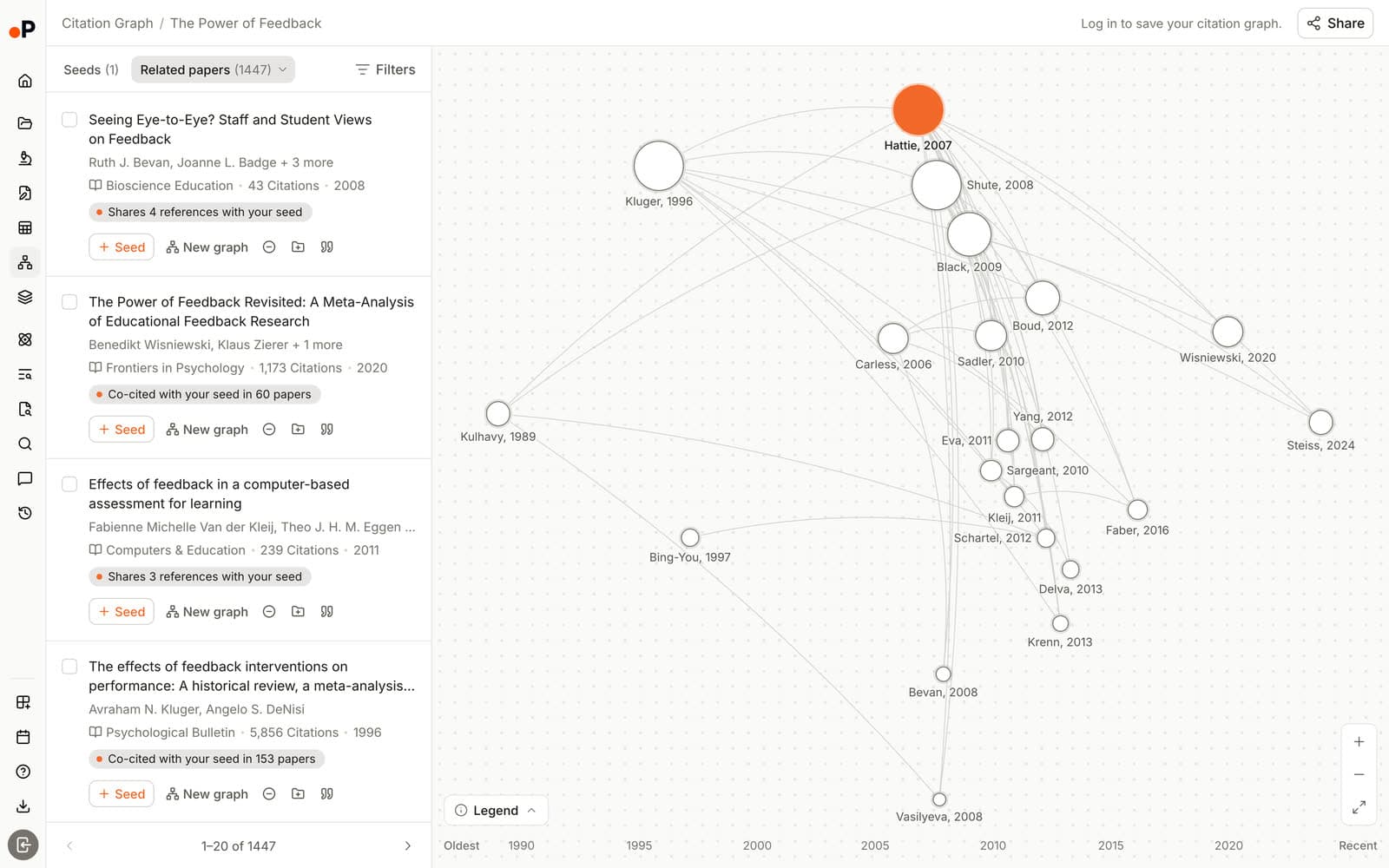
Both tools now draw a citation graph from up to five seed papers. To compare them, I ran the same seed in each in late October 2026: Trauer et al.'s 2015 meta-analysis of cognitive behavioral therapy for chronic insomnia. I then added a second seed, van Straten et al.'s 2018 meta-analysis on the same topic.
Paperguide's Citation Graph is free and needs no signup to build or browse a graph. You add 1 to 5 seed papers by title or DOI, and the graph splits into three views: Related papers, Earlier work (what the seed builds on) and Later work (what cites it). On the insomnia seed it returned 1,252 related papers, 104 in Earlier work and 847 in Later work. Every paper carries a "Why it's here" line, such as "Co-cited with your seed in 135 papers" or "Shares 25 references with your seed". Adding the second seed brought seven new papers into the top 20, each labelled as connected to both seeds. When you are logged in, graphs save to your account, you can share them by link, and papers go straight into the Reference Manager.
Consensus includes a Citation Graph, still labelled Beta, built from direct citations, co-citation and bibliographic coupling. The layout is clear: older papers sit on the left, newer ones on the right, arrows show citation direction, and colour marks each seed's cluster. An Ask button lets you chat with the papers in the graph, which uses Pro messages. On the free plan the graph shows 20 papers ("Low" density). The 40 and 60 paper densities are marked "PRO". On the insomnia seed none of the 20 papers was published in 2024 or later. There is no separate references or citations view, and no explanation of why a paper appears. Adding the second seed changed nothing: the same papers stayed in the same order. Graphs are not saved, so reloading the page clears them.
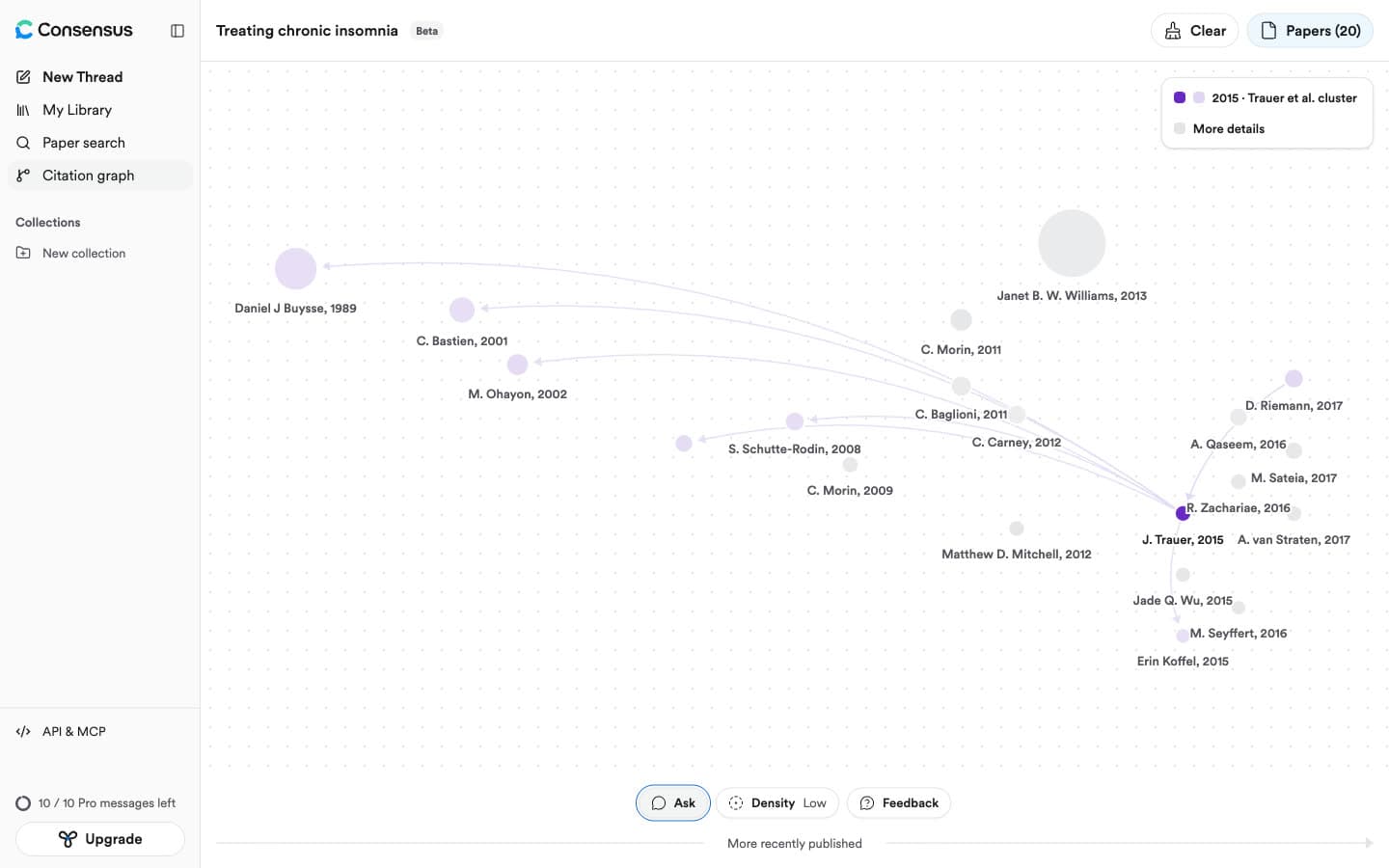
Verdict: Paperguide has the deeper and more useful citation graph for finding studies. It shows earlier and later work separately, explains every link, responds to extra seeds, saves your graphs and costs nothing. Consensus gives a neat one-screen picture of a small set of classic papers, and its chat over the graph is handy if you already pay for Pro. For a citation search that finds studies you missed, Paperguide's graph is the better tool.
Research Quality Signals
Paperguide displays SJR rankings, SNIP scores, and citation metrics throughout the platform, from search results through literature review screening. This helps distinguish Q1 journal papers from lower-impact studies when building a research background.
Consensus includes Q1 to Q4 journal rank filtering, methodology filters, citation threshold sliders, and preprint exclusion in Pro Search. These are useful for narrowing results but the platform does not display deeper metrics such as SJR, SNIP, or impact factor in search results or paper details.
Verdict: Consensus includes useful quality filters worth acknowledging. Paperguide provides deeper transparency with SJR and SNIP visible throughout the platform. For research where source credibility affects conclusions, Paperguide offers more granular insight.
Pricing Comparison
| Plan | Paperguide | Consensus |
|---|---|---|
| Free plan | $0 (1,500 AI credits/mo) | $0 (10 Pro messages, up to 3 Deep reviews) |
| Entry paid | Plus $12 per seat/mo, billed annually ($144/yr) | Pro $12/mo, billed annually ($144/yr) |
| Mid/High tier | Pro $29 per seat/mo, billed annually ($348/yr) | Deep $45/mo ($540/yr) |
| Team | Evidence Teams $89 per seat/mo, billed annually ($1,068/yr); Enterprise custom | Team $30/seat/mo ($360/yr) |
Consensus pricing scales around search depth: Pro at $12 a month, billed annually ($144 a year), gives unlimited access to its research tools, including the citation graph at higher densities, while the Deep plan at $45/month includes 200 Deep reviews. Paperguide pricing covers a broader toolset: Plus at $12 per seat per month, billed annually ($144 a year), includes 12,500 AI credits a month across AI Search, Literature Review AI, Extract Data, Chat with PDF, AI Paper Writer, and Reference Manager. Pro at $29 per seat per month, billed annually ($348 a year), adds 50,000 credits, systematic reviews up to 5,000 papers, and a plagiarism checker for 100,000 words a month. Yearly billing saves up to 41%.
Paperguide's free plan includes 1,500 AI credits a month with access to core tools. Consensus's free plan includes 10 Pro messages and up to 3 Deep reviews, with Quick Search limited to abstracts only. Paperguide's Citation Graph is free on every plan, while Consensus limits free graphs to 20 papers.
Paperguide vs Consensus: Final Comparison
| Category | Paperguide | Consensus |
|---|---|---|
| Best for | End-to-end scientific research | Fast academic search and synthesis |
| Paper database | 200M+ | 400M+ (stated on its pricing page) |
| Research quality signals | SJR, SNIP, citation metrics inline | Q1-Q4 filter in Pro Search |
| Literature Review | 5-step structured (Standard + Extended) | No dedicated agent |
| Data Extraction | 50 columns, 100 papers, templates | Not available |
| AI writing | Connected + plagiarism/grammar checker | Not available |
| Reference Manager | Full-featured + Zotero + Chrome ext | Basic library (DOI/Zotero import) |
| Research Agent | Multi-step (gap analysis, drafts) | Not available |
| Deep Research | Manual control at every stage | Automated narrative synthesis |
| Citation Graph | Free, earlier and later work, saved | Beta, 20 papers on free, not saved |
| Consensus Meter | No | Yes |
| Writing Integration | Full (search to draft) | None |
| Free plan | 1,500 AI credits/month, core tools | 10 Pro messages, up to 3 Deep reviews |
Final Verdict
Paperguide offers the stronger end-to-end AI research workflow for researchers who need a connected pipeline from paper discovery to a citation-grounded draft with quality transparency at every step. Its Literature Review AI follows a structured five-step process with SJR/SNIP screening, the Deep Research Report gives manual control at every stage, and the AI Paper Writer with plagiarism checking, grammar checking, and "@" citation insertion closes the loop between research and writing. For evidence synthesis, Paperguide Systematic Review runs protocol-driven reviews with Dual Review (two blind reviewers plus a conflict resolver) or AI Systematic Review with a named verifier, and generates the PRISMA diagram from actual counts. Combined with a generous free plan (1,500 AI credits a month), Paperguide provides the most complete research workflow for PhD students, graduate researchers, and academic teams.
Consensus is a strong platform for fast, citation-backed answers. Its natural-language search is intuitive, Pro Search filters (Q1 to Q4, methodology, citation threshold) are useful for narrowing results, and Deep Search provides broad narrative synthesis with a consensus meter. Its Citation Graph gives a tidy one-screen view of a small set of classic papers, though Paperguide's free Citation Graph goes further with earlier and later work and a reason for every link. For researchers who primarily need quick evidence summaries without structured extraction or writing, Consensus is efficient.
For researchers who want a connected research operating system rather than separate search tools, Paperguide is the stronger AI research platform overall in 2026. If you need fast answers backed by citations without structured research outputs, Consensus handles that well. Researchers evaluating reference management alongside AI search may also find our comparisons with Zotero and Mendeley useful for understanding how Paperguide handles the full research pipeline.
Frequently Asked Questions
Is Paperguide better than Consensus?
Paperguide is the better choice for researchers who need a connected end-to-end workflow with quality signals like SJR and SNIP, structured extraction, and AI writing. Consensus is stronger for fast academic search and citation-backed evidence summaries. The right choice depends on whether you prioritize workflow completeness or speed-focused search and synthesis.
Does Consensus have a literature review tool?
Consensus does not have a dedicated literature review agent. Its closest feature is Deep Search, which generates narrative synthesis with a consensus meter but does not follow structured review methodology with inclusion/exclusion criteria or screening. For researchers who need guidance on how to write a literature review, Paperguide offers a five-step Literature Review AI with Standard and Extended modes.
Does Consensus show research quality metrics?
Consensus includes Q1 to Q4 journal rank filtering, methodology filters, and citation threshold sliders in Pro Search. However, it does not display SJR, SNIP, or impact factor in search results or paper details. Paperguide displays SJR and SNIP throughout the platform.
Which tool is more affordable for students?
Paperguide's yearly billing saves up to 41%. Consensus does not currently list a student discount. Paperguide's free plan also includes 1,500 AI credits a month compared to Consensus's 10 Pro messages.
Can Consensus generate research drafts or papers?
No. Consensus does not include AI writing features or drafting workflows. Researchers who need to write research documents with citations will need a separate tool. Paperguide includes an AI Paper Writer with plagiarism checking, grammar checking, "@" citation insertion, and 1,000+ citation styles.
Does Consensus have a data extraction feature?
No. Consensus does not offer structured data extraction, custom column creation, or export-ready datasets. Researchers working on systematic reviews or meta-analyses will need Paperguide's Extract Data, which supports up to 50 columns and 100 papers per table with source verification and CSV/Excel export.
What is the Consensus Meter?
The consensus meter in Deep Search summarizes whether papers support, oppose, or give mixed answers to a research question. It provides a quick directional view but counts papers into categories without weighing study design, sample size, or journal quality, so it should not replace full evidence quality assessment.
How does Consensus pricing compare to Paperguide?
Consensus Pro costs $12 a month ($144 a year) and Deep costs $45 a month ($540 a year), billed annually. Paperguide Plus costs $12 and Pro costs $29 per seat per month, billed annually ($144 and $348 a year). The entry prices match, but Paperguide includes more tools (AI Paper Writer, Extract Data, Literature Review AI, Reference Manager) at each tier.
Does Paperguide have a citation graph?
Yes. Paperguide's Citation Graph is free and needs no signup to build a graph from 1 to 5 seed papers, added by title or DOI. It shows related papers, earlier work and later work, with a line explaining why each paper appears. Logged in, graphs save to your account and papers go to the Reference Manager.
Researching a topic?
Find papers and get cited answers
Search the literature, find gaps and write with citations.
Start for freeNo credit card required