7 Best Elicit Alternatives for Systematic Review Workflows in 2026

Elicit, launched in 2022, became one of the most widely used AI research tools among systematic reviewers, evidence-based medicine teams, and research operations groups inside universities and pharmaceutical companies. By 2026, the platform handles natural-language paper search across an index of 125M+ academic papers, structured data extraction across custom columns, and large-scale systematic review screening that reaches up to 40,000 papers per workflow on Enterprise.
The reality for many researchers in 2026 is that Elicit handles extraction at scale better than any tool in this category but stops short on the steps around extraction. There is no native AI Paper Writer to turn the data into a draft, no full reference manager to keep the library inside one workspace, no Chat with PDF for deep paper interrogation, and search reproducibility was flagged in a 2025 peer-reviewed evaluation as falling short of formal systematic review transparency standards. Pricing also scales steeply, with Pro at $49/mo and Scale at $169/mo putting Elicit among the higher-cost tools in the systematic review category. Researchers searching for the best systematic review software in 2026 increasingly need a platform that carries structured extraction through every step from discovery to a finished, citation-styled draft.
This guide covers the 7 best Elicit alternatives in 2026, free and paid, ranked by how each one closes the gaps Elicit stops short on. Some specialize in evidence-style search, others in citation validation, and one carries structured extraction through every step from discovery to a finished, citation-styled draft inside a single workspace.
TL;DR
Paperguide is the best Elicit alternative in 2026. It pairs structured data extraction with a protocol-first systematic review supporting up to 20,000 papers, academic search across 200M+ peer-reviewed papers, a 5-step Literature Review AI, an AI Paper Writer with five in-editor AI tools and 1,000+ citation styles, and a native reference manager, all inside one workspace. The 7 alternatives in this guide each address one piece of Elicit's gap, but Paperguide is the only one that closes the whole research pipeline from discovery through systematic screening to a citation-styled draft.
Top Elicit Alternative in 2026
| Feature | Paperguide | Consensus | SciSpace | NotebookLM | AnswerThis | Scite | Anara |
|---|---|---|---|---|---|---|---|
| AI Search | ✓ | ✓ | ✓ | ✗ | ✓ | ⚠ | ✗ |
| Systematic Review | ✓ | ✗ | ✗ | ✗ | ⚠ | ✗ | ✗ |
| Chat with PDF | ✓ | ⚠ | ✓ | ✓ | ✓ | ⚠ | ✓ |
| Literature Review | ✓ | ⚠ | ✓ | ⚠ | ⚠ | ✗ | ✗ |
| Data Extraction | ✓ | ✗ | ⚠ | ⚠ | ⚠ | ✗ | ✗ |
| AI Paper Writer | ✓ | ✗ | ⚠ | ✗ | ⚠ | ✗ | ⚠ |
| Reference Manager | ✓ | ✗ | ✗ | ✗ | ✗ | ✗ | ✗ |
| Verified Citations | ✓ | ⚠ | ⚠ | ⚠ | ⚠ | ✓ | ⚠ |
| SJR / SNIP Signals | ✓ | ⚠ | ✗ | ✗ | ✗ | ⚠ | ✗ |
| Word/Docs Export | ✓ | ⚠ | ⚠ | ⚠ | ⚠ | ✓ | ⚠ |
| Free Plan | ✓ | ✓ | ✓ | ✓ | ✓ | ✗ | ✓ |
| Starting Price | $12/mo | $11.99/mo | $12/mo | Free | $9/mo | $20/mo | $10/mo |
Paperguide is the best Elicit alternative in 2026 because it covers every step Elicit stops short on inside one connected workspace. A six-stage systematic review workflow handles up to 20,000 papers on Enterprise with dual-review blind screening, Cohen's kappa tracking, and PRISMA 2020 flow diagrams. Academic search across 200M+ peer-reviewed papers from PubMed, arXiv, OpenAlex, and Semantic Scholar comes with SJR and SNIP quality signals that re-rank results and are visible on every result. The 5-step Literature Review AI screens up to 200 papers and synthesizes the top 50. Custom-column Extract Data handles up to 100 papers per table with quote-level source citations on every cell. The AI Paper Writer ships citation-styled drafts with five in-editor AI tools, 1,000+ citation styles, and plagiarism and grammar checking. A native Reference Manager completes the loop with annotations, highlights, AI summaries, Zotero and Mendeley migration, a Chrome extension, and shared libraries with role-based permissions.
Quick read: Paperguide is the only tool that scores ✓ across all six workflow steps. Consensus delivers the fastest evidence-style answers but stops at the answer card. SciSpace offers strong Chat with PDF for individual papers. Scite leads on citation classification but has no free tier. NotebookLM and Anara work only with sources you upload.
What is Elicit?
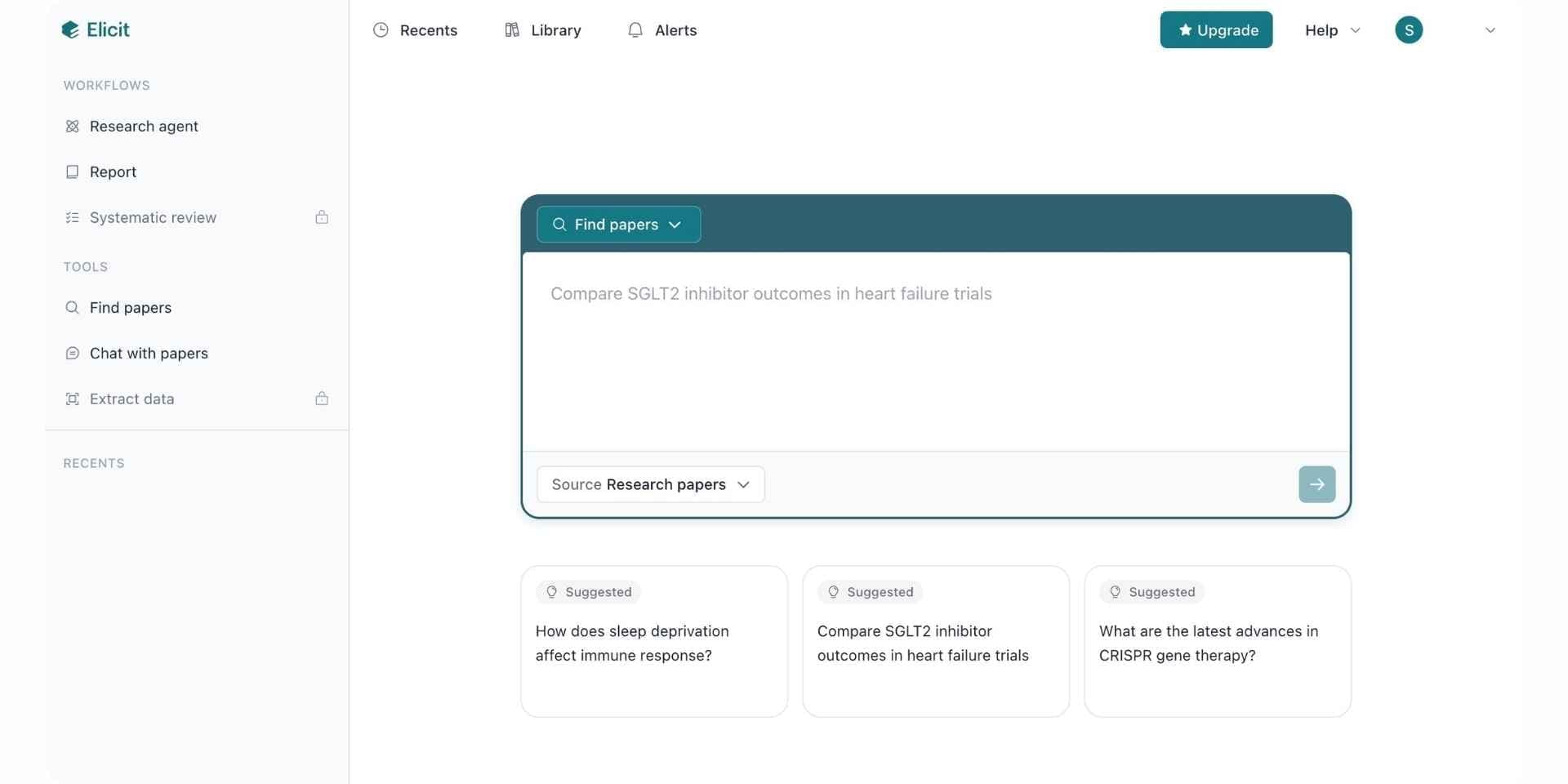
Elicit is an AI research tool built around large-scale systematic review screening and structured data extraction across 125M+ academic papers. The platform was originally developed for evidence-synthesis workflows and is widely used by systematic reviewers, evidence-based medicine teams, and research operations groups inside universities and pharmaceutical companies. Its core differentiator is screening volume: on Enterprise, Elicit handles up to 40,000 papers per workflow with inclusion and exclusion criteria, adjustable thresholds, and structured extraction across custom columns. API access on Pro and above makes Elicit one of the few research tools that supports automated research operations at scale. It is one of the most tested entries in our broader review of AI tools for research.
Core Capabilities
- Semantic search across 125M+ academic papers with quality-filter options.
- Custom-column data extraction with 2 to 40 columns depending on plan.
- Systematic review workflow with pilot screening and threshold-based filtering.
- API access on Pro and above for automated research operations.
- Notebooks for organizing papers, extractions, and queries.
- Zotero export for downstream reference management.
- Inclusion and exclusion criteria with adjustable thresholds.
Pros
- Strongest pure systematic-review screening at scale (up to 40,000 papers on Enterprise)
- Custom-column data extraction with 2 to 40 columns depending on plan
- API access on Pro and above for automated research operations
- Semantic search across 125M+ papers with inclusion/exclusion filters
- Free Basic plan available for evaluating the workflow
Cons
- No AI Paper Writer for full document generation
- No native reference manager with citation-style management
- Search reproducibility flagged in a 2025 peer-reviewed evaluation as falling short of formal systematic review transparency
- Monthly credits on lower plans burn through quickly during heavy extraction
- Pro pricing at $49/mo is among the higher tiers in this category
- No Chat with PDF for deep multi-paper interrogation
- No SJR or SNIP quality signals surfaced inline
Why Choose an Elicit Alternative in 2026?
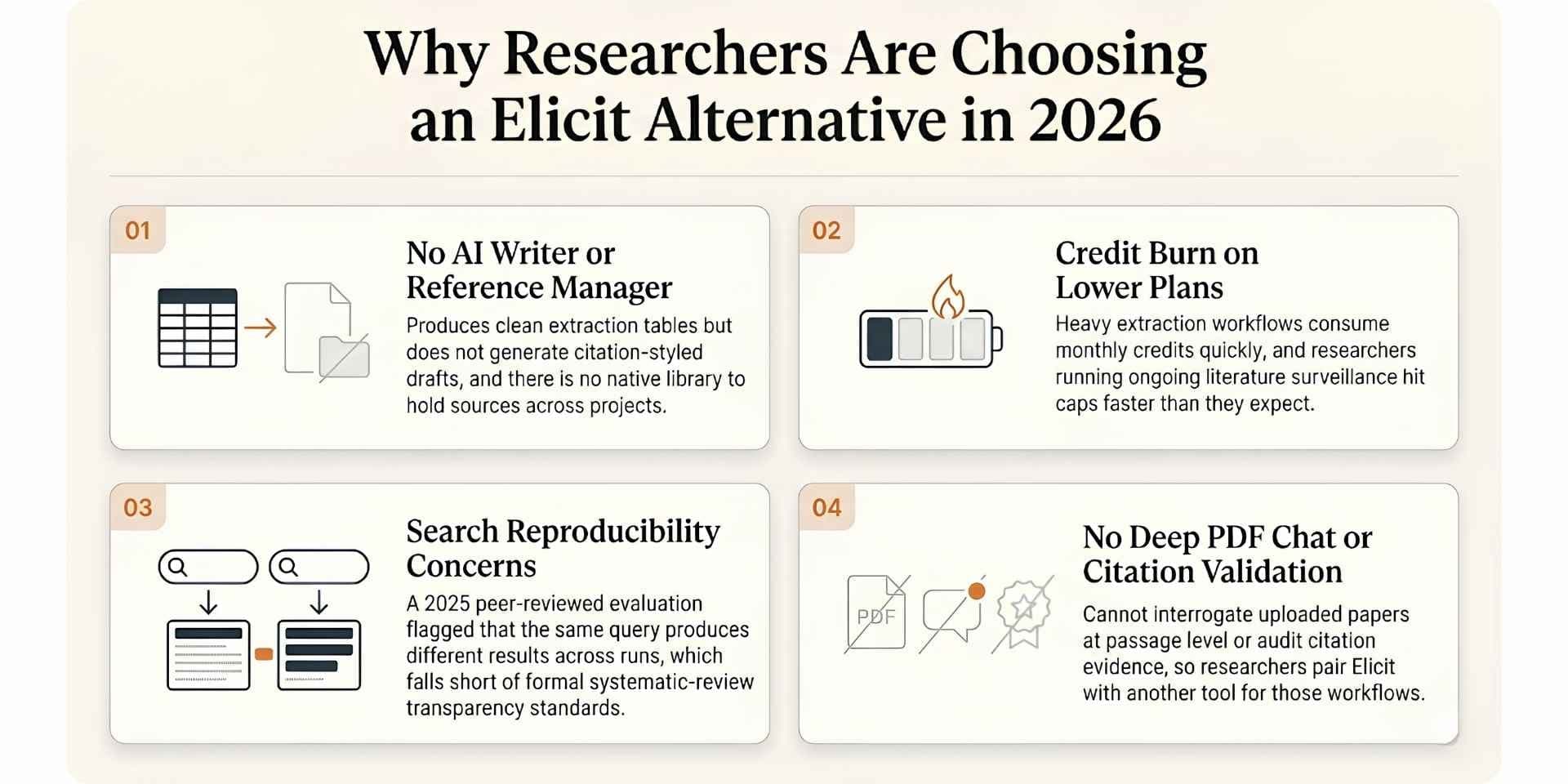
The decision to move beyond Elicit usually comes down to four reasons that show up across G2, Trustpilot, and Reddit threads on r/PhD and r/PhdProductivity in 2025 and 2026:
1. No AI Paper Writer or full reference manager. Elicit produces extraction tables but does not generate citation-styled drafts. Researchers drafting a background section or full manuscript export their data and switch tools.
2. Credit burn on lower plans. Heavy extraction workflows consume monthly credits quickly. Researchers running ongoing literature surveillance hit credit limits on Plus and end up on Pro at $49/mo.
3. Search reproducibility concerns. A 2025 peer-reviewed evaluation flagged that Elicit searches vary across runs, which falls short of formal systematic review transparency standards.
4. No deep Chat with PDF or citation validation. Researchers who also need multi-paper PDF interrogation or risk of bias auditing pair Elicit with another tool.
Best Elicit Alternative in 2026
1. Paperguide
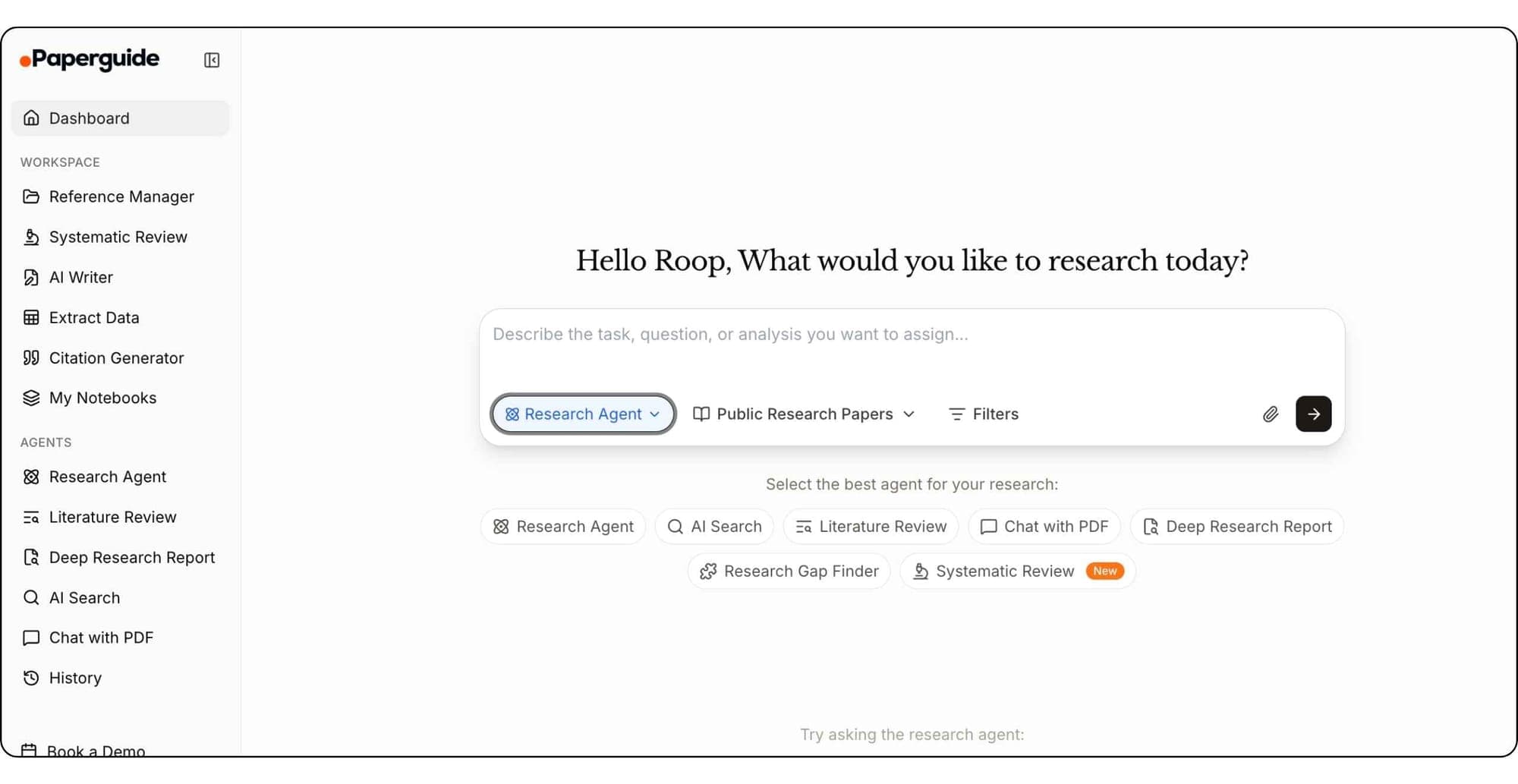
Paperguide is the connected AI scientific research platform that delivers the structured extraction Elicit is known for and then carries the workflow into the stages Elicit stops short on. Academic search across 200M+ peer-reviewed papers from PubMed, arXiv, OpenAlex, and Semantic Scholar feeds a 5-step Literature Review AI, custom-column Extract Data tables, the AI Paper Writer with 1,000+ citation styles, and a native reference manager, all sharing a single workspace. Recent releases retrained the Research Agent on upgraded base models, rebuilt the AI Paper Writer with agentic in-document chat and equation support, and pushed Literature Review screening to 200 papers with the top 50 synthesized. Verified citations live on every claim, and SJR and SNIP quality signals are exposed throughout.
Key Features
- Systematic Review. Paperguide Systematic Review follows a six-stage protocol-first workflow: Protocol, Papers, Abstract Screening, Full-Text Screening, Data Extraction, and Generate Report. Researchers choose between AI-led screening for speed or dual-review blind screening for defensibility (available on Evidence Teams and Enterprise). Dual-review mode tracks Cohen's kappa inter-rater reliability and resolves conflicts through a lead reviewer. Review capacity scales by plan: up to 1,000 papers on Plus, 5,000 on Pro and Evidence Teams, and 20,000 on Enterprise. A PRISMA 2020 flow diagram builds in real time and exports as SVG, PNG, or PDF. The project audit trail exports as CSV or PDF, and an auto-generated AI methods statement draws from the audit trail so teams can document their review process for journal submission. AI Evidence shows the model's reasoning per screening criterion, kept separate from the reviewer's final decisions. Image and Table Extraction, which will pull figures and tabular data from source PDFs, is coming soon on Pro and above. Team roles (Edit, Reviewer, View-only) with per-stage assignments keep multi-person reviews organized, and EZproxy and LibKey provide institutional journal access. SSO and RBAC are available on Enterprise.
- Literature Review AI. Literature Review AI follows a structured five-step flow: Plan, Search, Screen, Extract, and Synthesize. Standard mode handles up to 50 papers. Extended mode screens up to 200 papers across the 200M+ database, PubMed, arXiv, OpenAlex, Semantic Scholar, or a personal reference library. Every included paper passes through SJR, SNIP, and citation-count quality screening before contributing to the final review.
- AI Paper Writer. The AI Paper Writer ships agentic in-document chat, Smart Continue (the AI picks up from the cursor and cites selected sources), Math blocks with KaTeX rendering, inline equations, Word document import, and 1,000+ citation styles including Vancouver, AMA, APA, and journal-specific formats. Five AI tools work inside the editor: AI Chat searches the 200M+ database or the user's library and inserts citation-backed text directly into the document; AI Edit rewrites passages for tone, clarity, or simplification while preserving citation markers; Smart Continue extends from the cursor with structural consistency; Autocomplete provides real-time inline suggestions with citations; and Describe to LaTeX converts plain-English equation descriptions into rendered LaTeX. Researchers insert citations from their library using '@' mentions, and adjacent citations group automatically into combined parentheses following the active style. Plagiarism checking, grammar checking, version history, DOCX export, and collaborative editing are built in.
- AI Reference Manager. The native AI Reference Manager covers folders, subfolders, tags, annotations, highlights, and AI summaries on library papers. Import methods include BibTeX, RIS, DOI, URL, and PDF upload (up to 100MB on paid plans), plus one-click Zotero and Mendeley migration. A Chrome extension handles capture and institutional proxy access. The built-in PDF viewer supports annotation, highlights, and notes. Shared libraries with role-based permissions allow collaborative work, and the manager supports 1,000+ citation styles. Every paper in the library is a usable source across search, extraction, review, and the AI Paper Writer.
- Extract Data. Extract Data supports up to 50 custom columns and 100 papers per table on paid plans. Custom columns cover sample size, intervention, comparator, outcome, methodology, effect size, study design, risk of bias, and any researcher-defined field. Every cell links back to the source passage with quote-level citations so reviewers can verify each extraction against the original text. Each column takes a title, an instruction, and one of three output types (free answer, Yes or No, or your own set of options), and missing values are marked Not reported, Not applicable, or Unclear instead of being invented. Image and Table Extraction for figures and tabular data is coming soon on Pro and above. Reusable column templates speed up repeat reviews, and export to CSV or Excel feeds downstream meta-analytic work in R or RevMan.
- AI Search. AI Search runs hybrid semantic and keyword retrieval across 200M+ peer-reviewed papers from PubMed, arXiv, OpenAlex, and Semantic Scholar, plus the user's own reference library in the same query. An agentic layer runs multiple query variations in parallel, and the output synthesizes from the top 20 papers rather than 10. SJR quartile, SJR score, SNIP, and citation metrics re-rank results and are visible on every result, not sitting behind a filter.
- Chat with PDF. Chat with PDF processes full-text context rather than chunk-based retrieval, supporting multi-paper comparison with passage-level grounding. Click any citation to jump to the source paper, page number, and supporting quote. Insights feed into literature reviews and the AI Paper Writer with passage-level source verification.
- Deep Research Report. Deep Research Report follows the same pipeline as the Literature Review AI but with full researcher control at every stage: user-defined research questions, manual include/exclude on retrieved papers, and customizable extraction fields before synthesis runs. Standard mode reviews 80 papers and uses the top 30. Extended mode reviews 100 papers and uses the top 50.
- Research Agent. Paperguide's most comprehensive feature, retrained in 2026 on upgraded base models for sharper task understanding, fewer hallucinations, and leaner token use. The Research Agent runs the full evidence synthesis workflow end to end: search, screening, comparison, contradiction detection, gap analysis, extraction, and draft generation inside a single connected session.
- Quality Signals. SJR rankings, SNIP scores, and citation metrics are surfaced inline across AI Search, screening, Literature Review AI, and Deep Research Report. These quality signals re-rank results and travel into outputs rather than sitting only in a filter, a layer of quality transparency Elicit does not present in-context.
Pros
- End-to-end research workflow in one workspace: search, systematic review, literature review, extract, write, and manage references
- Protocol-first systematic review with a six-stage workflow, dual-review blind screening, Cohen's kappa tracking, PRISMA 2020 flow diagrams, and review capacity up to 20,000 papers on Enterprise
- Verified citations on every claim, traceable down to the page and passage
- Academic search across 200M+ peer-reviewed papers (larger than Elicit's 125M+) with agentic parallel query variation
- Structured 5-step Literature Review AI with screening up to 200 papers and top-50 synthesis
- Full AI Paper Writer with five in-editor AI tools, '@' citation insertion, math blocks (KaTeX), Word import, 1,000+ citation styles, plagiarism and grammar checking
- Native Reference Manager with Zotero and Mendeley import, Chrome extension, shared libraries with role-based permissions, annotations, highlights, and AI summaries
- SJR, SNIP, and citation metrics re-rank results and are surfaced across every stage of the workflow
- Generous free plan with 2,000 monthly AI credits
Cons
- Less name recognition in some labs than Elicit, SciSpace, or Scite
- Single-review screening capped at 200 papers (Elicit's Enterprise tier reaches 40,000 papers per workflow)
- No NotebookLM-style Studio outputs (audio overviews, mind maps, flashcards)
Best For
Researchers who want the structured extraction Elicit offers plus a protocol-first systematic review, a full AI Paper Writer, and a native reference manager in one workspace. PhD candidates, postdocs, and lab teams running thesis chapters, systematic reviews, and grant proposals benefit from the connected workflow. HEOR analysts and clinical researchers running systematic literature reviews for regulatory submissions, Clinical Evaluation Reports, and health technology assessments benefit from the six-stage systematic review workflow with PRISMA reporting and audit trail exports. Scientific researchers in biotech, pharma, and R&D who need citation-grounded evidence synthesis with quality metrics at every screening stage also find Paperguide a strong contender for the best systematic review software in 2026.
Pricing
| Plan | Price (annual) | AI Credits/mo | Systematic Review Cap |
|---|---|---|---|
| Free | $0 | 2,000 | Not included |
| Plus | $12 per seat/mo, billed annually ($144/yr) | 12,500 | Up to 1,000 papers |
| Pro | $29 per seat/mo, billed annually ($348/yr) | 50,000 | Up to 5,000 papers |
| Evidence Teams | $89 per seat/mo, billed annually ($1,068/yr) | 150,000 | Up to 5,000 papers, dual reviewer screening |
| Enterprise | Custom | Custom | Up to 20,000 papers |
A 30% academic discount applies with a valid university email, and yearly billing saves up to 41%.
Verdict
Paperguide is the strongest overall Elicit alternative in 2026 because it delivers the extraction depth Elicit is famous for and then adds the workflow stages Elicit does not: a protocol-first systematic review with six stages, dual-review blind screening, and PRISMA reporting; open-literature search with quality signals that re-rank results; a manuscript-grade AI Paper Writer with five in-editor AI tools and 1,000+ citation styles; and a native reference manager with annotations, shared libraries, and Zotero migration. For researchers who valued Elicit's structured extraction and need systematic review, writing, and reference management alongside it, Paperguide is the natural step up.
2. Consensus
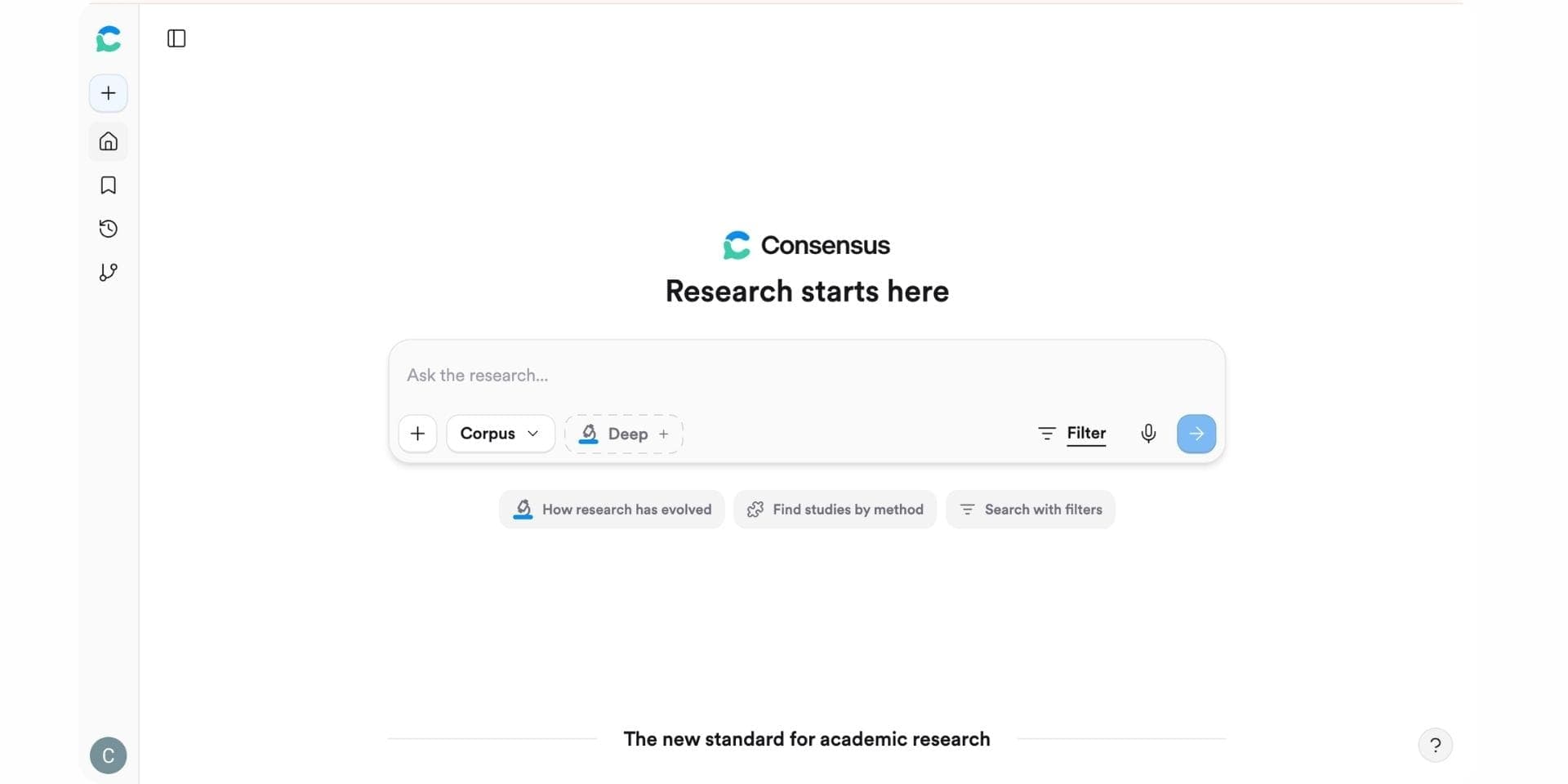
Consensus is an AI-powered research search engine launched in 2022 that answers natural-language questions using peer-reviewed papers and displays a consensus meter showing whether the literature supports, contradicts, or is split on a claim. The platform was built around fast first-pass evidence checks rather than full review writing, and its core appeal is the directional evidence verdict it delivers in seconds. Consensus indexes 200M+ peer-reviewed papers, with Citation Graph for visual paper discovery and Pro Search filters.
Key Features
- 200M+ peer-reviewed paper index with citation-backed synthesis.
- Consensus Meter on yes/no research questions.
- Pro Search filters for methodology, Q1-Q4 journal rank, citation count, and open access.
- Citation Graph for visual paper discovery.
- Deep Search for multi-source narrative synthesis.
Pros
- Fastest first-pass evidence answers in the category
- 200M+ peer-reviewed paper index (larger than Elicit's 125M+)
- Consensus Meter delivers directional evidence verdicts in seconds
- Affordable Pro plan at $11.99/mo
Cons
- No AI Paper Writer for full document generation
- No structured literature review workflow
- No custom-column data extraction or native reference manager
- Consensus meter does not weight study design, sample size, or risk of bias
Best For
Researchers, clinicians, and journalists who need fast directional evidence verdicts on yes/no questions, ideal as a triage layer before deeper synthesis in Paperguide.
Pricing
Free plan with 15 Pro messages and 3 Deep reviews per month, Pro at $11.99/mo, Deep at $45/mo, Team at $30/seat/mo.
Verdict
Consensus is the strongest first-pass evidence tool. Researchers who liked Elicit's extraction but mainly need directional evidence answers find Consensus faster and cheaper. Paperguide is the broader replacement when extraction, writing, and reference management are also required.
3. SciSpace
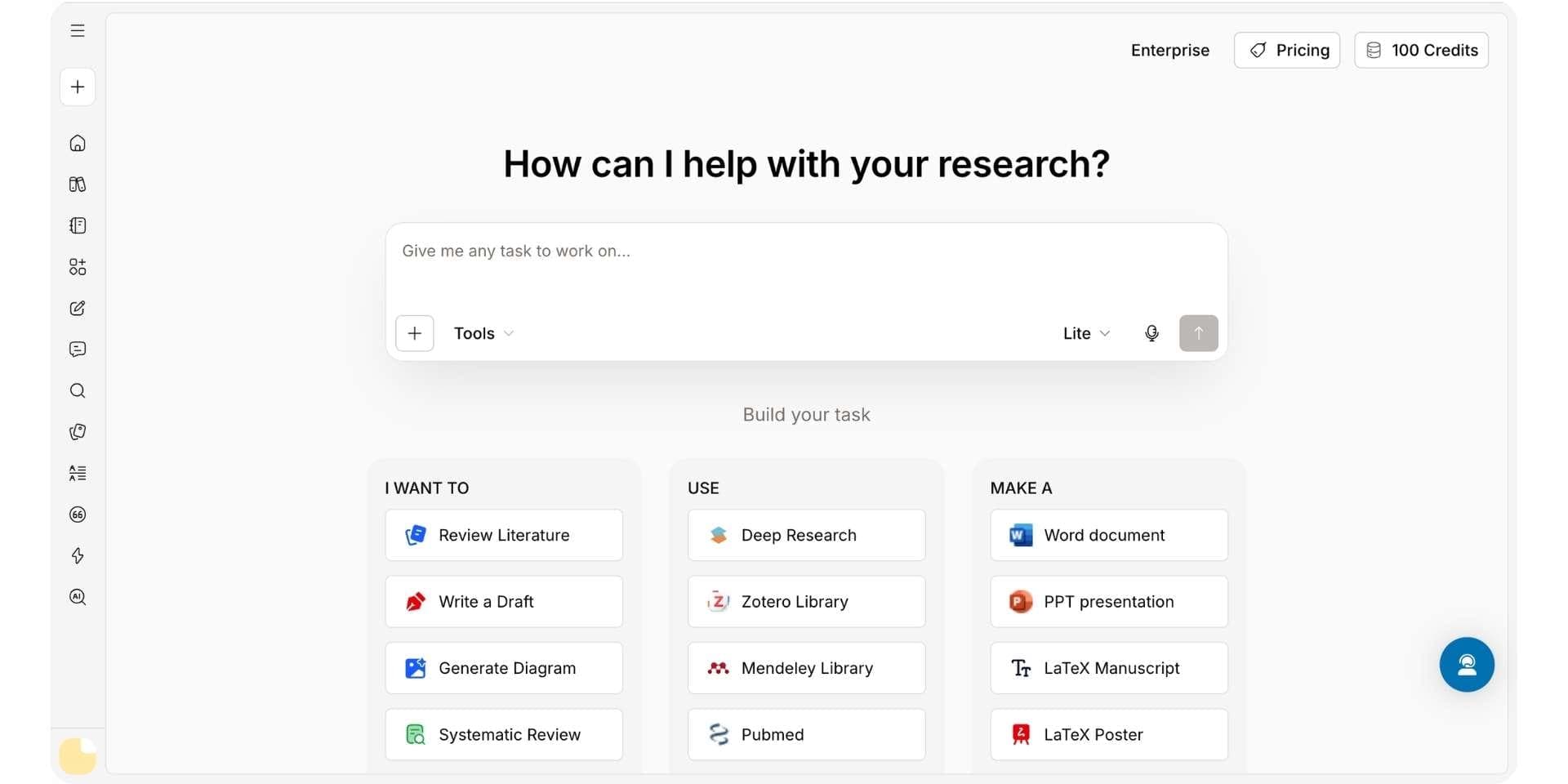
SciSpace, originally launched as Typeset before rebranding, is an AI research assistant built around AI-powered Chat with PDF, literature reading, and a growing ecosystem of customized research agents across a paper database of 280M+ entries. Researchers upload papers and use SciSpace to explain dense passages, summarize methods, extract structured data, and run lightweight literature reviews. The platform is popular with graduate students for first-pass paper review.
Key Features
- Chat with PDF with plain-language explanations of equations, figures, and terms.
- Basic literature review and Deep Review across a 280M+ paper index.
- Data extraction tables inside the Library workflow.
- AI Writer for short drafts.
- Customized AI agents including BioMed Agent, Meta Analysis Agent, and Manuscript Writer.
Pros
- 280M+ paper database, the largest in this guide
- Strong Chat with PDF for individual papers
- Customized AI research agents across multiple disciplines
Cons
- Occasional fabricated references flagged in G2 and Trustpilot reviews (2025-2026)
- Library is lighter than dedicated reference managers
- No SJR or SNIP quality signals surfaced in the workflow
- Extraction is less configurable than Elicit's custom columns
Best For
Graduate students and lab teams who spend most of their day reading and interrogating individual papers with Chat with PDF, supported by a large 280M+ paper database.
Pricing
Free plan with limits, Premium at $12/mo annual, Advanced at $70/mo annual, Max at $160/mo annual.
Verdict
SciSpace works as a reading layer for individual papers and a lighter alternative to Elicit's extraction depth. Researchers who want a connected workflow with verified citations everywhere pick Paperguide.
4. NotebookLM
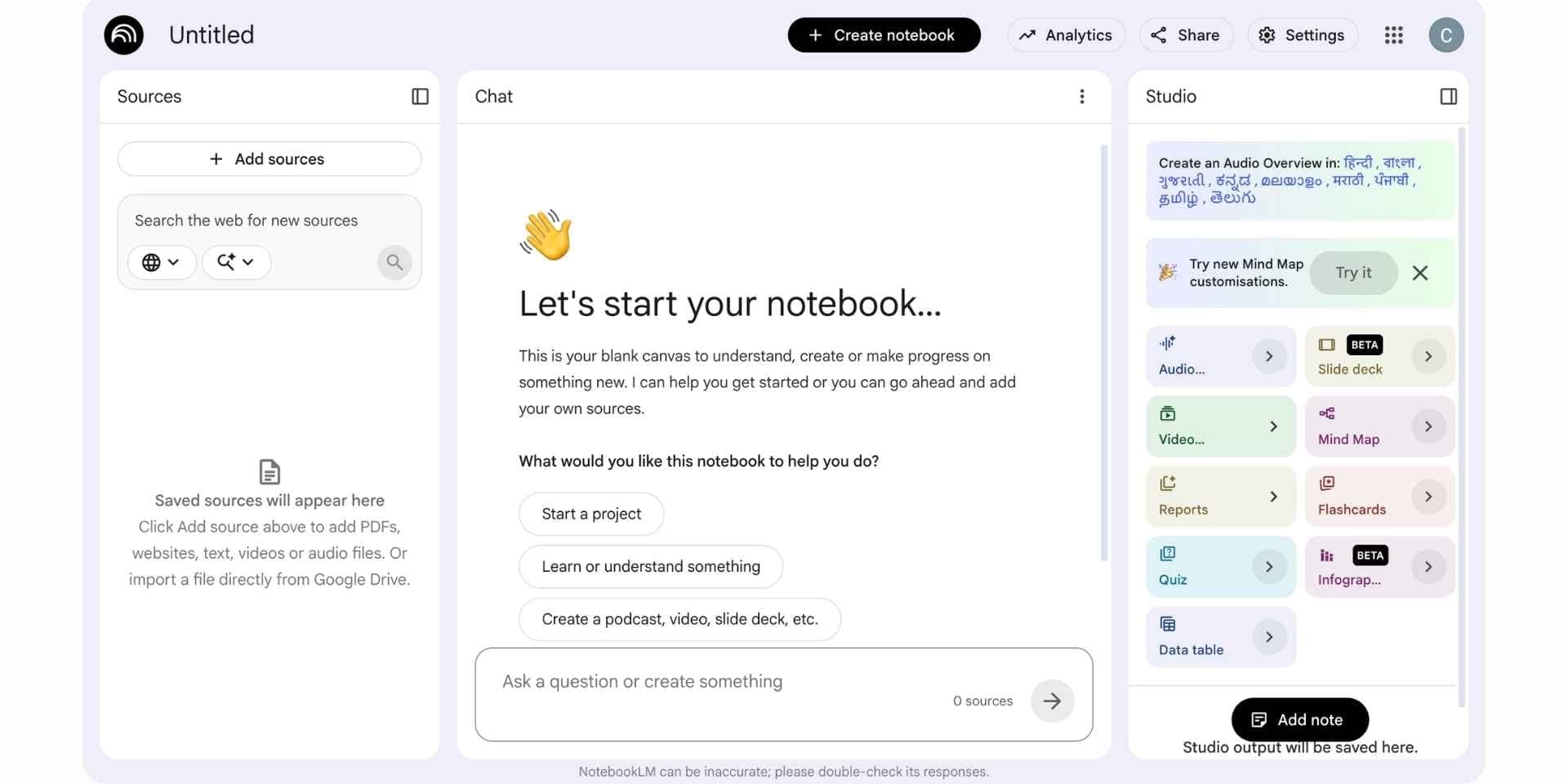
NotebookLM is Google's source-grounded AI notebook, launched in 2023 and significantly expanded through 2025 and 2026 with the Studio output ecosystem. The platform turns documents you upload into chat-based answers, podcast-style audio discussions, narrated video summaries, mind maps, flashcards, quizzes, infographics, and slide decks. NotebookLM does not search the academic literature; it synthesizes the sources you already have.
Key Features
- Source-grounded Q&A across 50 to 300 uploaded sources (plan-dependent).
- Studio outputs: Audio Overview, Video Overview, Mind Map, Flashcards, Quiz, Slide Deck.
- Multi-source chat with inline citations.
- Configurable chat style and response length.
Pros
- Best-in-class Studio outputs unmatched by any other tool here
- Source-grounded Q&A with inline citations
- Generous free tier through a Google account
- Configurable chat style and response length
Cons
- No academic search across peer-reviewed literature
- No custom-column data extraction (auto-tables only)
- No structured Literature Review AI or AI Paper Writer
- Source caps (50 free, 300 Pro) bite quickly during a serious review
Best For
Students and educators who want Studio-format outputs (audio overviews, mind maps, flashcards) from a curated source set, often paired with Paperguide for the actual research pipeline.
Pricing
Free with a Google account (50 sources/notebook). Google AI Plus at $7.99/mo expands to 100 sources, Pro at $19.99/mo to 300 sources.
Verdict
NotebookLM is excellent for synthesizing a curated source set and turning it into learning formats. Researchers who liked Elicit's extraction and structured workflow find NotebookLM complementary for study material but pick Paperguide for the actual research pipeline.
5. AnswerThis
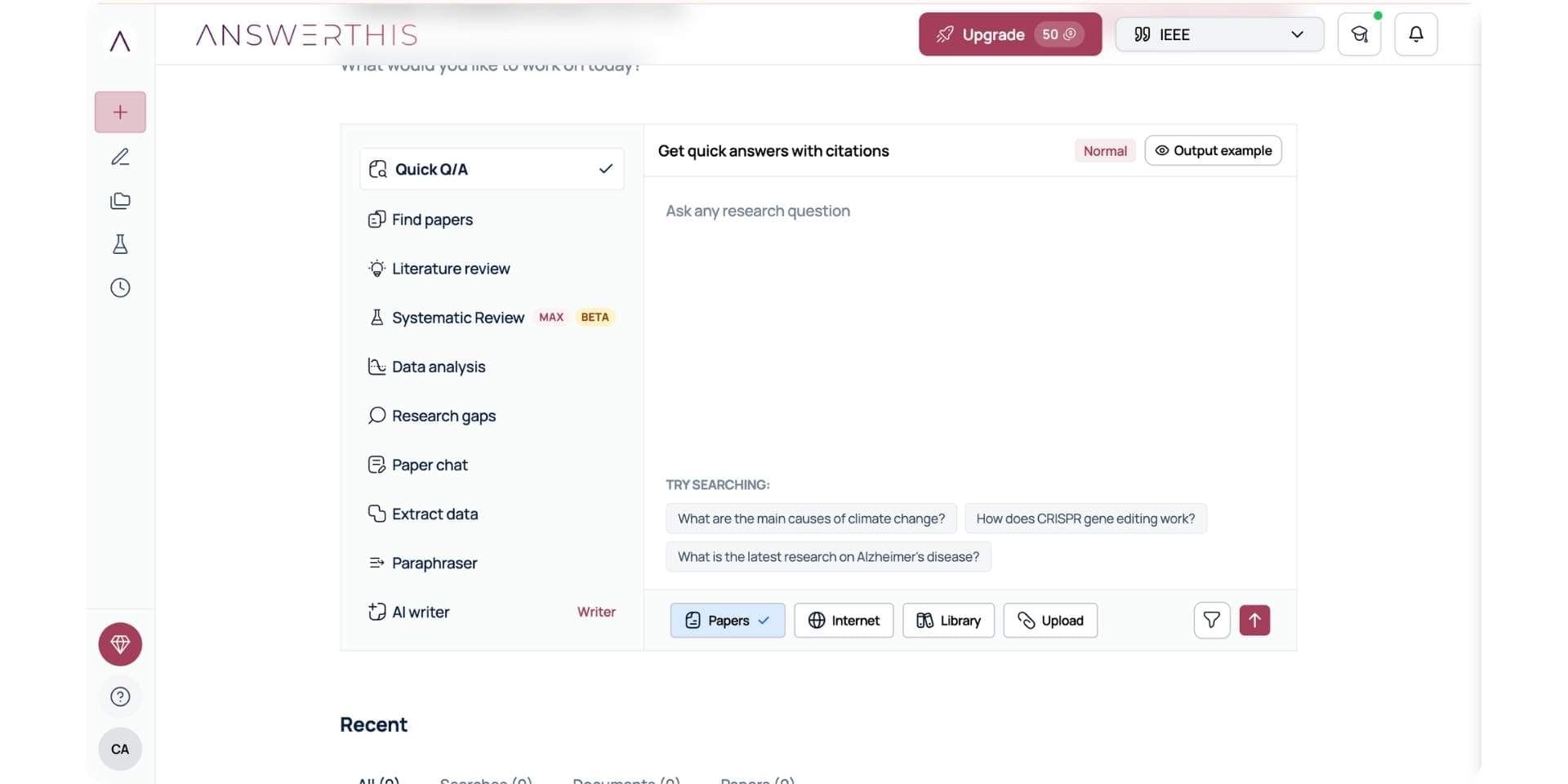
AnswerThis is a lightweight AI research tool launched in 2024 and built for fast, time-boxed literature reviews and research-gap analyses across an index of 200M+ academic papers. The platform is designed around the proposal stage of research, when speed matters more than depth and a researcher needs a quick scaffold of the literature before committing to a full review.
Key Features
- Search across 200M+ papers.
- Lit-review style outputs with inline citations.
- Research-gap analysis prompts.
- Basic AI Writer for short drafts.
Pros
- Fast, time-boxed lit reviews across 200M+ papers
- Gap-analysis prompts surface unexplored research areas
- Affordable entry tier at $9/mo
- Useful at the proposal stage for shaping a research question
Cons
- Output structure is fixed rather than configurable
- No custom-column data extraction (Elicit is stronger here)
- No native reference manager
- AI Writer limited to short drafts only
Best For
First-year PhDs and master's students who need a fast literature scaffold and gap analysis at the proposal stage before committing to a full review.
Pricing
Free plan, paid tier from $9/mo.
Verdict
AnswerThis is a faster entry-stage alternative to Elicit when shaping research questions and gap analysis is the primary need. Paperguide is the upgrade for full extraction, writing, and reference workflows.
6. Scite
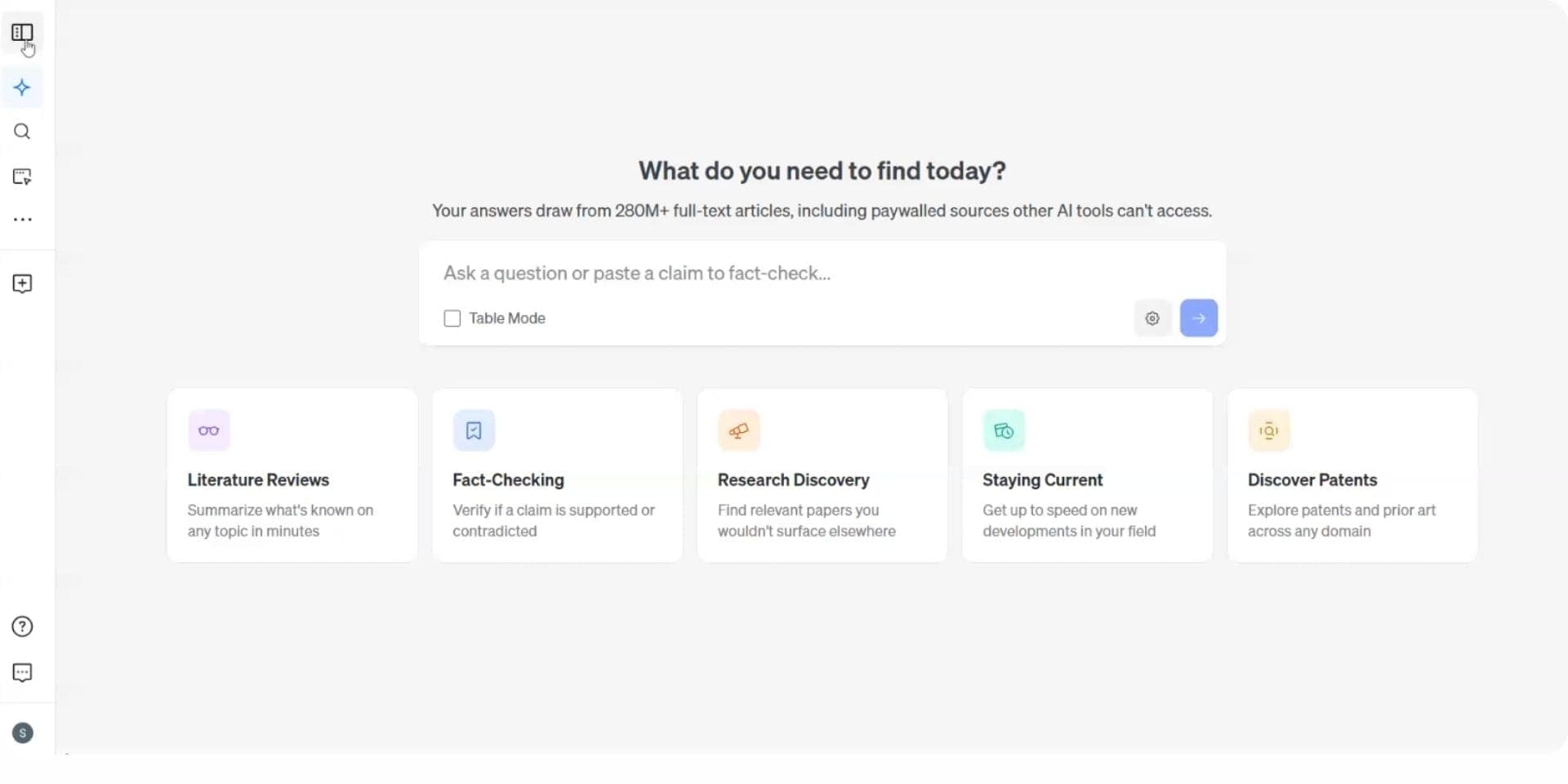
Scite is a citation intelligence platform launched in 2018 and one of the most respected tools in the academic research stack for citation auditing. Its Smart Citations classify how every paper is cited downstream as Supporting, Mentioning, or Contrasting, indexed across 1.2B+ citation statements pulled from full-text article PDFs. The browser extension brings citation badges directly into Google Scholar alternatives and PubMed search results.
Key Features
- Smart Citations classified as Supporting, Mentioning, Contrasting.
- 1.2B+ citation statements indexed.
- AI Assistant for citation-aware Q&A.
- Reference Check for bibliography auditing.
- Browser extension for Google Scholar and PubMed.
Pros
- Best-in-class citation classification (Supporting / Mentioning / Contrasting)
- 1.2B+ citation statements indexed from full-text article PDFs
- Reference Check audits bibliographies for retracted or disputed sources
- Browser extension surfaces citation badges on Google Scholar and PubMed
Cons
- No Chat with PDF for uploaded papers
- No structured literature review workflow or custom-column extraction
- No AI Paper Writer for document generation
- No free tier on core features ($20/mo Personal entry point)
Best For
Authors auditing bibliographies and citation evidence before journal submission, often used as a validation layer alongside Paperguide or Elicit.
Pricing
Limited free trial, Personal at $20/mo, Pro at $50/mo.
Verdict
Scite layers citation validation on top of an existing workflow. Researchers who liked Elicit's extraction and also want citation auditing pair Scite with Paperguide as the unified research workspace.
7. Anara
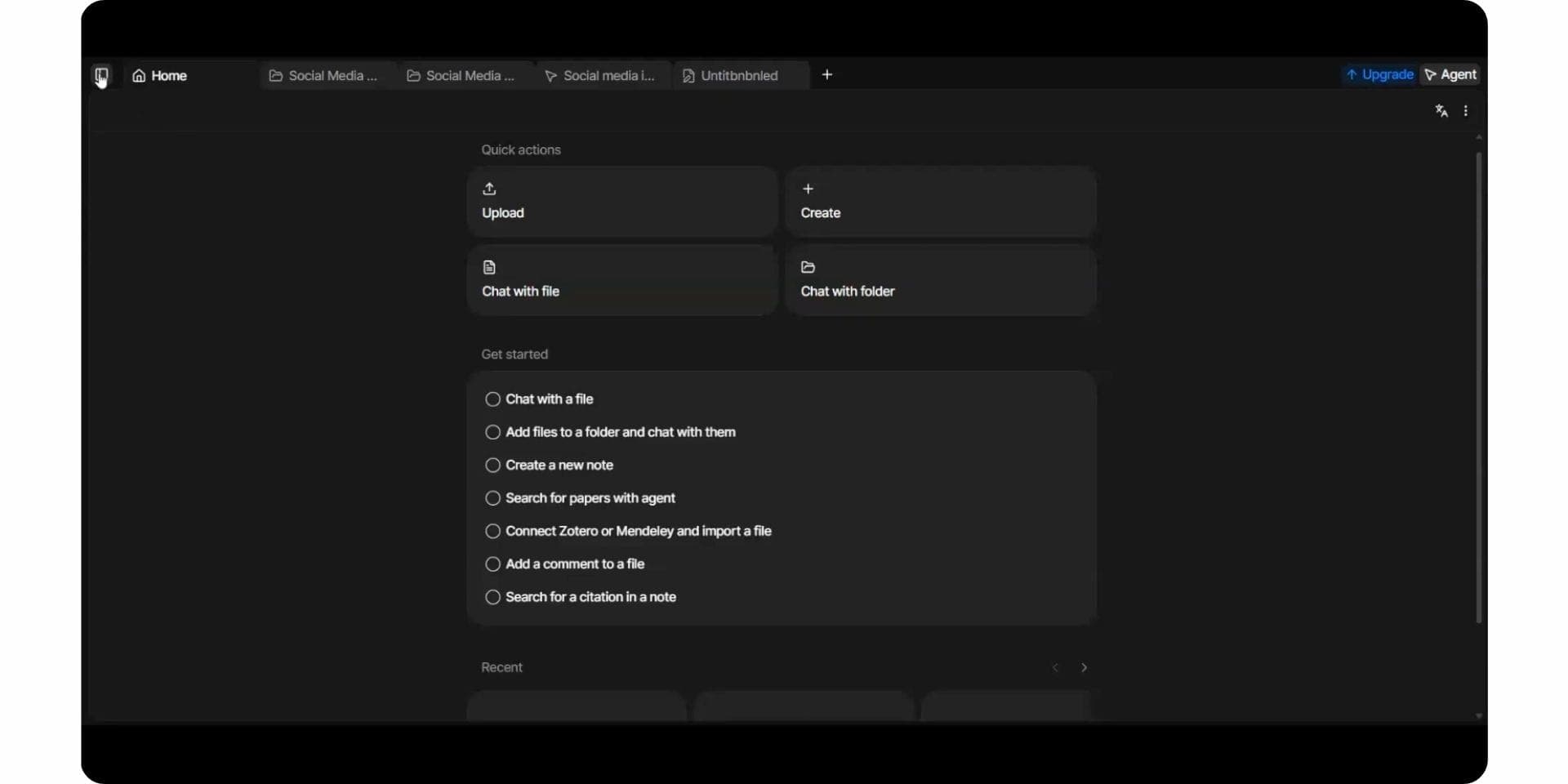
Anara is a multi-paper PDF chat and annotation platform built around a researcher's personal library of uploaded papers. Its Chat with Folder feature lets users query an uploaded set of PDFs together and receive passage-linked answers, with annotation, AI summaries, and a writing layer built into the document surface.
Key Features
- Multi-paper chat across an uploaded library.
- Annotation, highlights, and AI summaries.
- Research agent for follow-up questions.
- AI writing inside the document surface.
Pros
- Strong multi-paper Chat with Folder for personal corpora
- Annotation, highlights, and AI summaries inside the document surface
- AI writing layer built into the reading workspace
- Affordable Plus plan at $10/mo
Cons
- No native academic search across peer-reviewed literature
- No structured Literature Review AI or systematic extraction tables
- Reference manager is lighter than Paperguide or Zotero
- Trustpilot reviews flag inconsistent document parsing on long files
Best For
Researchers working from a personal library of uploaded PDFs who want deep multi-paper reading, annotation, and a lightweight writing layer in one place.
Pricing
Free plan, Plus at $10/mo, Pro at $20/mo.
Verdict
Anara is the strongest reading and annotation layer for a personal corpus. Researchers who liked Elicit's extraction but mainly need deep multi-paper PDF chat find Anara complementary. Paperguide combines both inside one workspace.
How to Choose the Best Elicit Alternative in 2026
Choosing the right Elicit alternative comes down to four questions, each tied to a different stage of the research workflow:
1. Do you need structured extraction and systematic review at scale? Elicit's Enterprise screens up to 40,000 papers per workflow with custom columns. Paperguide's systematic review handles up to 1,000 papers on Plus, 5,000 on Pro and Evidence Teams, and 20,000 on Enterprise, with a six-stage protocol-first workflow, dual-review blind screening, and PRISMA 2020 flow diagrams. Extract Data handles 100 papers per table with 50 custom columns and quote-level source citations. Terms such as dual reviewer screening and PRISMA flow diagram are explained in this guide to systematic review terminology.
2. Do you need to write a citation-styled draft from the extracted data? Only Paperguide and AnswerThis include an AI Writer. Paperguide is the only one with 1,000+ citation styles, plagiarism and grammar checking, and agentic in-document chat.
3. Do you need a native reference manager? Paperguide is the only tool here with a full reference manager. Elicit exports to Zotero but does not manage references natively.
4. Does citation reliability and search reproducibility matter? Paperguide grounds every claim in a verified quote and surfaces SJR and SNIP signals. Scite classifies citations Supporting / Mentioning / Contrasting. Elicit's search reproducibility was flagged in a 2025 peer-reviewed evaluation.
Free vs Paid Elicit Alternatives in 2026
Elicit's Basic free tier is limited compared to peers. The table below shows what each free tier actually unlocks.
| Tool | Free Plan Includes | Free Plan Limit |
|---|---|---|
| Paperguide | AI Search, Literature Review AI, Chat with PDF, AI Paper Writer, Reference Manager (systematic review from Plus) | 2,000 credits/mo |
| Consensus | Pro Search, Deep reviews | 15 Pro messages, 3 Deep reviews/mo |
| SciSpace | Chat with PDF, basic lit review | Limited credits |
| NotebookLM | Full Studio outputs, source-grounded chat | 50 sources/notebook, 50 chats/day |
| AnswerThis | Basic lit reviews | Limited generations |
| Scite | 7-day free trial only | No permanent free tier on core features |
| Anara | Basic Chat with Folder | Limited uploads |
| Elicit | Search, basic extraction, basic reports | 2 extraction columns, 2 reports/mo |
Paperguide and NotebookLM have the most usable free tiers for sustained research work. Paperguide is the only free plan that covers the complete research pipeline (search through writing). Scite is the most restrictive, with all useful features locked to the $20/mo Personal plan.
Best Elicit Alternative for PhD Students and Graduate Researchers
For PhDs and graduate students, the decision comes down to workflow depth and budget. Paperguide leads on both. It covers the full thesis workflow (discovery, systematic review, lit review, extraction, writing, references), Plus is $12 per seat per month and Pro is $29 per seat per month, both billed annually. Plus includes systematic review up to 1,000 papers, which covers the majority of graduate-level reviews. Elicit Pro at $49/mo costs more than Paperguide Pro while lacking writing and reference management.
For systematic-review-heavy programs where screening across 100 to 40,000 papers is the weekly job, pair Elicit's screening with Paperguide's writing layer. For most graduate workflows, Paperguide alone covers the full pipeline because the Literature Review AI handles up to 200 papers per review.
Why Researchers in 2026 Are Shifting to Paperguide
Paperguide is the best AI platform for scientific research in 2026. It replaces Elicit for researchers who need a connected end-to-end workflow rather than an extraction-only platform, pairing the best AI Paper Writer in 2026 with the best AI Reference Manager, a structured Literature Review AI, and verified citations on every claim inside one workspace.
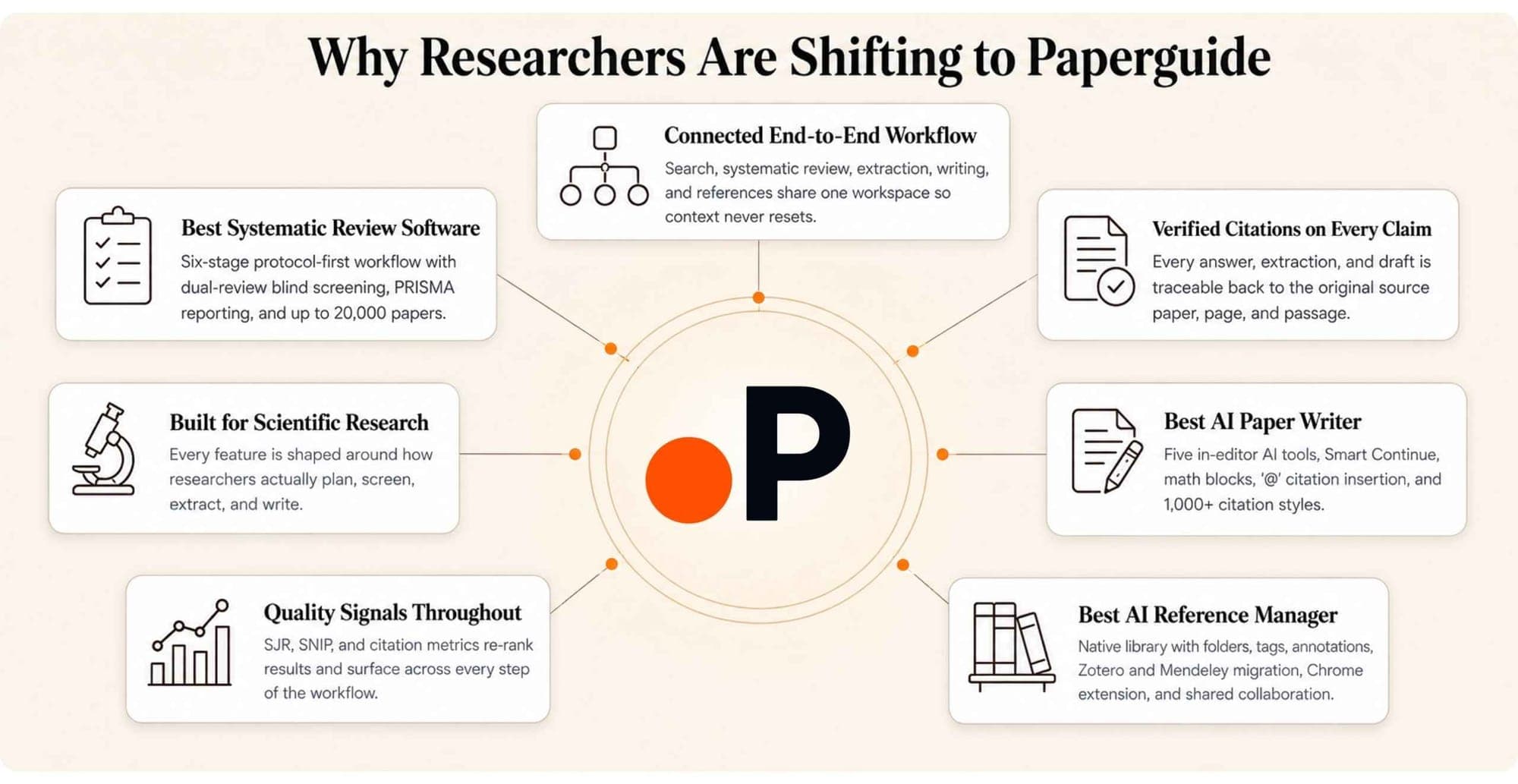
The shift from Elicit to Paperguide in 2026 is driven by seven reasons:
1. End-to-end workflow in one workspace. AI Search, Systematic Review, Literature Review AI, Extract Data, Reference Manager, AI Paper Writer, Chat with PDF, and Deep Research Report share one connected workspace, so research context never resets between steps.
2. Protocol-first systematic review. Paperguide's six-stage systematic review workflow (Protocol, Papers, Abstract Screening, Full-Text Screening, Data Extraction, Generate Report) supports dual-review blind screening with Cohen's kappa tracking, PRISMA 2020 flow diagrams, and an auditable decision trail that exports as CSV or PDF. Review capacity scales from 1,000 papers on Plus to 20,000 on Enterprise. Elicit handles large-scale screening but does not offer dual-review blind screening, PRISMA flow diagrams, or a structured protocol stage.
3. Verified citations on every claim. Every answer, extraction, and draft is traceable back to the source paper, page number, and supporting quote, which eliminates the manual reference validation researchers do after Elicit extractions.
4. The best AI Paper Writer in 2026. Five AI tools inside the editor: AI Chat, AI Edit, Smart Continue, Autocomplete, and Describe to LaTeX. Researchers insert citations using '@' mentions, and the writer supports 1,000+ citation styles including Vancouver, AMA, APA, and journal-specific formats, plus plagiarism checking, grammar checking, collaborative editing, version history, and DOCX export. Elicit has no AI Paper Writer.
5. The best AI Reference Manager in 2026. Native, with folders, subfolders, tags, annotations, highlights, AI summaries on library papers, BibTeX/RIS/DOI/URL/PDF import, one-click Zotero and Mendeley migration, a Chrome extension for capture and institutional proxy access, shared libraries with role-based permissions, and 1,000+ citation styles. Elicit exports to Zotero but has no native manager.
6. Quality signals everywhere. SJR quartile, SJR score, SNIP, and citation metrics re-rank results and are surfaced throughout AI Search, screening, Literature Review AI, Systematic Review, and Deep Research Report. These signals travel into outputs rather than sitting only behind a filter. Elicit's quality filters are lighter.
7. Pricing. Free plan with 2,000 AI credits/mo. Plus at $12 per seat per month, billed annually ($144 a year), includes systematic review up to 1,000 papers. Pro at $29 per seat per month, billed annually ($348 a year), includes up to 5,000 papers. Evidence Teams at $89 per seat per month, billed annually ($1,068 a year), adds PRISMA-grade dual reviewer screening on up to 5,000 papers. Enterprise supports up to 20,000 papers with SSO and RBAC. A 30% academic discount applies with a valid university email. Elicit Pro at $49/mo costs more than Paperguide Pro while lacking writing and reference management.
| Reason | What It Looks Like in Paperguide |
|---|---|
| End-to-end workflow | AI Search, Systematic Review, Lit Review, Extract Data, AI Paper Writer all connected |
| Protocol-first systematic review | 6-stage workflow, dual-review blind screening, PRISMA 2020, up to 20,000 papers |
| Verified citations | Every claim, extraction, and draft links to source paper, page, and passage |
| Best AI Paper Writer 2026 | Five in-editor AI tools, '@' citations, math blocks, 1,000+ styles, plagiarism checking |
| Best AI Reference Manager | Native library, Zotero/Mendeley migration, Chrome extension, shared libraries, annotations |
| Quality signals | SJR, SNIP, citation metrics re-rank results and travel into outputs |
| Pricing | Free 2,000 credits/mo, Plus $12/mo (1,000 papers SR), Pro $29/mo (5,000 papers SR), billed annually |
Final Verdict
Elicit works exceptionally well at the job it was built for. For systematic-review screening across 100 to 40,000 papers with custom-column extraction, inclusion and exclusion criteria, and adjustable thresholds, it is the strongest tool in this category. The API access on Pro and above makes it one of the few research tools that supports automated research operations at scale, and the workflow has earned a loyal following among systematic reviewers and evidence-based medicine teams.
Researchers who stay on Elicit long enough usually hit the same three walls. The first is no AI Paper Writer or full reference manager, so the workflow stops at the extraction table and restarts in another tool for drafting. The second is monthly credit burn on lower plans, which forces upgrades to Pro at $49/mo or higher. The third is search reproducibility flagged in a 2025 peer-reviewed evaluation, which falls short of formal PRISMA-aligned systematic review transparency standards.
Paperguide is the only alternative here that closes all three walls inside a single workspace. It pairs a protocol-first systematic review (six stages, dual-review blind screening, PRISMA 2020, review capacity up to 20,000 papers on Enterprise) with the best AI Paper Writer in 2026 (five in-editor AI tools, '@' citation insertion, 1,000+ styles), the best AI Reference Manager (annotations, highlights, AI summaries, Zotero and Mendeley migration, shared libraries), academic search across 200M+ peer-reviewed papers, a Literature Review AI that screens up to 200 papers and synthesizes the top 50, custom-column Extract Data with quote-level source citations, verified citations on every claim, and SJR and SNIP quality signals that re-rank results throughout the workflow. For researchers who liked Elicit's extraction depth and want systematic review, writing, and reference management alongside it, Paperguide is the natural step up. For teams evaluating the best systematic review software in 2026, Paperguide's combination of protocol-first workflows with PRISMA reporting, quality signals at every screening stage, and end-to-end coverage starting at $12 per seat per month, billed annually, makes it the strongest all-around choice.
Frequently Asked Questions
Is there a free Elicit alternative?
Yes. Paperguide, Consensus, SciSpace, NotebookLM, AnswerThis, and Anara all offer free plans. Paperguide's free plan is the most complete, covering academic search, Literature Review AI, Chat with PDF, AI Paper Writer, and the reference manager with 2,000 monthly credits.
What is the best Elicit alternative for systematic reviews?
Paperguide for protocol-first systematic reviews with its six-stage workflow (Protocol, Papers, Abstract Screening, Full-Text Screening, Data Extraction, Generate Report), dual-review blind screening, PRISMA 2020 flow diagrams, and review capacity scaling from 1,000 papers on Plus to 20,000 on Enterprise. For mega-reviews above 20,000 papers, Elicit's Enterprise tier reaches 40,000 papers per workflow. Researchers looking for the best systematic review software in 2026 at an accessible price point will find Paperguide's $12/mo entry (billed annually) significantly more affordable than Elicit's $49/mo Pro plan, with PRISMA reporting and audit trail exports included.
What is the best Elicit alternative for PhD students?
Paperguide, because thesis and dissertation work spans discovery, extraction, synthesis, and writing in the same week, and only Paperguide covers all four with verified citations in one workspace.
How is Paperguide different from Elicit?
Elicit specializes in large-scale screening and extraction tables. Paperguide treats extraction as one step in a connected workflow that also covers a six-stage protocol-first systematic review with PRISMA 2020 reporting, academic search across 200M+ papers with SJR and SNIP re-ranking, a 5-step Literature Review AI, an AI Paper Writer with five in-editor AI tools and 1,000+ citation styles, and a native reference manager with annotations, shared libraries, and Zotero migration, all with verified citations on every claim.
Can I import my Elicit library into Paperguide?
Yes. Paperguide accepts BibTeX, RIS, and direct PDF uploads, and integrates with Zotero and Mendeley.
Which Elicit alternative has the best AI Paper Writer?
Paperguide. Its AI Paper Writer ships drafts with auto-citations in 1,000+ citation styles and exports to Word and PDF without leaving the workspace.
Which Elicit alternative is best for fast yes/no questions?
Consensus, because the consensus meter and evidence-tagged answers are faster than running a structured extraction for directional questions.
Related Reading
If Elicit is part of your screening or systematic-review workflow, a few of our other guides build directly on this comparison.
For broader cluster context, our walkthrough on how to write a literature review explains the structured process Elicit's extraction layer feeds into.
For head-to-head detail, the Paperguide vs Elicit deep dive walks through every workflow side by side. Focused comparisons cover Elicit vs SciSpace, Elicit vs Consensus, Elicit vs AnswerThis, Elicit vs Anara, Elicit vs Scite, and Elicit vs NotebookLM for capability-by-capability differences.
For researchers handling formal evidence synthesis, our deeper analysis of AI tools for meta analysis and the best academic search engines covers the broader workflow Elicit fits into.
Running a review?
Run your systematic review in Paperguide
Dual screening, verifiable extraction and PRISMA reporting in one place.
Start a reviewNo credit card required